Vishvamitra's Long Journey
Ramayana
King Janaka welcomed Vishvamitra, Ram, and Lakshmana to Mithila. Among those present was Shatananda, the son of Gautama and Ahalya. Relieved to hear that his mother had been restored to the hermitage, he praised Ram's respectful visit. Then he told the princes the long history of their guide.
Vishvamitra had once been a powerful king. While travelling with a great army, he visited Sage Vashishtha's hermitage. Vashishtha offered hospitality to everyone through the abundance of a wondrous cow, Shabala.
The king wanted that power for his own court. He offered wealth and then tried to take Shabala by force. Shabala resisted and appealed to Vashishtha. From her power came defenders who stopped the royal army. Vishvamitra's sons attacked in anger and were destroyed by Vashishtha's spiritual force.
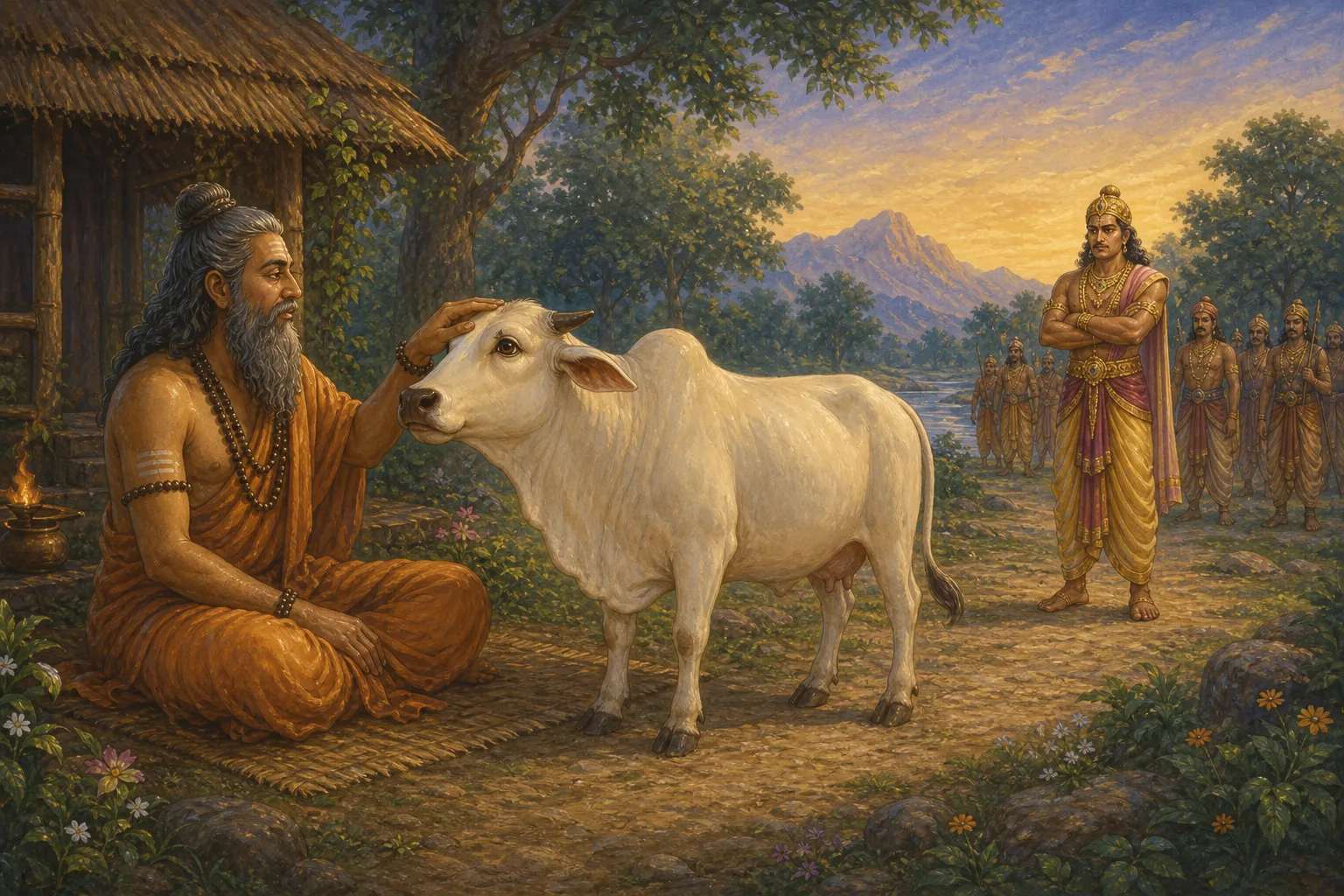
The defeated king understood that military strength was not the only kind of power. But his first response was not humility; it was a determination to gain greater weapons. He performed austerities, received celestial arms from Shiva, and returned to challenge Vashishtha. Vashishtha's staff absorbed every weapon. Again Vishvamitra failed.
He then sought the deeper status of a royal sage. His discipline was repeatedly interrupted by anger and rivalry.
During this period King Trishanku asked to enter heaven in his living body. His own teachers refused. Vishvamitra accepted the request, partly from compassion and partly from conflict with Vashishtha's line. When the gods rejected Trishanku, Vishvamitra held the falling king in the sky and began creating another heaven. Brahma and the devas intervened. A compromise left Trishanku suspended among stars. The episode displayed astonishing creative power, but also the danger of turning another person's wish into a contest of pride.
Another crisis concerned Shunashepa, a boy selected as a human offering when a royal rite could not be completed. Shunashepa sought Vishvamitra's protection. The sage taught him prayers that saved his life. Yet when Vishvamitra ordered his own sons to take the boy's place and they refused, he cursed them. Rescue and coercion stood side by side, showing that moral growth was still incomplete.
Vishvamitra continued his discipline. Menaka came to his retreat, and they lived together for years. When he realized how far he had moved from his chosen purpose, he did not harm her; he departed and began again. Later, when Rambha arrived during another test, Vishvamitra suspected a trap and cursed her in anger. He immediately recognized that anger, not desire, now blocked him.
So he undertook a harder discipline: not merely fasting or standing in difficult conditions, but refusing to let rage command his speech. Even when Indra, disguised as a mendicant, asked for the food with which Vishvamitra meant to end a long fast, the sage gave it away and continued without complaint.
Brahma eventually called him a great sage, but Vishvamitra still sought recognition as a Brahmarshi. The final confirmation came when Vashishtha himself accepted him without rivalry.

Shatananda's story did not describe a flawless hero who always made wise decisions. It described a person of enormous ability who also grasped, coerced, cursed, competed, protected, learned, failed, and resumed the work. His highest title came only after power was joined by restraint and reconciliation.
Ram looked at the sage who had guided him from Ayodhya. Vishvamitra had taught him to call weapons back because he had spent a lifetime learning that power without self-command could not complete its purpose.

How other traditions tell it
The order and emphasis of Shabala, Trishanku, Shunashepa, Menaka, Rambha, and Vishvamitra's final recognition vary across texts and adaptations. The Shunashepa material includes threatened human sacrifice, coercion, curses, and contested social language; it requires senior review and should not be softened into a simple obedience lesson. This story follows Valmiki's Bala Kanda 50–65 cluster without presenting every action as exemplary.
Source
Primary story based on the Valmiki Ramayana, Bala Kanda, Sargas 50–65. This is a newly written adaptation for older children and family discussion, not a direct translation.
References used for the series record
- Valmiki, The Ramayana, Bala Kanda 50–65; Ralph T. H. Griffith translation: https://en.wikisource.org/wiki/The_Ramayana
- IIT Kanpur, Valmiki Ramayanam, Bala Kanda 1.50–1.65: https://www.valmiki.iitk.ac.in/
“Lasting transformation comes not from winning every contest, but from recognizing harm, learning restraint, and beginning again.”