The March and Vibhishana's Refuge
Ramayana
Hanuman's report ended uncertainty, but it began a task greater than any single leap. Sita was alive in Lanka, and time mattered. Sugriva summoned the vanara forces. Ram asked that the march protect its own members and avoid needless damage to villages, fields, water, and fruit along the road. Scouts watched the front and sides while experienced leaders guarded the long column.
The army moved south through forests and across hills until the sound of the ocean filled the air. From the shore, Lanka was still beyond reach. Ram, Lakshman, Hanuman, Sugriva, Jambavant, Angada, Nala, Nila, and countless companions looked across the moving water. What Hanuman had crossed alone now had to be crossed by an entire alliance.
Meanwhile, Ravana called his counsellors. Vibhishana, his younger brother, urged him to return Sita and prevent a war. He did not praise the approaching army blindly; he argued from what Lanka had already seen. One messenger had entered the guarded city, found Sita, survived capture, and escaped. Ravana's court rejected the warning. Harsh words followed, and Vibhishana understood that loyalty to a brother could not require supporting an injustice that the brother refused to correct.
Vibhishana left Lanka with four companions and appeared in the sky above Ram's camp. He announced his name, his relation to Ravana, the counsel he had given, and his request for refuge. The vanara leaders did not agree at once. Sugriva suspected a spy. Angada advised testing the newcomer. Jambavant and others considered the danger of trusting someone from the enemy court.
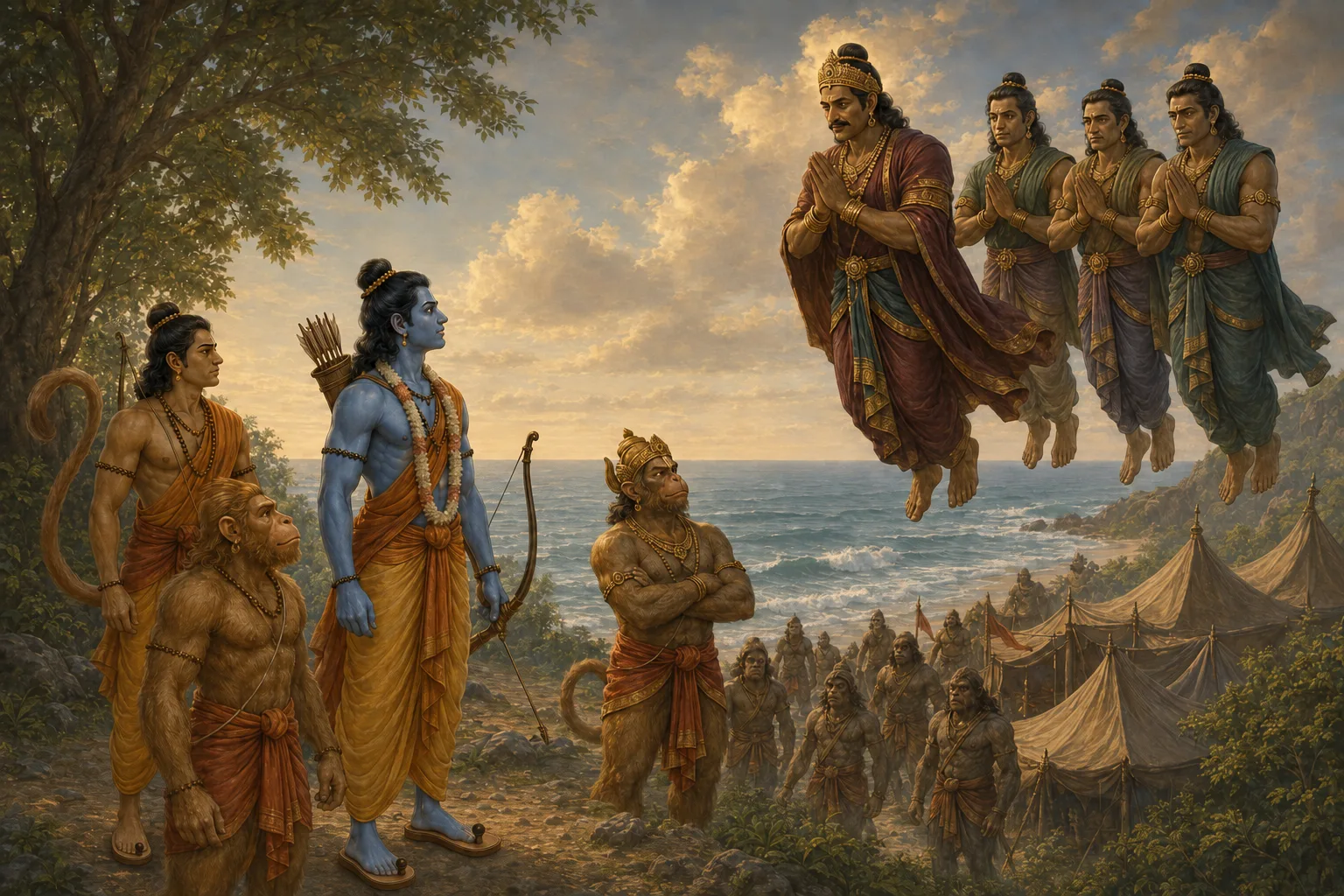
Hanuman listened to Vibhishana's words, timing, expression, and willingness to speak plainly. A spy, he reasoned, might tell a more pleasing story. Vibhishana had come openly after opposing Ravana, when return would be dangerous. Hanuman recommended acceptance, but he did not claim certainty. He offered evidence for Ram to judge.
Ram heard every view. Then he stated the principle that would govern his decision: one who sincerely came seeking protection should not be abandoned, even if that person had once stood among enemies. Refuge did not erase the need for vigilance, but fear could not be allowed to make mercy impossible. Ram accepted Vibhishana and promised protection.
Vibhishana shared what he knew of Lanka, Ravana's commanders, and the city's defences. The allies welcomed his knowledge without treating every inhabitant of Lanka as identical to its king. Ram declared that Vibhishana would one day rule Lanka if justice prevailed, a promise that also gave him responsibility for the city's future.
Ahead now lay only the ocean itself — vast, and unmoved by anything the army had accomplished so far.
“Trust should be guided by careful judgment, and strength should make room for refuge and cooperation.”
New stories in your inbox
One story every week, and a special tale on festivals. Free, always.
Your email goes to our newsletter provider (beehiiv) so we can send you stories. It is not linked to any child's reading on this site. Unsubscribe any time from the email footer.