Hanuman Crosses the Ocean
Ramayana
On the southern shore, the vanaras gazed across an ocean so wide that its farther edge disappeared into the sky. Somewhere beyond those waves stood Lanka. Somewhere in Lanka, Sita waited.
Jambavant had reminded Hanuman of the strength that had always lived within him. Now Hanuman climbed Mount Mahendra and looked south. He thought of Ram, of the ring entrusted to him, and of the message he must carry.
"I will find Sita," he promised. "If she is not in Lanka, I will search farther. I will not return without news."
Hanuman gathered his strength. His body grew until he seemed as solid as the mountain beneath him. Trees shook. Animals hurried into their caves. The peak pressed down under his feet, and streams of water rushed from its sides.
Then Hanuman leapt.
He flew over the sea like an arrow released from a mighty bow. The wind supported its son, and the ocean rolled far below. Trees pulled loose by the force of his departure followed briefly through the air, scattering blossoms across the water before falling into the waves.
The ocean remembered an old kindness shown by Ram's ancestors. Wishing to help Ram's messenger, it asked the golden mountain Mainaka to rise from beneath the water and offer Hanuman a place to rest.
Mainaka rose, shining in the sunlight.
"Great Hanuman," the mountain said, "pause upon my summit. Eat sweet fruits and recover your strength before continuing."
Hanuman was grateful, but he would not delay.
"Your welcome has already refreshed me," he answered.
He touched the mountain respectfully with his hand and continued toward Lanka. Mainaka had offered friendship, and Hanuman answered with gratitude rather than treating kindness as an obstruction.

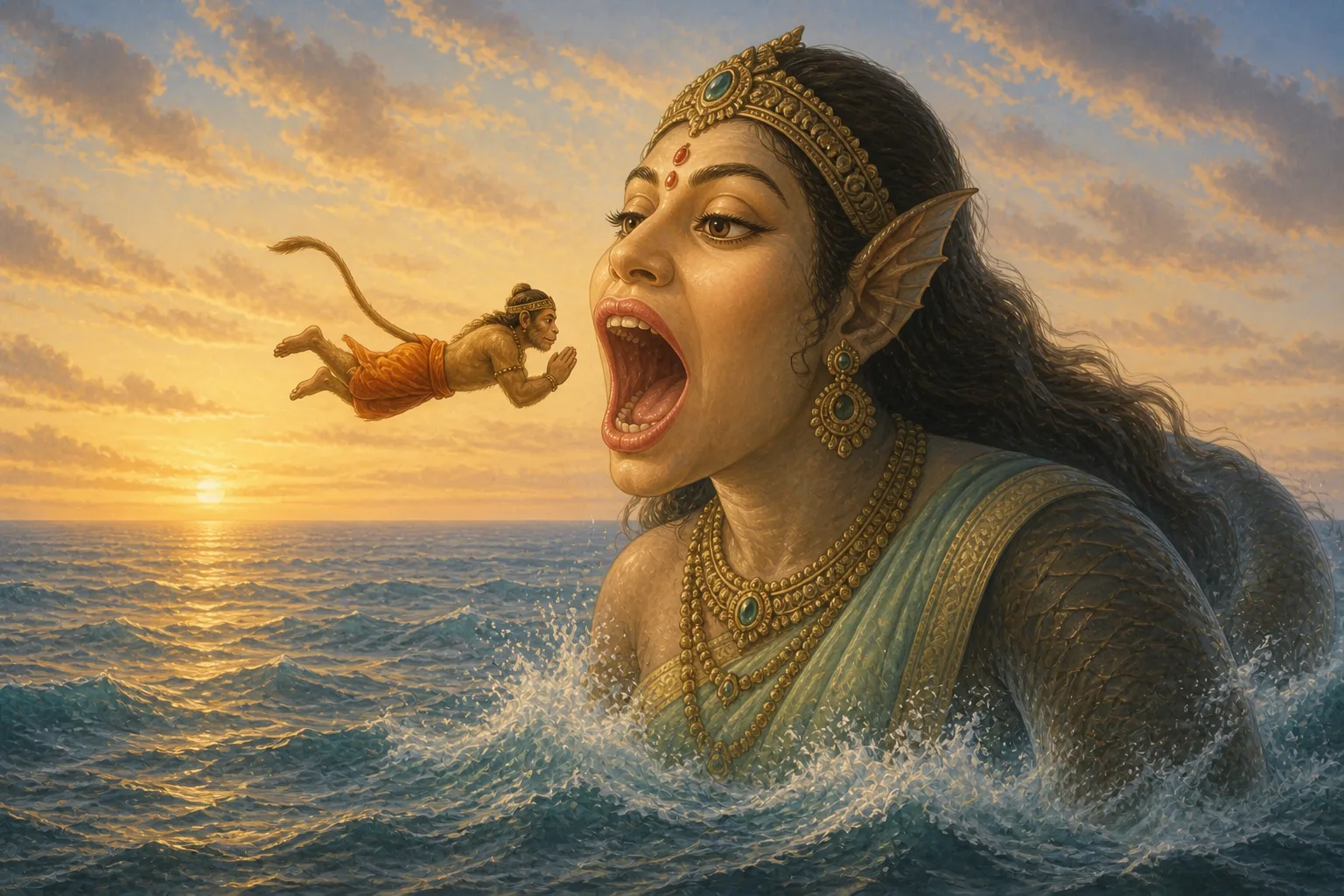
The devas watching from above wished to learn whether Hanuman possessed wisdom as well as strength. They asked Surasa, mother of the nagas, to test him. She rose before him and opened an enormous mouth.
"The gods have granted that you must enter my mouth," she declared.
Hanuman explained that he was carrying out Ram's urgent work and promised to return afterward. But Surasa blocked his way and opened her mouth wider.
Hanuman made himself larger. Surasa's mouth grew larger still. Again and again they expanded until they seemed to fill the sky.
Suddenly Hanuman became as small as a thumb. He darted into Surasa's mouth and out again before she could close it.
"I have entered your mouth as required," he said, "and now I must continue."
Surasa resumed her gentle form.
"You have passed the test with courage and intelligence," she replied. "Go with my blessing. May you find Sita and complete Ram's work."
Hanuman continued. Farther on, he felt his speed failing. The sky ahead was clear, yet something pulled him downward.
He remembered that Sugriva had spoken of a dangerous being who caught travellers by seizing their shadows. Looking below, Hanuman saw Simhika rising from the waves.
Simhika dragged his shadow toward her and opened her jaws. This was not an offer of hospitality or a test that could be answered with a clever promise. She intended to stop him completely.
Hanuman allowed her to draw close. Then he reduced his size, entered her open mouth, struck swiftly at the source of her power, and escaped before she could trap him. Simhika fell back into the sea, and the hidden pull released him.
At last a green island appeared on the horizon. Hanuman saw forests, mountains, and the walls of a splendid city. Lanka shone like a city in the heavens.
He landed upon a wooded height and looked carefully at the guarded gates. The messenger who had crossed the sea like a mountain now made himself small. Strength had carried him to Lanka; patience and wisdom would help him enter it.
Holding Ram's purpose steadily in his heart, Hanuman waited for nightfall.
“Different obstacles call for different kinds of strength.”
New stories in your inbox
One story every week, and a special tale on festivals. Free, always.
Your email goes to our newsletter provider (beehiiv) so we can send you stories. It is not linked to any child's reading on this site. Unsubscribe any time from the email footer.