Bhagiratha and the Descent of the Ganges
Ramayana
Part 1: King Sagara's unfinished rite
Long ago, King Sagara of Ayodhya began an ashvamedha, a royal horse rite described in ancient tradition. A specially chosen horse travelled under the protection of the king's people. If it returned safely, the concluding ceremony could be completed.
But the horse disappeared.
Sagara sent many of his sons to search. They looked across the land and dug deep passages through the earth in their determination to find it. At last they came upon Sage Kapila sitting in meditation. The missing horse grazed nearby.
The princes assumed that Kapila had stolen it. They rushed forward with angry accusations.
Kapila opened his eyes. The force of the princes' own aggression met the immense energy of his meditation, and they fell lifeless, reduced to ash.
Kapila had not stolen the horse. It had been placed there as part of a divine disturbance of Sagara's rite.
Back in Ayodhya, Sagara waited in sorrow.
Part 2: Anshuman finds the path
Sagara sent his grandson Anshuman to search. Unlike the first group, Anshuman entered Kapila's hermitage quietly. He saw the horse, the ashes, and the meditating sage.
He bowed.
"Revered one," Anshuman said, "I have come for the horse, but I also seek the truth about my family."
Kapila opened his eyes and saw that the young prince had approached with respect.
"Take the horse and complete your grandfather's rite," he said. "As for Sagara's sons, ordinary water cannot bring peace to their spirits. Only Ganga, the river who flows in the celestial realm, has the power to reach them here."
Garuda, Anshuman's divine relative, also encouraged him. "Do not answer this tragedy with another burst of anger. Carry home the knowledge of what must be done."
Anshuman returned with the horse. Sagara completed the ceremony, but the larger task remained.
Sagara spent years seeking a way to bring Ganga to Earth. Anshuman continued after him. Anshuman's son Dilipa carried the hope into another generation.
None saw the river descend.
Yet their effort was not wasted. Each preserved the story, protected the kingdom, and prepared the next person to continue.
Part 3: Bhagiratha takes up the work
Dilipa's son Bhagiratha inherited the throne and the unfinished promise.
He governed carefully, then entrusted the daily work of the kingdom to capable ministers while he undertook long prayer and disciplined reflection. His practice was demanding, but it was not a rejection of life. He ate, rested, and kept his responsibilities in order, returning each day to the same purpose.
At last Brahma appeared.
"Your perseverance has been heard," Brahma said. "Ganga may descend from the celestial realm. But her falling waters are mighty enough to shake the mountains and overwhelm the land. Earth cannot receive her unaided. Ask Shiva to guide her descent."
Bhagiratha thanked Brahma and began another period of prayer, this time seeking Shiva's help.
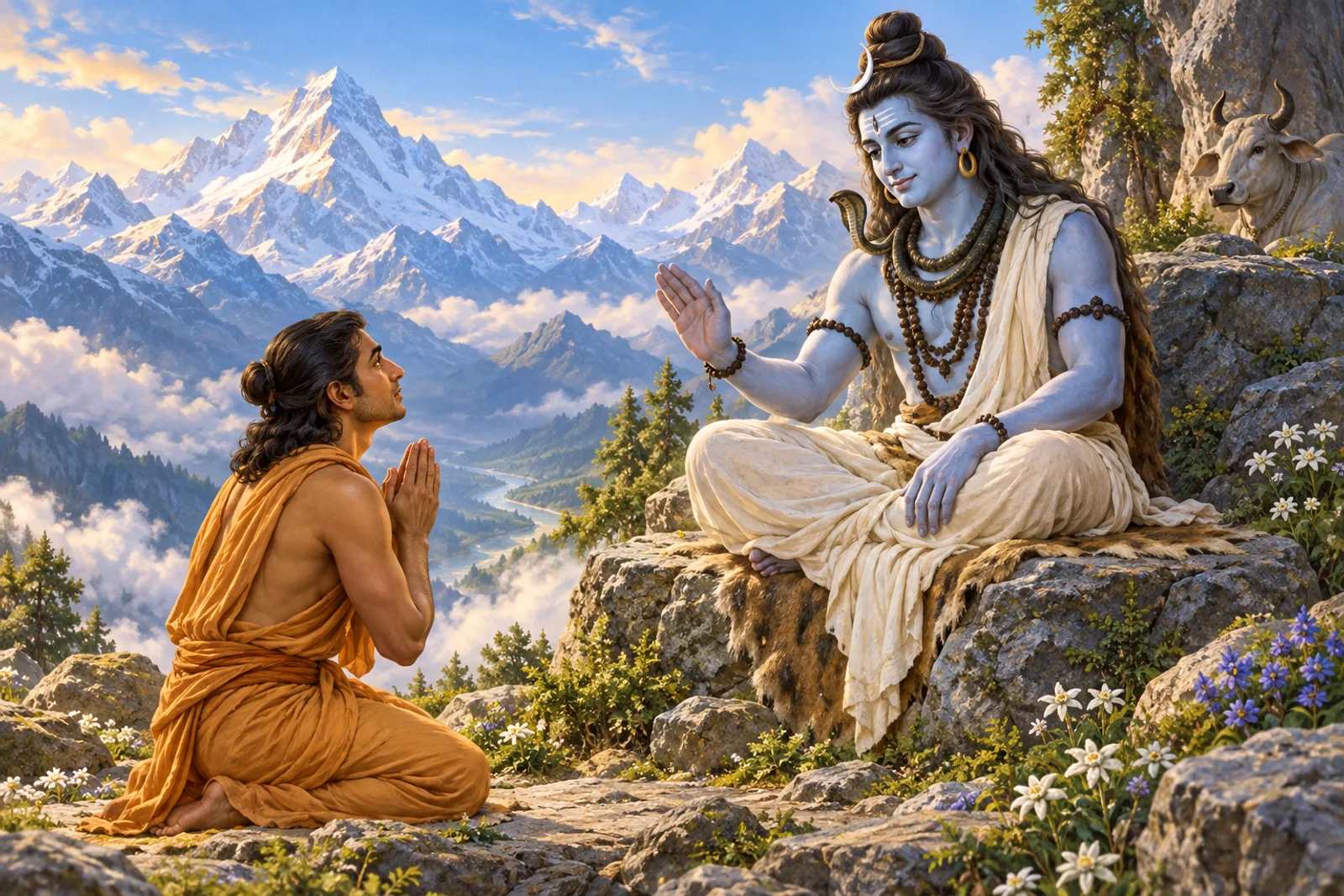
Shiva appeared among the Himalayan heights, serene and powerful.
"I will receive Ganga in my matted hair," he promised. "Her force will be held and released in streams the earth can bear."
Part 4: Ganga's question
Bhagiratha then turned his prayer toward Ganga herself.
The river goddess appeared in luminous white and blue, her long hair flowing like water.
"Why should I leave the celestial realm?" she asked. "On Earth, people will come to my waters carrying dust, sorrow, and the consequences of their actions. Who will protect my purity?"
Bhagiratha did not command her.
"You will bring life to fields, forests, towns, and creatures," he answered. "People will come not only to leave burdens but also to offer gratitude. Sages and communities will honour and protect your waters. I cannot promise that humans will never fail, but I can promise that your gift will create a duty of care."
Ganga considered his words.
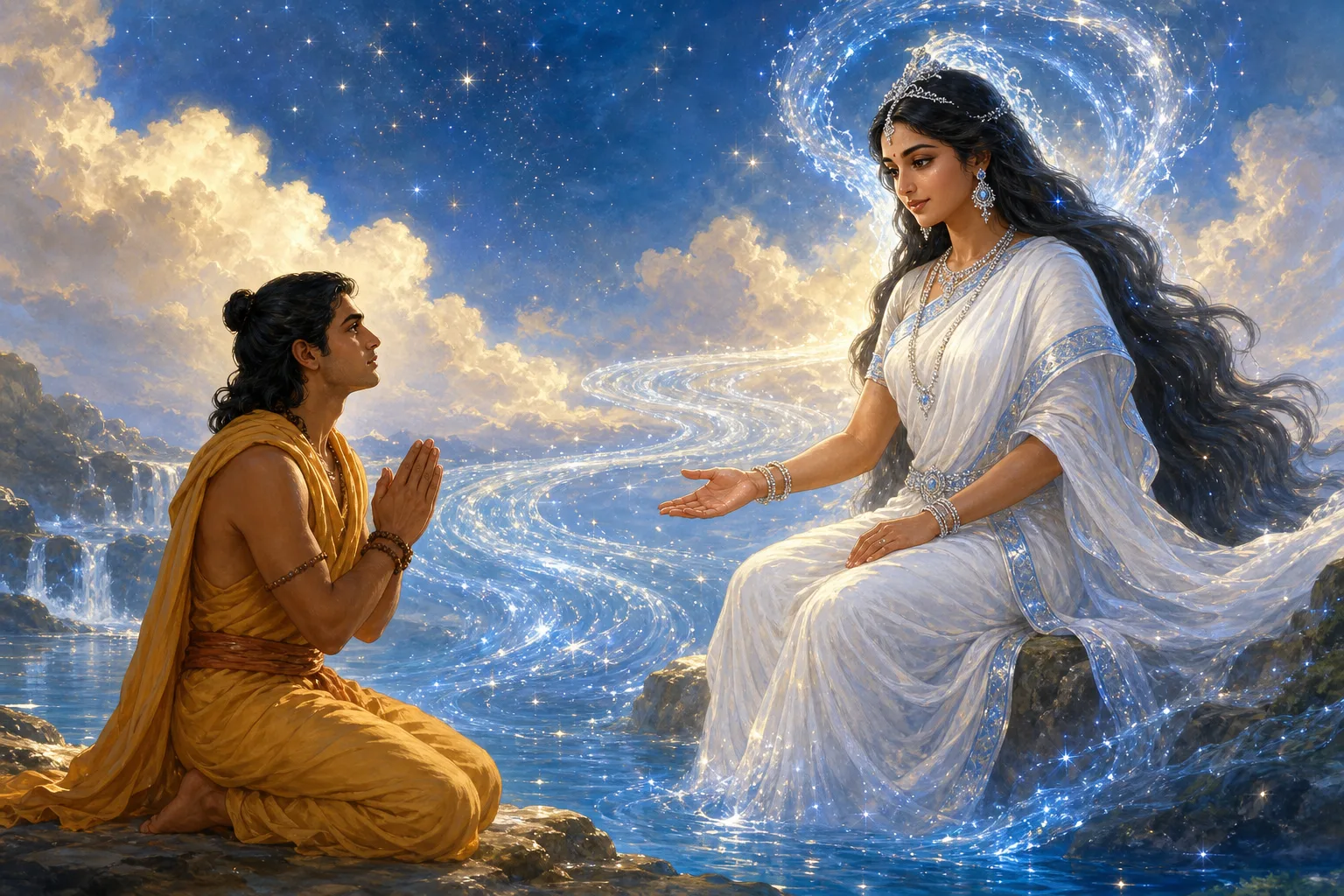
"Then I will descend," she said. "Let those who receive a river remember that sacredness is not permission to pollute it. Sacredness is a responsibility."
Part 5: The river in Shiva's hair
Ganga poured from the sky with tremendous force. Clouds spun around the mountains, and a silver-white river seemed to fill the heavens.
Shiva stood calmly beneath the torrent. The celestial river entered his high matted locks—and vanished within their endless pathways.
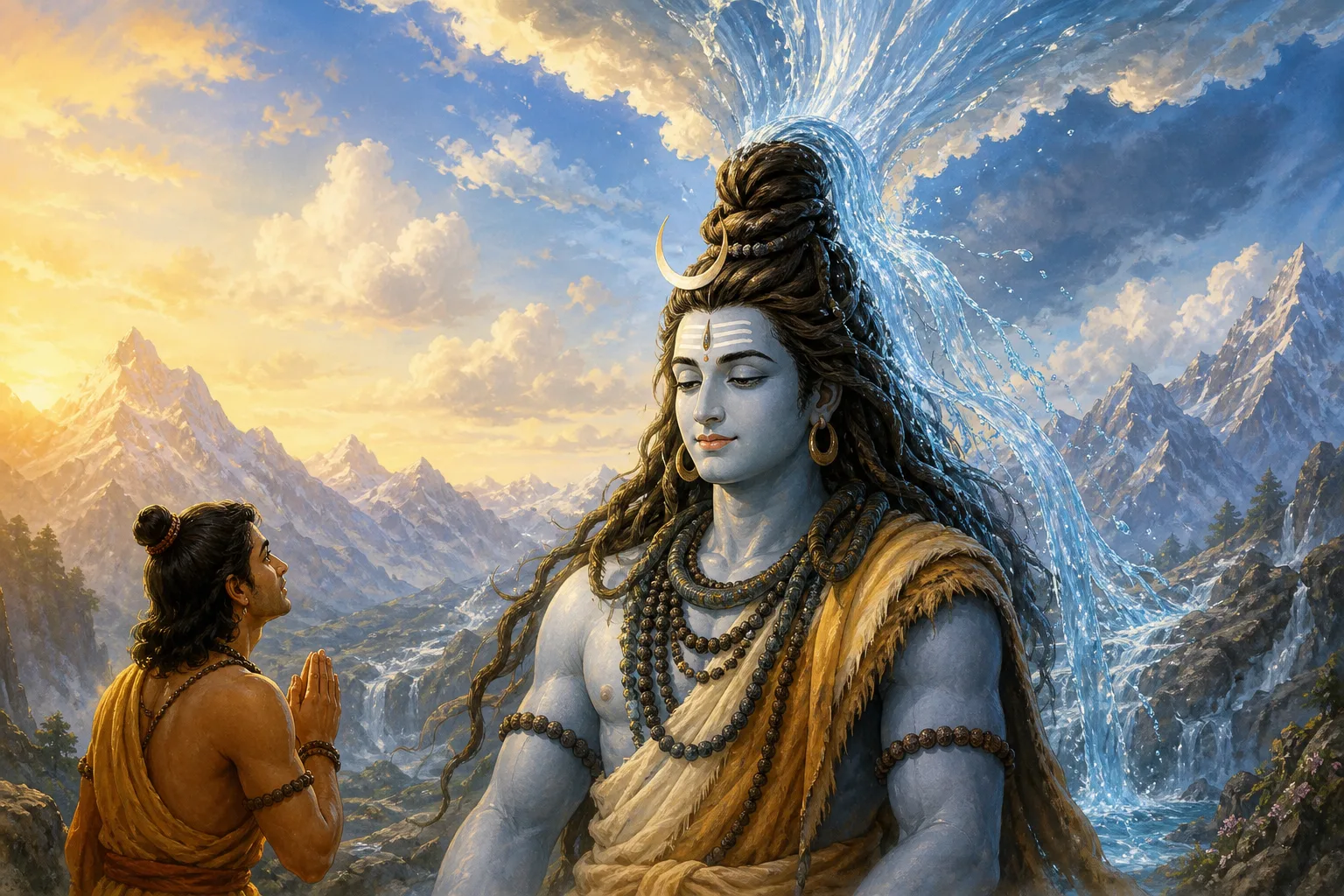
Ganga had expected to rush directly across the earth. Instead, she moved through the quiet darkness of Shiva's hair until her pride softened into patience.
Bhagiratha prayed again.
Shiva smiled and released Ganga in several graceful streams. Water ran over Himalayan stone, through valleys, and toward the plains. One stream followed Bhagiratha.
People and animals gathered in wonder. Dry ground softened. Plants lifted their leaves. The river's journey had begun.
Part 6: Sage Jahnu and the interrupted journey
Bhagiratha travelled ahead in a chariot, guiding the way toward the place where Sagara's sons lay.
The new river flowed eagerly. At one point her waters spread across Sage Jahnu's hermitage and disturbed the place where he kept his sacred fire and simple belongings.
Jahnu used his spiritual power to draw the river into himself, and the channel suddenly became dry.
Bhagiratha stopped. After generations of effort, the journey seemed blocked again.
He did not threaten the sage. He bowed and explained why Ganga's passage mattered.
Ganga too acknowledged that power must notice those in its path.
Jahnu's anger cooled. He released the river gently from his ear, accepting her as a daughter. From then on Ganga was also called Jahnavi, daughter of Jahnu.
The journey continued.
Part 7: The promise reaches the sea
At last Ganga flowed over the ashes of Sagara's sons. Her sacred waters brought peace to their spirits and opened their path onward.
Bhagiratha stood silently beside the river. He thought of Sagara, Anshuman, and Dilipa—people who had worked toward a result they never lived to see.
The river continued toward the sea.
Bhagiratha returned to the duties of his kingdom. He did not claim that he had completed the work alone. Brahma had shown the path, Shiva had made the descent safe, Ganga had freely given her waters, Jahnu had released her, and generations before Bhagiratha had kept the promise alive.
“Patient effort can complete a work begun by generations before us.”
New stories in your inbox
One story every week, and a special tale on festivals. Free, always.
Your email goes to our newsletter provider (beehiiv) so we can send you stories. It is not linked to any child's reading on this site. Unsubscribe any time from the email footer.