The Alliance with Sugriva
Ramayana
Hanuman brought Ram and Lakshman to Sugriva's refuge on Mount Rishyamuka. Until that morning, each side had known the other only through uncertainty. Ram and Lakshman were armed strangers searching the forest. Sugriva was an exiled ruler hiding from his powerful brother Vali. Hanuman's careful questions had opened a path between them, but trust still had to be built through truth and action.
Hanuman kindled a small fire in a clear place among the rocks. Fire witnessed the new friendship. Ram and Sugriva walked respectfully around it and faced one another as allies. Each had suffered separation, and each possessed help the other needed.
Sugriva promised to send searchers through forests, mountains, rivers, islands, and distant lands until they learned where Sita had been taken. Ram promised to help Sugriva confront the injustice that had cost him his home, his position, and the safety of living openly.
When the promise had been made, Sugriva spoke of an event that had troubled him for many days.
"Not long ago," he said, "my companions and I were sitting on this mountain when we heard a woman crying out. She was being carried through the sky by a powerful stranger. She called the names 'Ram' and 'Lakshman' and struggled to make herself seen."
Sugriva led the brothers to the edge of the rocky refuge and pointed toward the southern sky. He explained that the captive woman had noticed the vanaras below. She wrapped some ornaments in a piece of her upper cloth and let the bundle fall near them. Sugriva had kept it safe, hoping that one day it might tell someone what he had witnessed.
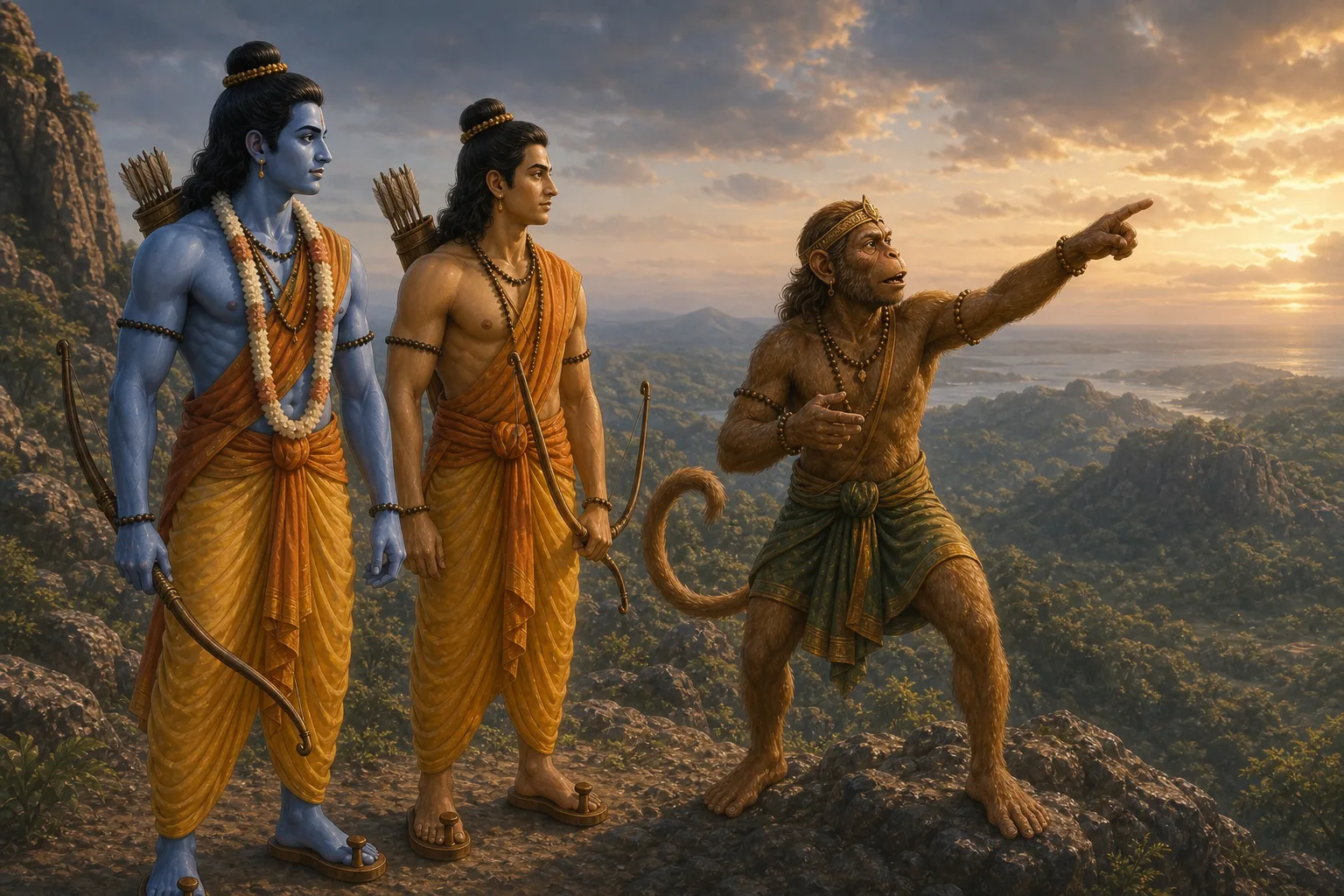
At Ram's request, Sugriva brought the bundle from the place where it had been protected. He unfolded the cloth carefully. A few ornaments caught the mountain light.
The objects were small, but to Ram they were the first physical sign of Sita since Jatayu's final message. They confirmed that she had remained alert during the abduction, had looked for witnesses, and had created a trail with whatever she could reach.
Ram lifted the ornaments with trembling hands. Grief that he had held in check rose again. He asked Lakshman whether he recognized them.
Lakshman answered with painful honesty. He could not identify the ornaments worn upon Sita's arms or near her face, because he had never stared at them. But he recognized the anklets. Each day, when he bowed respectfully at her feet, he had seen them.
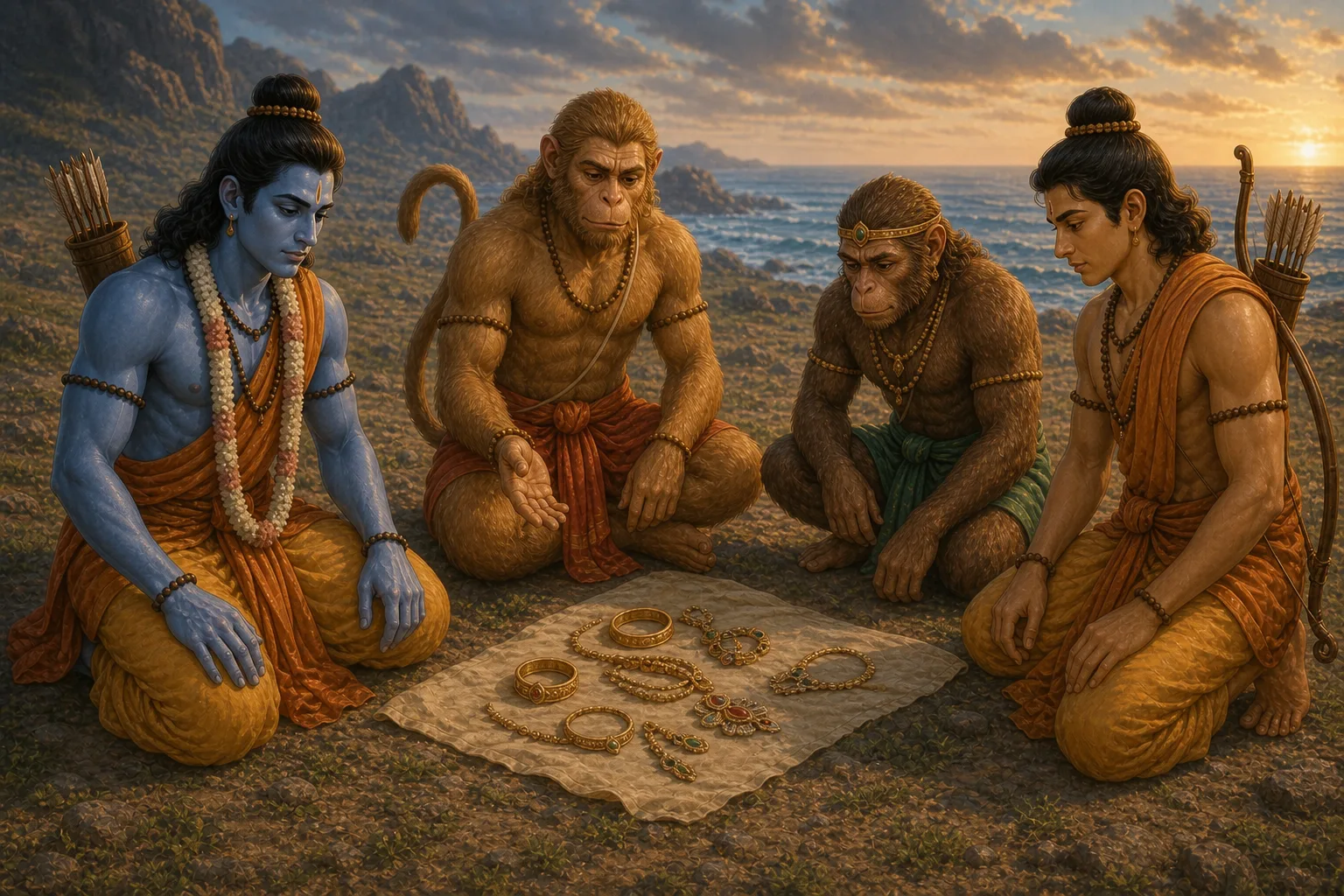
Ram did not treat the bundle as treasure. These were signs of Sita's presence, her intelligence, and the direction in which she had been taken. He asked Sugriva everything he could remember: the stranger's appearance, the path across the sky, the woman's words, and the direction in which they disappeared.
Sugriva could not yet name the abductor or point to the exact city where Sita was held. He did not pretend to know more than he knew. He promised instead that his wide network of vanara communities could search lands that two travellers alone could never cover.
Then Sugriva spoke more fully about his own need. His brother Vali still ruled Kishkindha. Sugriva said that Vali had driven him away, taken control of the kingdom, and kept Sugriva's wife Ruma from him. He asked Ram to help end that wrong.
The whole dispute could not be judged from one short statement. Ram therefore asked Sugriva to explain how the conflict between the brothers had begun and why Vali pursued him even to the edge of Rishyamuka. It was a long story, and Ram asked to hear all of it.
For now, Ram and Sugriva repeated their commitment. Ram would not forget Sugriva's loss once Sita's ornaments had been shown. Sugriva would not forget Sita's captivity once his own safety was restored. Their sorrows were not identical, but each could recognize displacement, fear, and longing in the other.
“A lasting alliance begins when both sides speak honestly, listen carefully, and accept responsibility for helping one another.”
New stories in your inbox
One story every week, and a special tale on festivals. Free, always.
Your email goes to our newsletter provider (beehiiv) so we can send you stories. It is not linked to any child's reading on this site. Unsubscribe any time from the email footer.