Hanuman Returns with Sita's Message
Ramayana
From Mount Arishta, Hanuman launched northward. The ocean crossing was no longer a journey into uncertainty. Sita was alive; he carried her words, her private memories, and the chudamani she had entrusted to him. Yet the return still demanded care. News mattered only if he reached those who could act upon it.
He crossed the sea with the same strength that had brought him to Lanka. Mainaka remained below, and the sky opened toward Mahendra. The waiting vanaras heard a great cry in the distance. Jambavant recognized its confidence: a messenger who had failed would not announce himself in that voice.
Hanuman landed among Angada, Jambavant, and the exhausted search party. Their first question was the only one that mattered. Hanuman answered, "I have seen Sita." He did not make them wait through a display of his adventures before giving relief.
He described Sita beneath the shimshapa tree, her refusal of Ravana, the guards, Trijata's intervention, the ring, and her message. He reported the limited time she believed remained. He also told them of his battles, capture, appearance in Ravana's court, the burning of Lanka, his fear that the fire had endangered Sita, and his return to confirm her safety.
The party's despair turned into celebration. On their way north they entered Madhuvana, a honey grove protected for Sugriva. Angada permitted the hungry searchers to eat and drink. Their joy became disorderly, and when the guardian Dadhimukha tried to stop them, some pushed and struck him. Dadhimukha went to Sugriva and reported the damage.
Sugriva understood the meaning behind the misconduct: the southern party would not dare return in such confidence unless it had succeeded. He reassured Dadhimukha, asked that the searchers be forgiven, and ordered them brought quickly.
Hanuman, Angada, and the party came before Ram, Lakshman, and Sugriva. Hanuman bowed and again began with the essential words: Sita was alive, faithful, and waiting in the Ashoka grove. Then he placed her chudamani in Ram's hands.
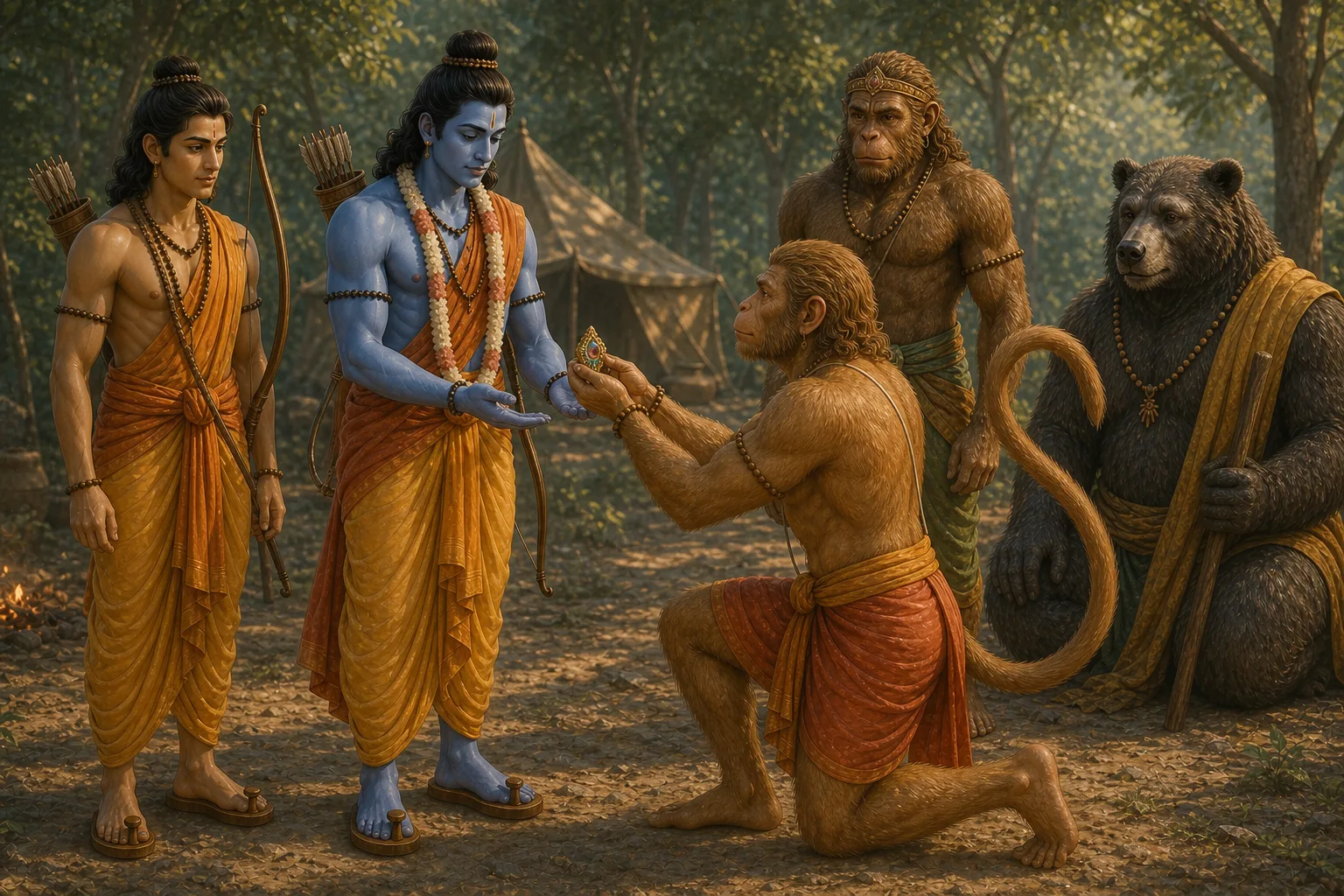
Ram recognized the jewel. It recalled Sita, her father Janaka, and the wedding that had joined their lives. Relief and grief arrived together: the token proved she lived, but also made her absence immediate. Ram held it close and asked Hanuman to repeat everything she had said.
Hanuman recounted the private crow episode and the forehead mark, signs that only Sita could have chosen. He conveyed her question about why two great warriors had not yet rescued her, her refusal to leave secretly on his back, her confidence that Ram would come openly, and her warning that time was short. He told them how hard her captivity had been; and how, threatened and exhausted, she still set her own conditions.
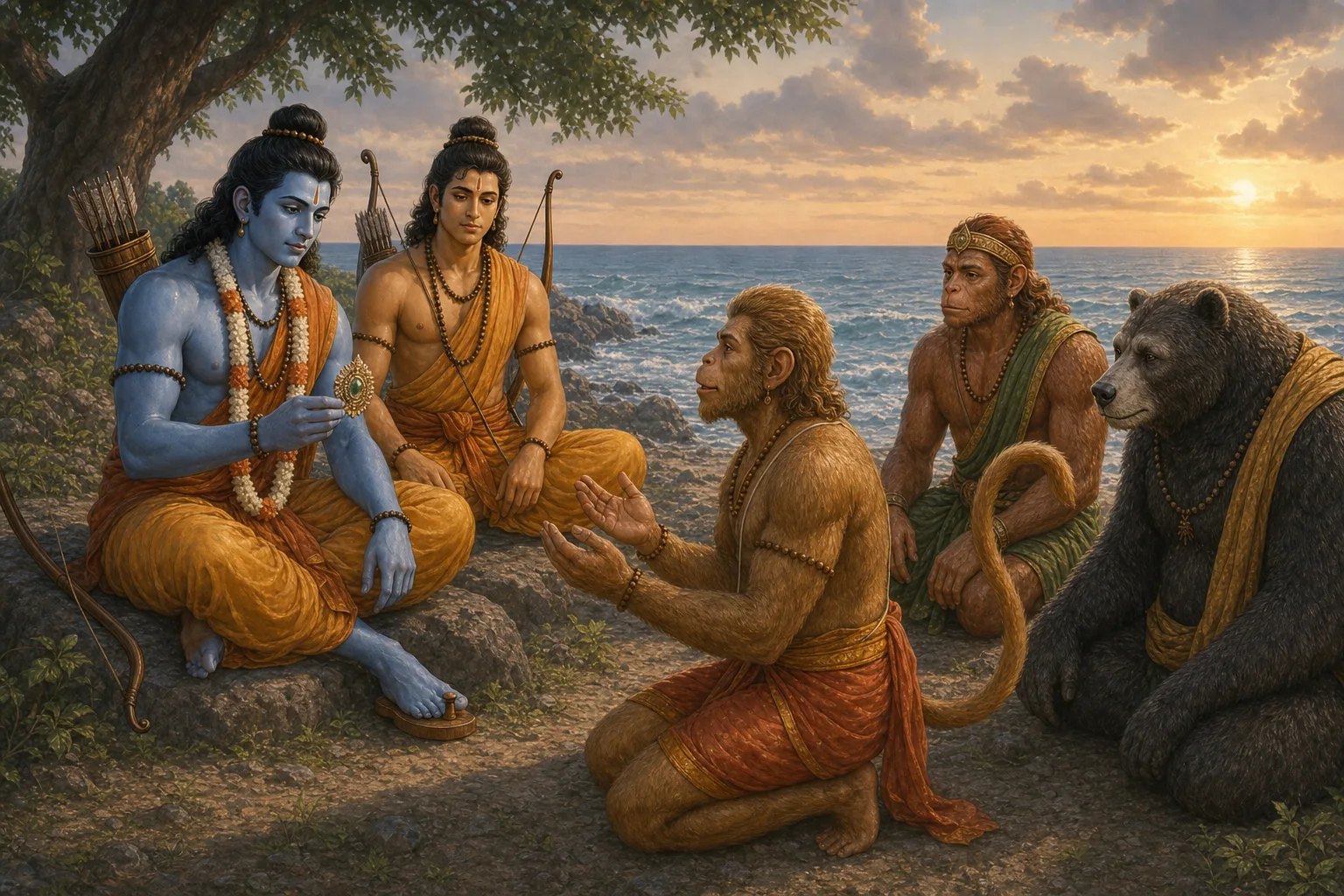
Ram praised Hanuman. A lesser messenger might complete only the instruction explicitly given. Hanuman had crossed the ocean, found Sita, earned her trust, assessed Lanka, faced Ravana, returned with proof, and preserved the mission when his own actions created danger. Ram said he had no gift equal to such service and embraced him.
The embrace changed uncertainty into a plan. Sugriva began organizing the march south. Ram asked about Lanka's gates, walls, forces, approaches, and terrain. Hanuman's observations during stealth, capture, and escape now became practical intelligence.
“Good news becomes trustworthy when the messenger carries evidence, context, and the speaker's own words.”
New stories in your inbox
One story every week, and a special tale on festivals. Free, always.
Your email goes to our newsletter provider (beehiiv) so we can send you stories. It is not linked to any child's reading on this site. Unsubscribe any time from the email footer.