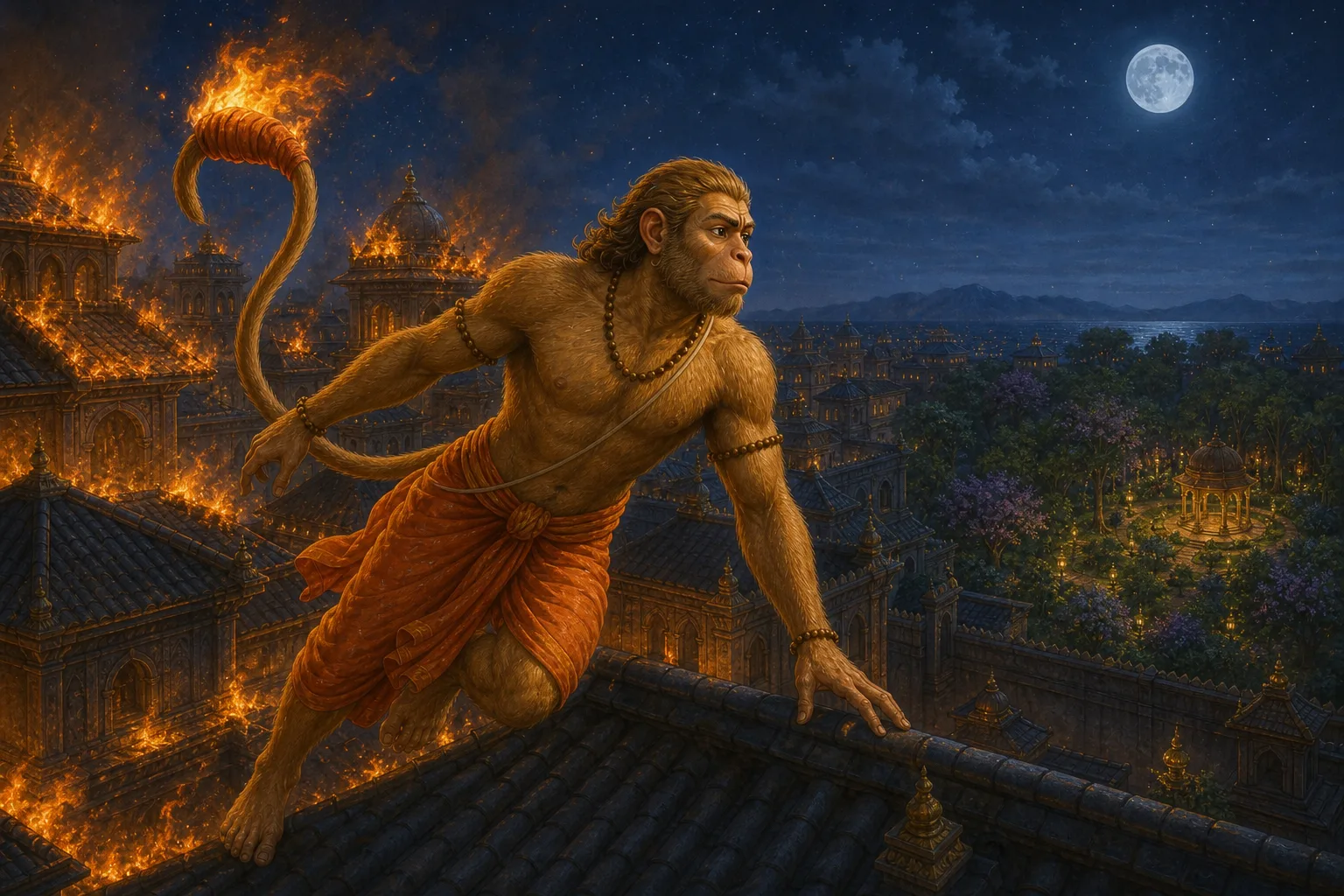
Hanuman and the Burning of Lanka
Ramayana
After receiving Sita's message, Hanuman considered what remained. He knew her location and condition, but Ram also needed knowledge of Lanka's response to a challenge. Hanuman decided to reveal himself, draw out its defenders, and seek a meeting with Ravana. This was a deliberate risk, not anger without purpose.
He ate fruit in the Ashoka grove and broke trees and structures associated with Sita's confinement, leaving the tree sheltering her unharmed. Guards attacked. Hanuman defeated the first force and then Jambumali, followed by the sons of Ravana's ministers and five commanders. The poem names deaths in these encounters. This telling does not hide them, because they explain the seriousness of Hanuman's choice and Lanka's alarm, but it avoids wounds, body counts, and triumphant spectacle.
Ravana next sent his young son Aksha in a swift chariot. Aksha covered the sky with arrows and followed Hanuman's movements with remarkable skill. Hanuman did not dismiss him because of his youth. He watched the prince with respect and considered whether the battle could be ended without killing him. But Aksha continued the attack with increasing force. Hanuman concluded that leaving such a capable warrior in the fight would prolong the danger. He destroyed the chariot, brought Aksha down, and killed him. The death is part of Valmiki's sequence and is stated plainly, not illustrated at the moment of impact.

Grieving and angry, Ravana sent his elder warrior-son Indrajit, also called Meghanada. Indrajit observed that ordinary arrows could not restrain Hanuman. He therefore invoked a Brahma weapon. Its divine binding closed around Hanuman, who remembered the protection granted to him by Brahma. He could have broken free after the weapon's limited effect, but chose to remain still. Capture could take him where stealth and battle could not: directly into Ravana's court. When the guards added ordinary ropes, the divine restraint no longer held in the same way, yet Hanuman continued to cooperate because the audience he wanted was now near.

The guards added ordinary ropes and dragged him through Lanka. Hanuman observed roads, walls, forces, and public response as he went. Even bound, he continued gathering information.
Ravana's sabha displayed the scale of Lanka's kingship: a high throne, carved pillars, gold, jewels, lamps, armed guards, ministers, and commanders arranged around their ruler. Its splendour made Ravana's choices more—not less—serious, because so much power had been placed behind an abduction he still refused to correct.
Before Ravana, Hanuman identified himself as Ram's messenger. He described the alliance with Sugriva, stated that Sita had been found, and advised Ravana to return her. He did not pretend one messenger had conquered Lanka, but warned that Ram, Lakshman, and the gathered vanara forces would cross the sea if peace were refused.
In a widely loved later visual tradition, Ravana tries to keep the messenger below his throne, so Hanuman lengthens and coils his tail into an asan and calmly seats himself at Ravana's height. That striking court image expresses the dignity of Ram's envoy. It is included here as a later tradition; the selected Valmiki sargas describe Hanuman brought bound before Ravana and admiring the court's splendour, but do not narrate this tail-seat action.

Ravana ordered Hanuman killed. Vibhishana objected. A king might punish or mark a hostile envoy, he argued, but killing a messenger violated the rules that allowed enemies to communicate. Ravana changed the sentence: since a vanara's tail was considered a source of pride, cloth would be wrapped around it, set alight, and displayed through the streets.
The guards wrapped Hanuman's tail, but he lengthened it so that more and more cloth was required. When they lit it, Sita heard what was happening and prayed that fire would be cool to Hanuman because he carried Ram's work and had treated her with respect. Hanuman felt heat around him but was not burned.
He reduced his size, slipped free of the bonds, and leapt onto the city roofs. Using the flame meant as humiliation, he set fire to prominent palaces, towers, armouries, and military buildings. Wind carried the blaze. The ancient poem describes enormous destruction and people crying out in fear. Fire cannot distinguish perfectly between a ruler's power and the city around it; the scene must not be treated as harmless celebration.

When Hanuman saw the blaze, triumph gave way to alarm. Had he endangered Sita through uncontrolled anger? He condemned his own haste and considered how one rash act could undo the entire mission. Reassuring voices and favourable signs suggested Sita was safe, but he did not rely on hope. He returned to the Ashoka grove and saw her again.
Sita confirmed that she had not been harmed. Hanuman bowed and repeated that Ram would come. She again asked him to carry her message faithfully and urged that the rescue not be delayed.
Hanuman then climbed Arishta mountain and prepared for the return leap. Behind him, Lanka had received both a warning and a wound. Ahead waited companions who did not yet know Sita was alive.
The episode leaves a difficult truth rather than a simple victory. Hanuman's courage, intelligence, and endurance are extraordinary. So is his willingness to question himself when force spreads beyond its intended target. The capacity to act does not remove the duty to examine consequences.
Source and editorial note
Based on Valmiki Ramayana, Sundara Kanda, Sargas 39–55. The grove's destruction, successive defenders, Aksha's battle and death, Indrajit's reasoning and Brahma weapon, deliberate capture, court, envoy debate, tail punishment, city fire, civilian fear, Hanuman's remorse, and confirmation of Sita's safety are retained non-graphically. The tail-seat asan is explicitly identified as a later visual tradition rather than attributed to the selected Valmiki passage. The fire is not framed as consequence-free entertainment.
References used for the series record
- Valmiki, Ramayana, Sundara Kanda 39–55: https://www.valmiki.iitk.ac.in/
- Ralph T. H. Griffith, public-domain English Ramayana: https://en.wikisource.org/wiki/The_Ramayana
“Courage must remain answerable for the consequences of the force it uses.”