Lakshman Joins the Exile
Ramayana
Ram and Sita were preparing for the forest when Lakshman came to them. His decision was clear: he too would go. Ram did not immediately agree. Their mothers Sumitra and Kaushalya would need support, he said, and caring for the family was also an important service. Lakshman replied that Shatrughna and Bharat would protect the elders. In the forest he would find paths, bring water and food, help build shelter, and guard Ram and Sita.
Lakshman understood that leaving palace comfort meant taking on practical work. Ram accepted his reasoning and sent him to retrieve two divine bows, armour, swords, and inexhaustible quivers held under Sage Vashishtha's care. Janaka had given these at the time of the weddings. They took what was required for safety and survival, not the equipment of a royal campaign.
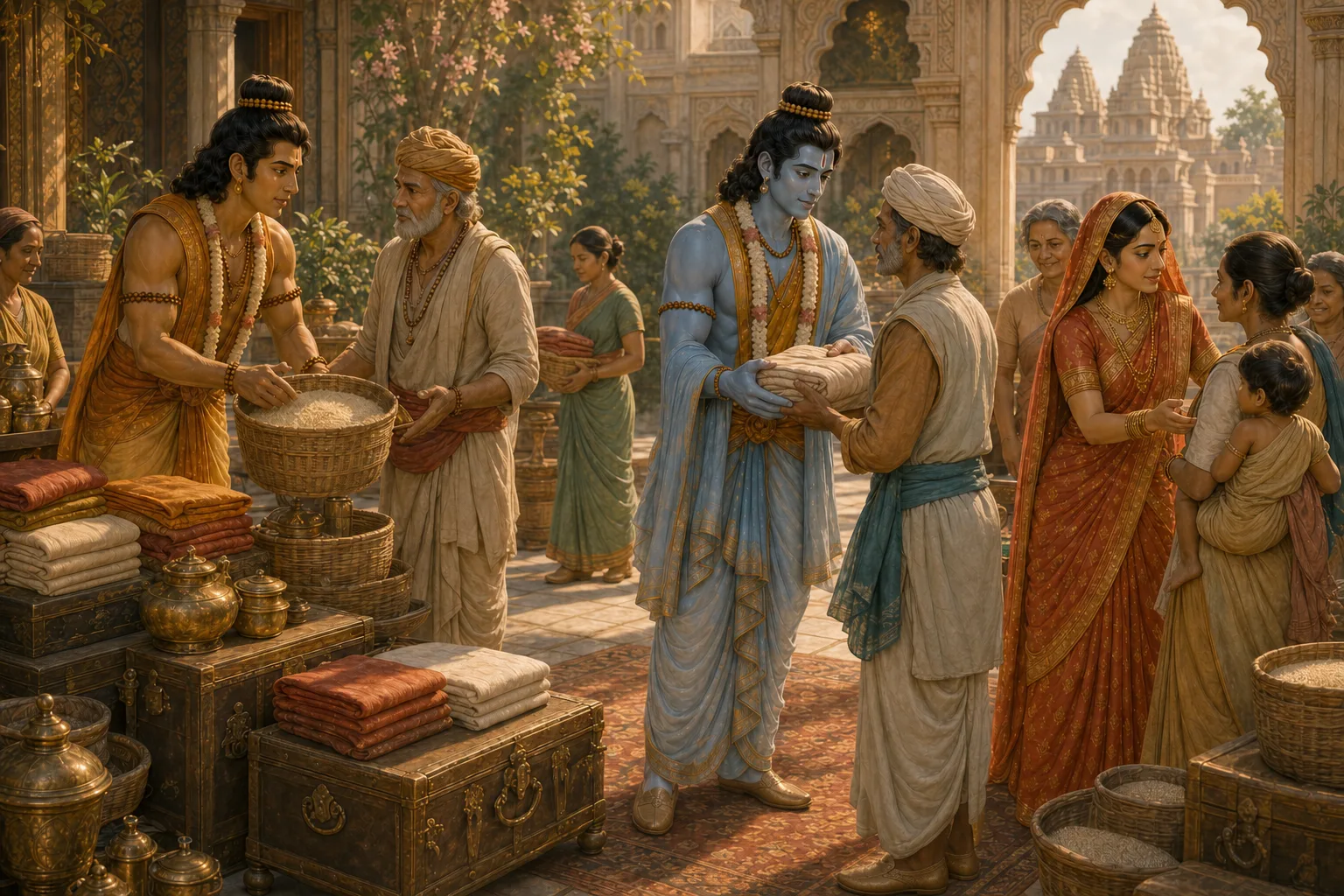
Before leaving, Ram, Sita, and Lakshman distributed their possessions. They gave wealth, cattle, clothing, and useful goods to priests, scholars, dependent households, workers, and people in need. The travellers' immediate purpose was to ensure that people whose livelihood depended on the household were not suddenly abandoned. Ram ordered provisions to support palace workers for years during his absence.
The three then returned to Dasharatha. The king still wished Ram to remain for even one more day, but Ram said that delay would only stretch the pain after the exile had been accepted. He declined royal wealth and an accompanying army. If every palace comfort followed him, the forest sentence would exist only in name.
Kaikeyi brought garments of bark such as forest ascetics wore. Ram and Lakshman exchanged their princely clothing for them. When bark cloth was placed before Sita, she did not at first know how it should be fastened, and the palace women were distressed. Vashishtha objected that the boon exiled Ram, not Sita; if she accompanied him by choice, she should not be humiliated or stripped of what she needed.
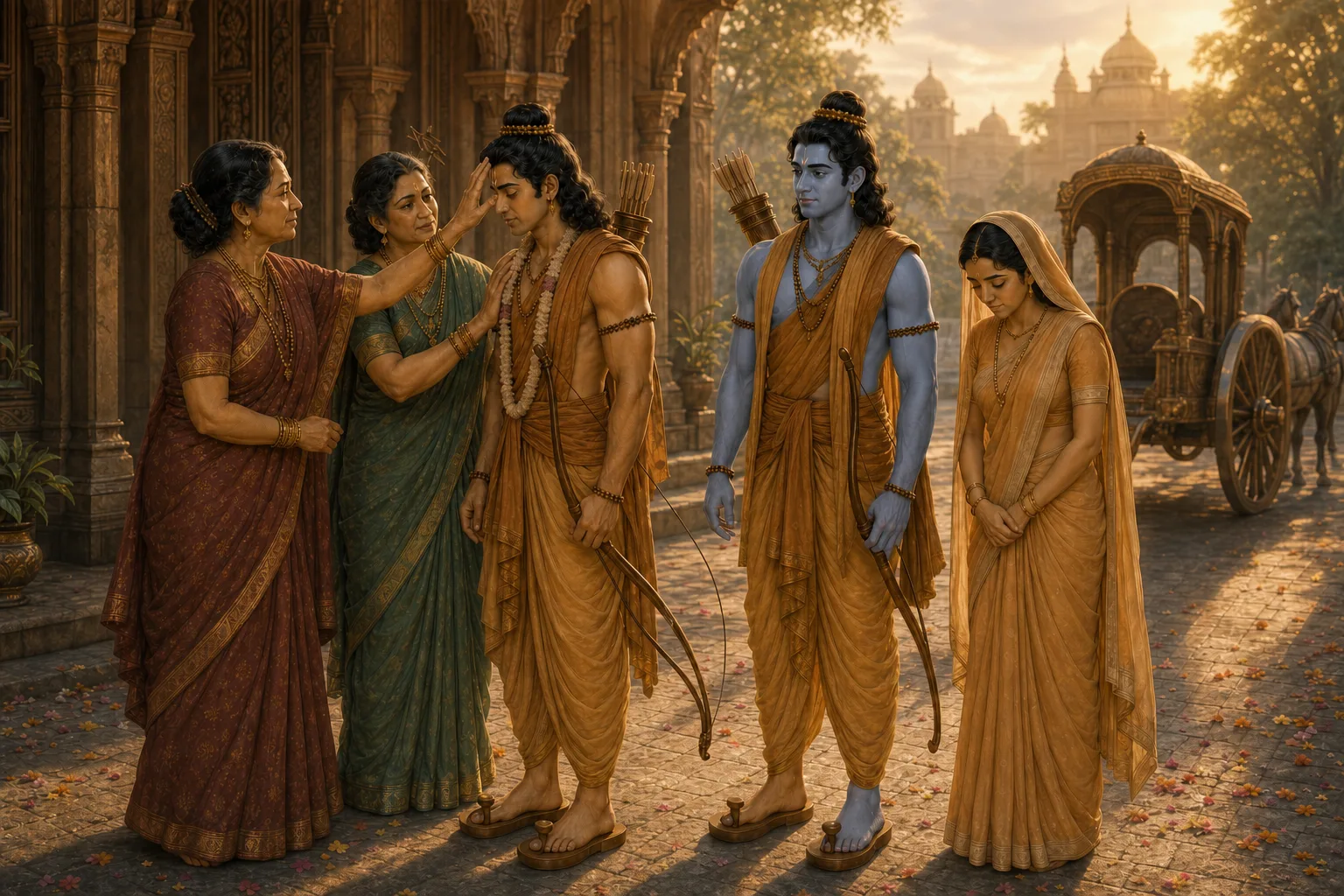
Sumitra called Lakshman close. Her blessing asked more than unquestioning obedience: "Know Ram as your father, Sita as your mother, and the forest as your Ayodhya."
Sita bowed to Kaushalya and the other mothers. Ram asked his father's blessing. Dasharatha was overwhelmed by the separation, but Sumantra's chariot waited at the gate. Sita entered first, followed by Ram and Lakshman. They carried bows and quivers, digging tools, baskets, and a few necessities for forest life—not the display of a victorious royal procession.
As the chariot moved, the people of Ayodhya ran behind it. Dasharatha and the queens came beyond the palace gates. The people begged Sumantra to drive slowly so they could keep Ram in sight; Ram asked him to go faster so the farewell would not prolong everyone's suffering. The charioteer heard grief calling from both directions. At last the chariot passed beyond the city. Ayodhya remained behind in mourning, while three travellers faced a life they could not yet fully imagine.
“Loyalty is strongest when it is freely chosen, carefully prepared, and joined with responsibility for those left behind.”
New stories in your inbox
One story every week, and a special tale on festivals. Free, always.
Your email goes to our newsletter provider (beehiiv) so we can send you stories. It is not linked to any child's reading on this site. Unsubscribe any time from the email footer.