Ramayana · Chapter 10

Ram Lifts Shiva's Bow and the Four Weddings

·Ramayana·3 min read
From the series
Ramayana
Text size

When Shatananda finished Vishvamitra's history, the sage told King Janaka why the princes had come. Ram and Lakshmana wished to see the ancient bow kept in Mithila.

Janaka explained that the bow was associated with Shiva and had been preserved by his family for generations. He also told them about Sita. While preparing the earth during a royal rite, Janaka had found an infant in a furrow. He and Queen Sunaina raised her as their daughter, and her name remembered that furrow.

As Sita grew, Janaka resolved that he would accept as her husband only a person able to lift and string the bow. Many rulers had tried and failed. Some responded to rejection by besieging Mithila until Janaka's allies drove them away. The history made clear that a public condition could bring danger as well as admiration.

Janaka ordered the bow brought out. It rested in a great chest moved by many attendants. Ram did not boast. With Vishvamitra's permission, he approached, lifted the bow, and began to string it.

The bow broke with a sound like thunder.
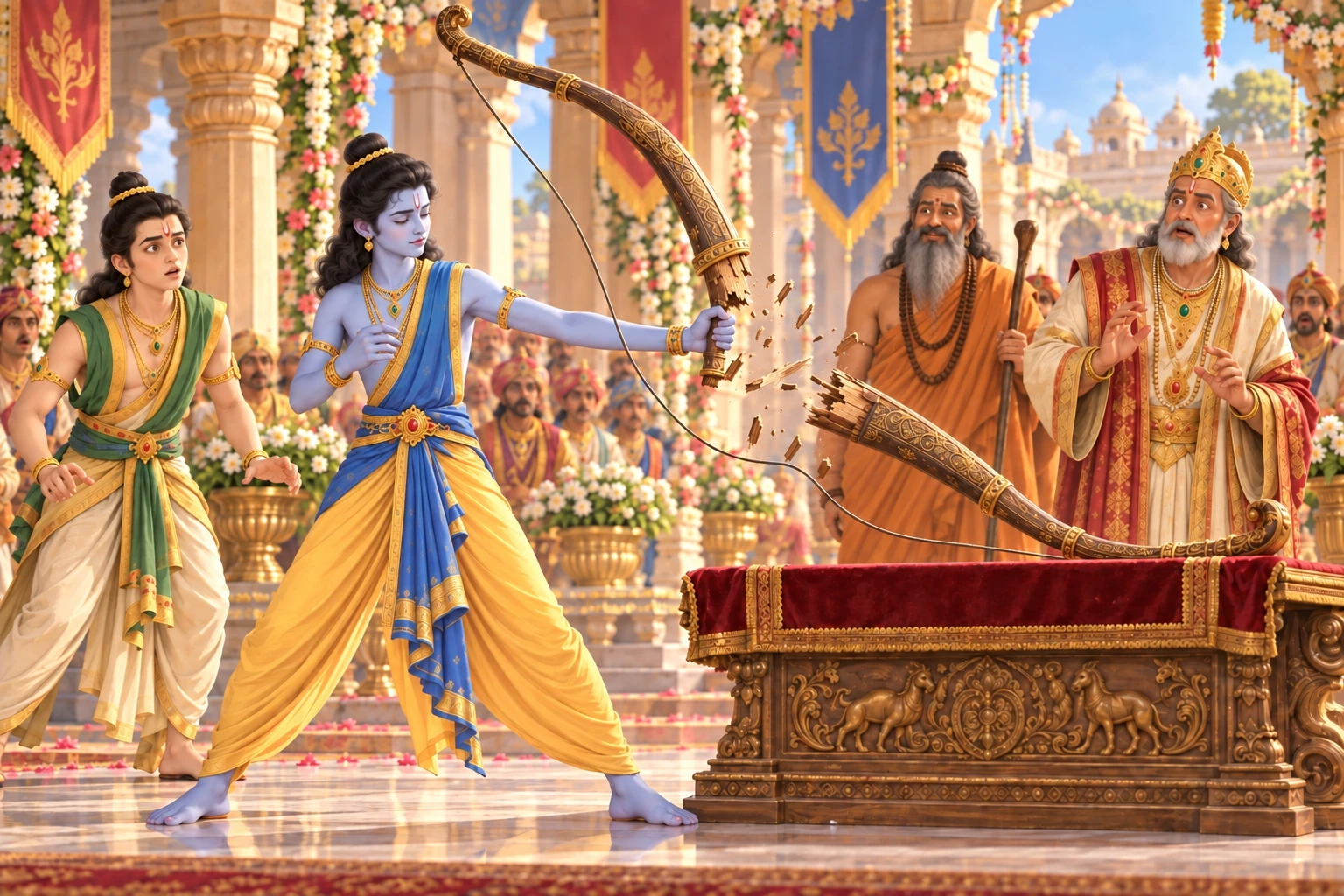
People throughout the hall were astonished. Janaka declared that Ram had fulfilled the condition. Vishvamitra agreed that the news must first be carried to Dasharatha. A marriage would join families and kingdoms; it could not be completed as though only one test mattered.

Messengers hurried to Ayodhya. Dasharatha consulted Vashishtha and his ministers, then travelled to Mithila with Bharata, Shatrughna, relatives, teachers, and gifts. The reunion of fathers and sons was joyful.

Before the weddings, both families recited their lineages. Vashishtha spoke of Ram's Ikshvaku ancestors, and Janaka's family described the line of Nimi and the rulers of Videha. These speeches were more than lists of famous names. They made the proposed relationship public and accountable.

Janaka proposed that Sita marry Ram and that his younger daughter Urmila marry Lakshmana. Janaka's brother Kushadhvaja had two daughters, Mandavi and Shrutakirti; they were matched with Bharata and Shatrughna. The text places the four marriages together, joining the brothers' futures as well as the royal houses.

Preparations filled Mithila. The families gave gifts, honoured guests, and completed the required ceremonies. At the appointed time Janaka placed Sita's hand in Ram's and asked them to walk through life together in dharma. Urmila and Lakshmana, Mandavi and Bharata, and Shrutakirti and Shatrughna were joined in turn.

The poem describes sacred fire, blessings, music, flowers, and celebration. A careful modern retelling should also remember that each bride was a person, not a reward attached to a feat of strength. The source gives little direct dialogue from the young women in these sargas. That silence should not be filled by pretending to quote feelings the text does not record. It should remain visible for editorial discussion and comparison with traditions that give Sita a different presence before the bow ceremony.

After the rites, the four couples prepared to leave Mithila with their families. Ram's journey had begun as a mission to guard a hermitage. It had brought him to a partnership and a new network of relationships whose joys and responsibilities would shape the rest of the epic.

The four newly married couples together in Mithila

How other traditions tell it

Tulsidas, Kamban, regional Ramayanas, performance traditions, and modern retellings often give Ram and Sita a meeting or recognition before the bow ceremony, expand Lakshmana's dialogue, or change the public contest. Valmiki's Bala Kanda 66–73 emphasizes Janaka's account, Ram's lifting and breaking of the bow, formal messages to Dasharatha, reciprocal genealogies, and four linked weddings. This adaptation follows that sequence while refusing to describe Sita as a prize. Marriage agency, royal power, and gender require review.

Source

Primary story based on the Valmiki Ramayana, Bala Kanda, Sargas 66–73. This is a newly written adaptation for children, not a direct translation.

References used for the series record

The moral of the tale

Strength becomes meaningful when families speak openly, promises are examined, and important decisions are joined with responsibility.