Hanuman Gives Ram's Ring to Sita
Ramayana
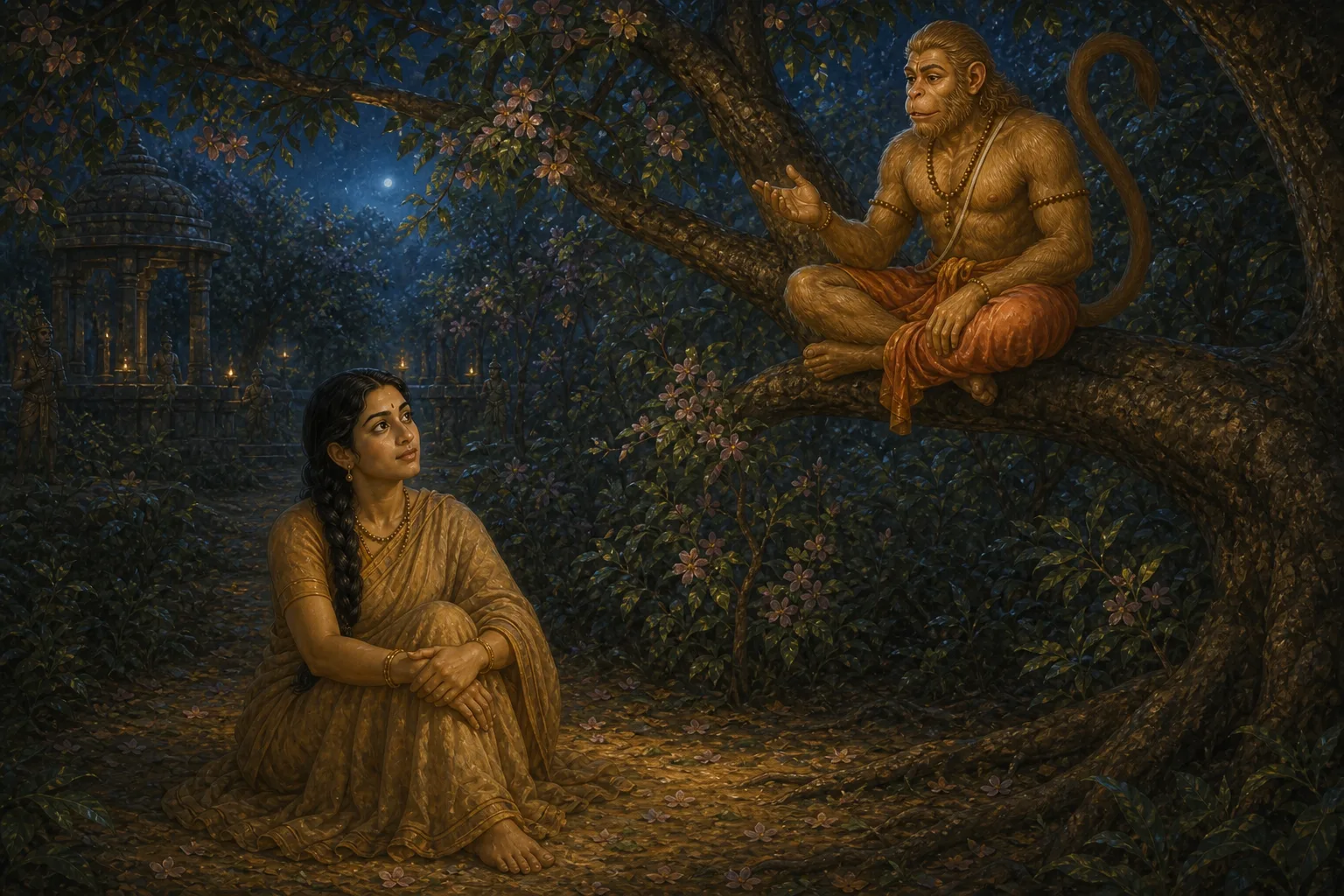
From the branches above the Ashoka grove, Hanuman softly began the story of Ram. He spoke of King Dasharatha, the exile, the life in the forest, Sita's abduction, Ram's grief, the alliance with Sugriva, and the search that had reached the southern ocean. Sita looked upward. These were not random words of comfort; they followed the path of her own life.
Hanuman came down in a small, non-threatening form and bowed from a respectful distance. Sita remained cautious. Ravana and his servants could change form, and hope itself could be used as a trap. She asked who he was, how he knew Ram, and how a vanara had crossed the sea.
Hanuman answered rather than demanding belief. He described Ram and Lakshman, their appearance and character, his first meeting with them near Rishyamuka, Sugriva's alliance, the ornaments Sita had dropped, and the search party's journey. He named himself as Hanuman, servant of Ram and minister of Sugriva.
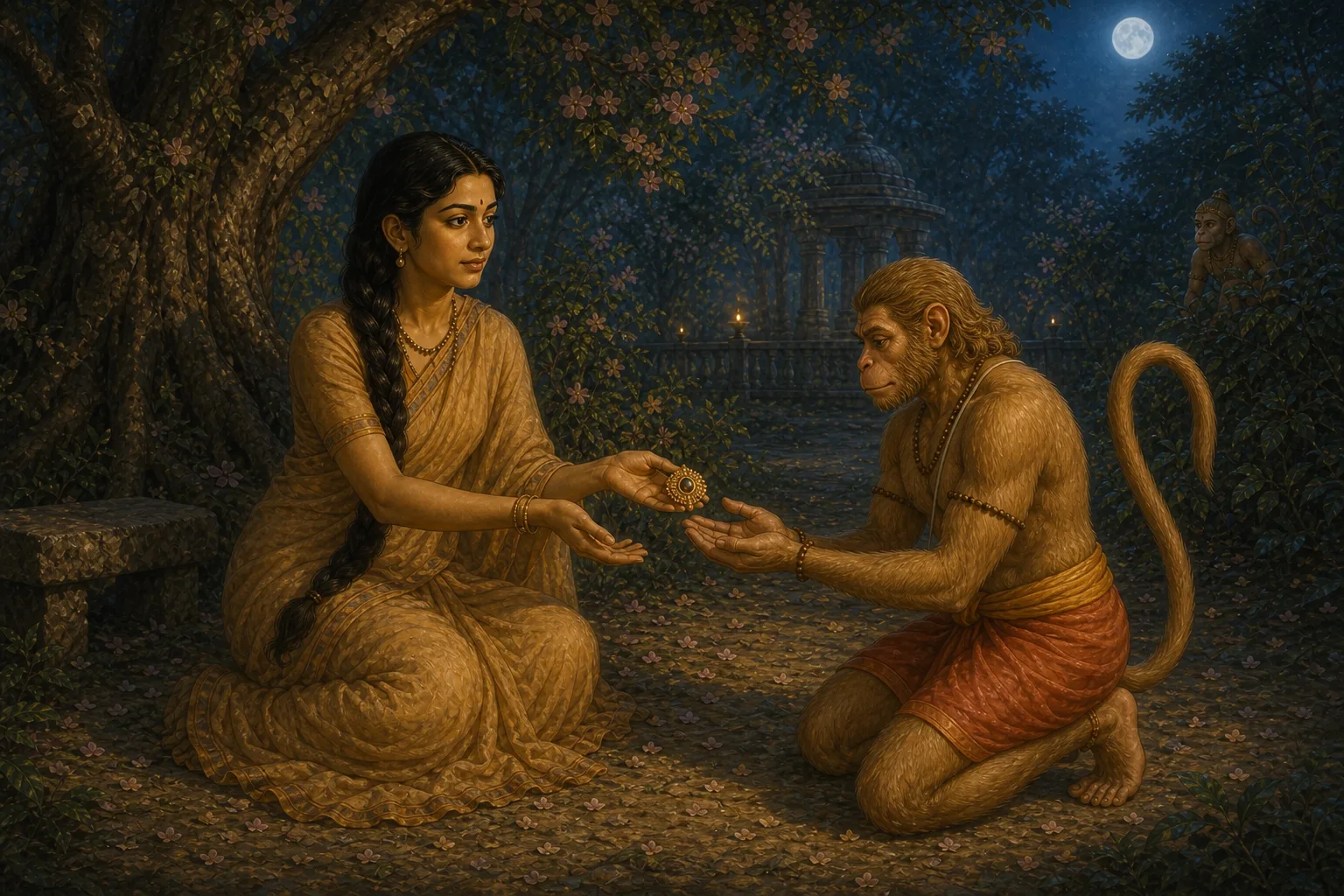
Then he placed a small signet ring upon his open palms. It bore the mark Sita knew. Ram had given it to the messenger so that words from a stranger could be joined with something she could verify.
Sita received the ring and her caution opened into recognition. The object did not erase months of fear, but it proved that the person before her had stood close to Ram and carried his trust.
She asked about Ram and Lakshman. Were they safe? Why had they not yet come? Hanuman did not dismiss the pain behind the questions. He explained that they had only recently learned her location and that Ram would act once Hanuman returned with proof.
Hanuman offered to carry Sita away immediately upon his back. He could enlarge his body and cross the ocean again. The proposal showed his eagerness, but Sita considered dangers he had not fully resolved. His speed could make it difficult for her to hold on. A battle in the sky might expose her to another fall or capture. She would not willingly touch another man except under necessity, and, above all, she wanted Ram to defeat the force that had abducted her rather than leaving Ravana's power unchallenged.
Hanuman accepted her answer.
Sita gave him details that Ram would recognize, including a private memory from Chitrakuta about a crow that troubled her and the blade of grass Ram empowered in response. She also recalled the mark of red mineral Ram once replaced upon her forehead. These memories could not easily have been learned in Lanka.
Finally she removed her chudamani, a jewel kept with her through captivity, and placed it in Hanuman's hands. It was not merely an ornament. It carried memory of her family, her marriage, and the life from which she had been taken.
She asked Hanuman to tell Ram that her endurance had a limit and rescue must come soon. She could hold on, she said, for one month more. Hanuman reassured her without making promises beyond his authority: he would cross back immediately, report exactly what he had seen, present the jewel, and urge Ram and the allies forward.
Before leaving, Hanuman asked for permission to eat fruit from the grove. Beneath the simple question lay another plan. He had found Sita and delivered the ring; now he wanted to assess Lanka's forces and send Ravana a warning. That decision would begin the next, more dangerous stage of his mission.
“Trust grows when words can be tested, signs can be recognized, and each person is free to decide.”
New stories in your inbox
One story every week, and a special tale on festivals. Free, always.
Your email goes to our newsletter provider (beehiiv) so we can send you stories. It is not linked to any child's reading on this site. Unsubscribe any time from the email footer.