The Churning of the Ocean and the Birth of the Maruts
Ramayana
As the travellers continued toward Mithila, Vishvamitra told Ram and Lakshmana why the place they had reached was called Vishala. Its history began with the churning of the Ocean of Milk.
Long ago, the devas and asuras both wanted amrita, the drink associated with freedom from age and death. Neither side could obtain it alone. They agreed to work together, using Mount Mandara as the churning staff and the great serpent Vasuki as the rope.
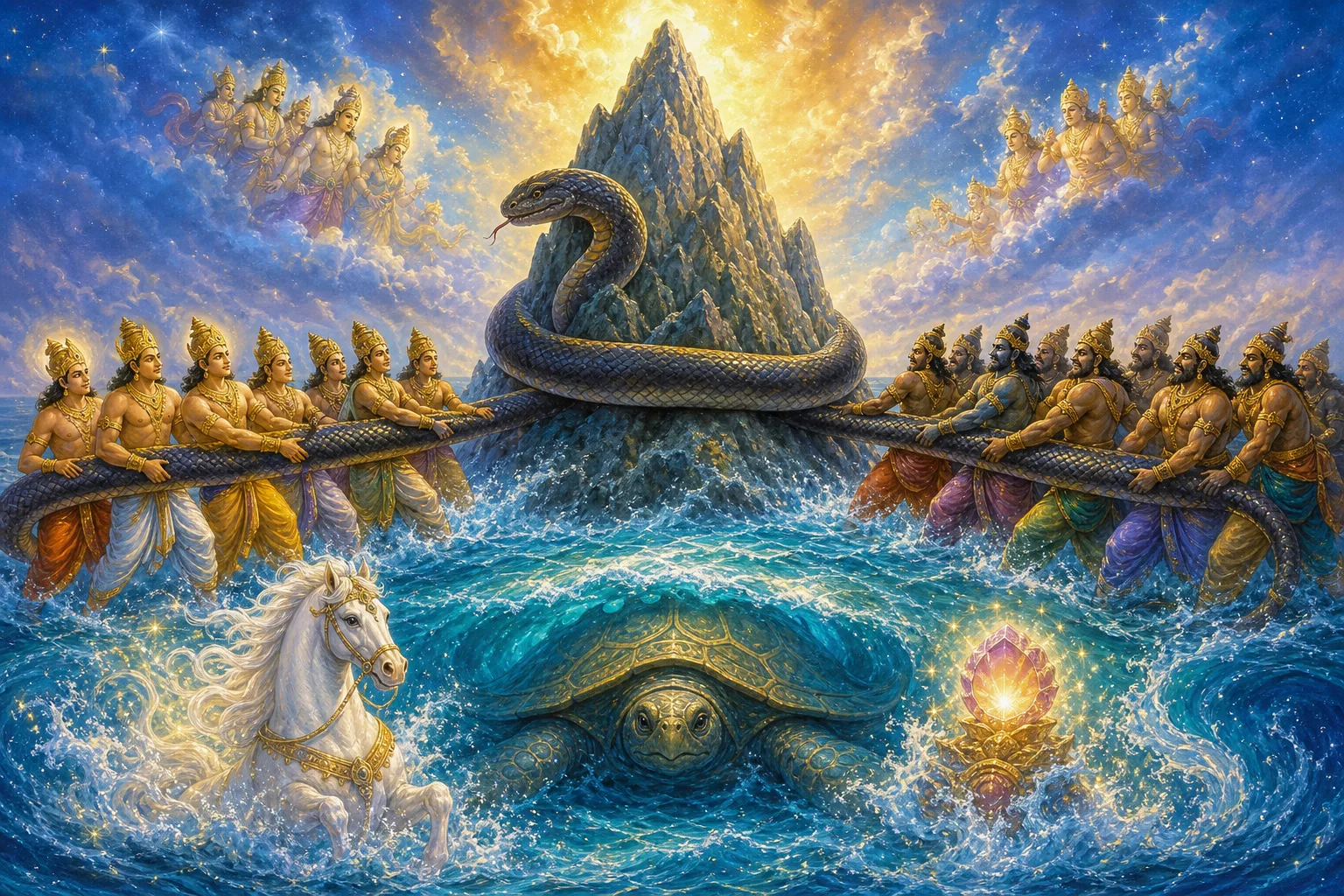
The labour was immense. When the mountain could not remain steady, divine help supported it. As the ocean turned, the first result was not treasure but deadly poison. Shiva received the poison so it would not spread through the worlds. The episode reminds listeners that great undertakings may release dangers no participant expected.
Then wonders emerged: celestial beings, animals, medicines, jewels, and Lakshmi, who chose Vishnu. At last Dhanvantari appeared carrying the vessel of amrita.
Cooperation ended in mistrust. Both sides wanted the result. Vishnu used a captivating form, widely known in later tradition as Mohini, to distribute the amrita to the devas. An asura named Rahu disguised himself and sat among them, but the Sun and Moon recognized him. Vishnu stopped him after the nectar touched his mouth, and the story connects Rahu's continuing anger with eclipses.
The devas prevailed, and Indra again held authority in heaven. But victory did not end every grievance.
Diti, mother of powerful asuras, grieved for children lost in the conflict. She asked her husband Kashyapa for a son strong enough to defeat Indra. Kashyapa gave her a long discipline to follow and warned that it required great care.
Indra came to serve Diti while she observed the vow. His service looked respectful, yet he feared the child she hoped to bear. Near the end of the appointed time, Diti fell asleep without completing one required act of purification. Indra entered the unborn child's space and divided it with his weapon.
Voices cried out. Indra repeatedly said, “Do not weep”—ma rudah. Instead of one child, many beings came forth. Diti awoke and understood what had happened. She asked that the children live and receive an honoured place rather than remain victims of fear.

The beings became the Maruts, storm deities associated with wind, thunder, and Indra's company. The ancient story resolves violence by giving them divine status, but it does not make Indra's secret act compassionate. Fear of a future enemy had led him to harm before a choice could even be made.
Vishvamitra then traced the line from Diti through the region's rulers to King Sumati of Vishala. Sumati welcomed the travellers, asked about Ram and Lakshmana, and listened with wonder to their recent deeds. After a night's hospitality, the company continued toward Mithila.
The two histories belonged together in the landscape: the ocean churning showed rivals cooperating and then fighting over the reward; Diti's story showed how victory and grief could produce another cycle of fear. The travellers carried both lessons onward.
How other traditions tell it
Lists of treasures, the poison episode, Mohini's role, Rahu, and the distribution of amrita vary greatly across Puranic and epic tellings. Valmiki's Bala Kanda 45–47 also moves from the churning into Diti, Indra, the Maruts, and the founding line of Vishala. This adaptation retains that less familiar continuation rather than ending with the nectar. Prenatal violence and adversarial community labels require explicit review.
Source
Primary story based on the Valmiki Ramayana, Bala Kanda, Sargas 45–47. This is a newly written adaptation for children, not a direct translation.
References used for the series record
- Valmiki, The Ramayana, Bala Kanda 45–47; Ralph T. H. Griffith translation: https://en.wikisource.org/wiki/The_Ramayana
- IIT Kanpur, Valmiki Ramayanam, Bala Kanda 1.45–1.47: https://www.valmiki.iitk.ac.in/
“Cooperation can uncover both danger and treasure, and power without compassion can create new harm.”