The Golden Deer and Sita's Abduction
Ramayana
Bent under Ravana's threat, Maricha had accepted a plan he already believed would end in disaster. Following it, he assumed the shape of a wondrous deer and approached Panchavati. Its body shone like gold, patterned with silvery spots and colours that flashed like jewels. It moved near the cottage and then bounded away between the trees. Lakshman immediately grew suspicious. No natural deer looked like this, and he had heard of Maricha's power to change form.
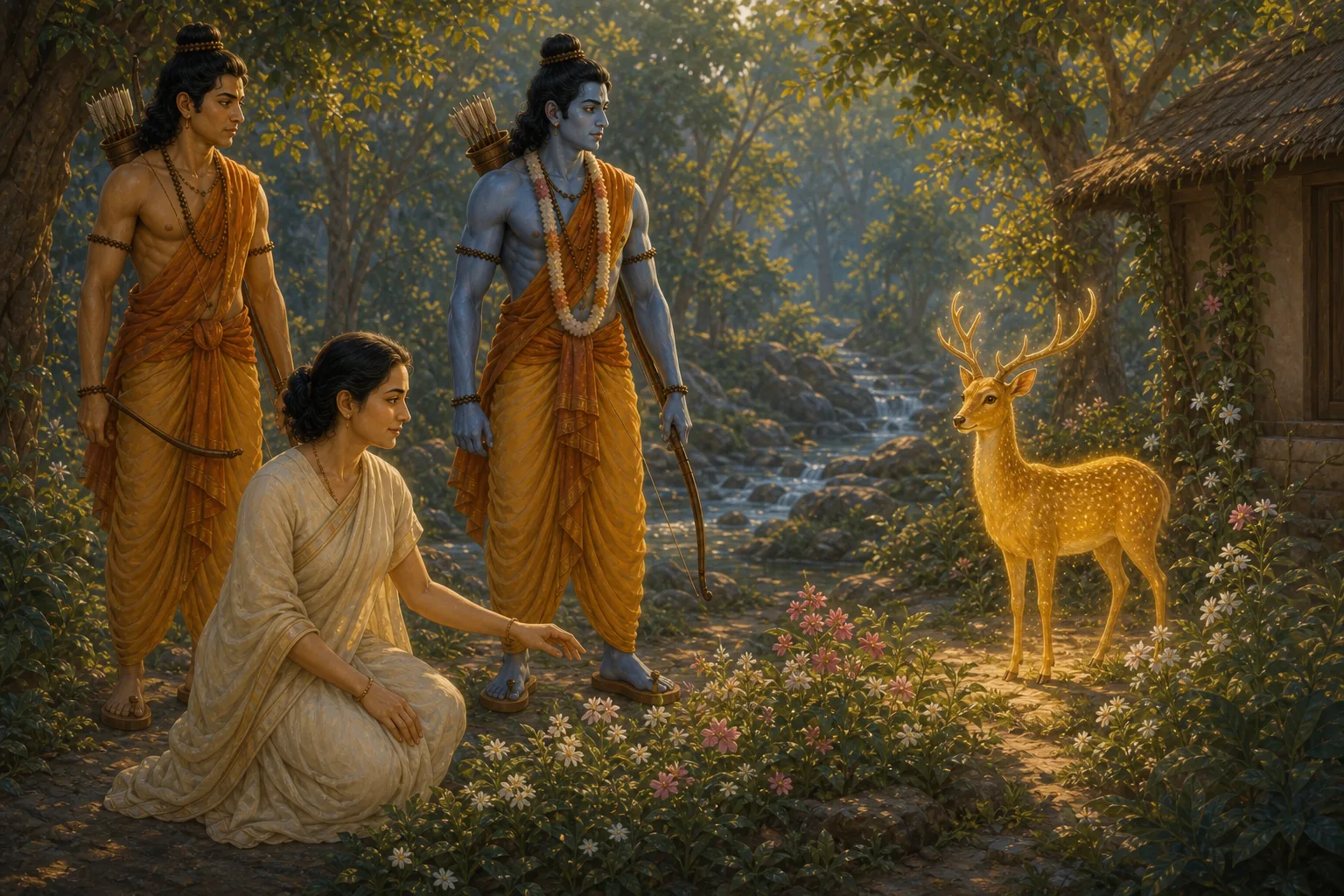
Sita asked Ram to capture it. If it could be taken alive, it might become a companion during exile; if it was truly a dangerous illusion, its threat should be ended. Holding both possibilities in mind, Ram decided to follow it and asked Lakshman to guard Sita.
Maricha drew Ram far into the forest. When Ram's arrow finally struck him, he recovered his true form and copied Ram's voice, crying, "Ah, Sita! Ah, Lakshman!" At the cottage Sita heard the call and was terrified. Lakshman said that no ordinary enemy could overcome Ram and that the cry must be a trick. Fear, however, closed around Sita's thoughts. She spoke harshly and insisted that Lakshman go at once. Hurt by the accusation, Lakshman prayed that the forest powers would protect her and left to find Ram.
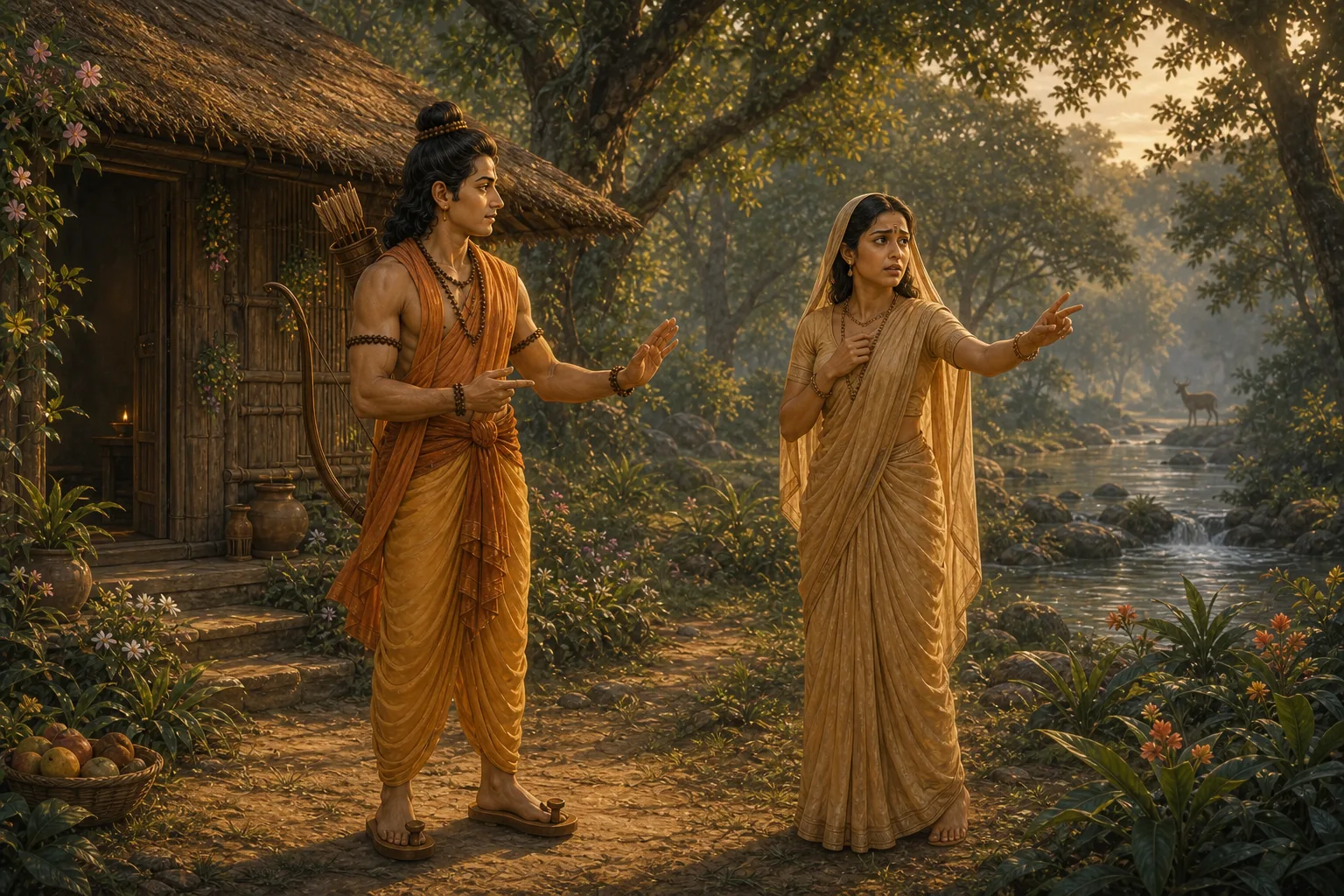
As soon as Lakshman left, Ravana approached disguised as a wandering ascetic. Offering food and water to a guest was a rule of forest hospitality, so Sita received him courteously and introduced herself. Ravana soon revealed his purpose and asked her to become queen of Lanka. Sita refused firmly, declared her devotion to Ram, and warned Ravana of the consequences.
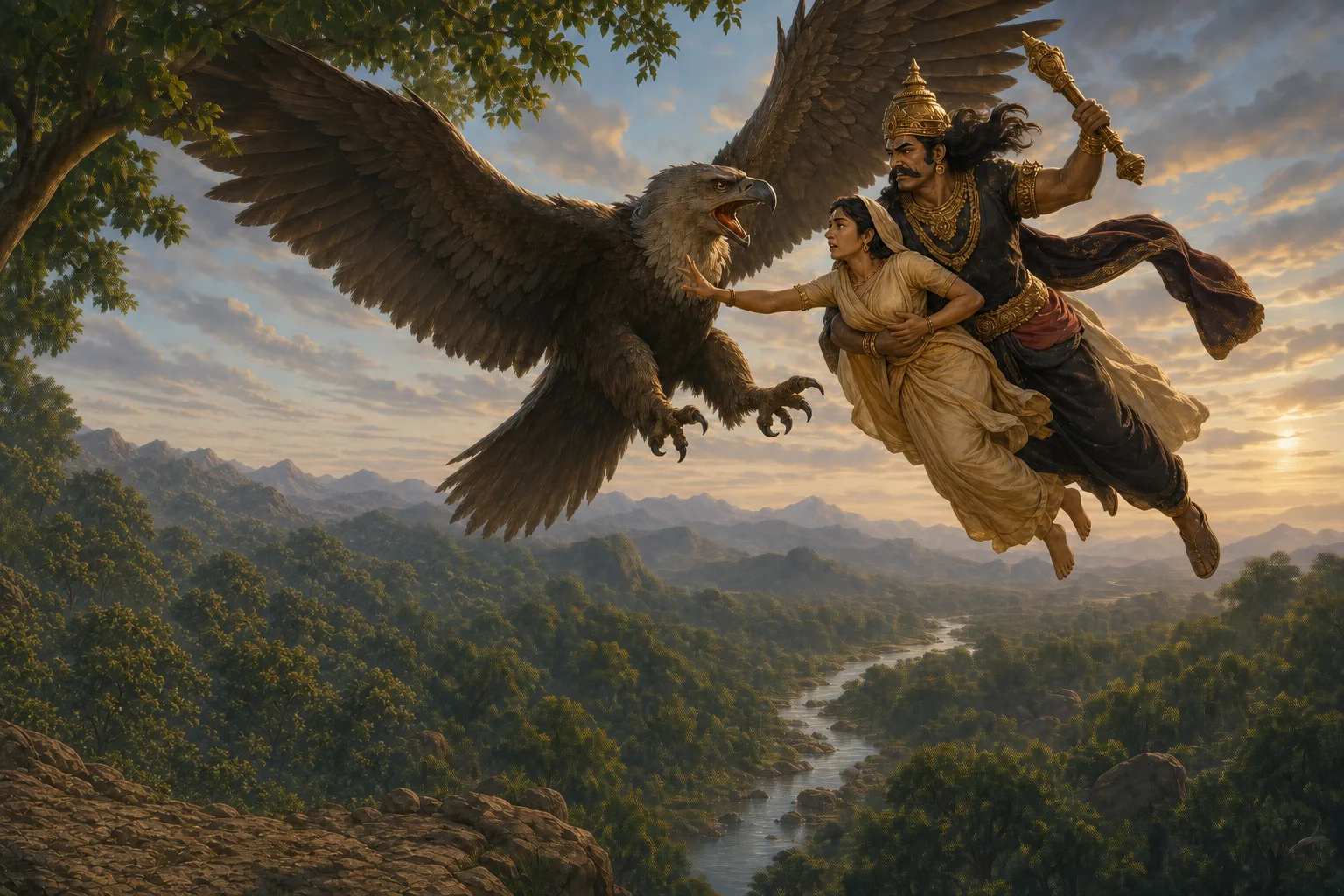
When refusal did not move her, Ravana revealed his terrifying form and carried Sita away by force. She called for help, asked the trees, river, and forest creatures to tell Ram what had happened, and continued to resist.
The elderly Jatayu heard her cries. He blocked Ravana and declared that taking a wife while her husband was absent was cowardly and wrong. Though advanced in years, Jatayu rose into the sky. He broke Ravana's bow, damaged his chariot, and tried to free Sita. Ravana struck his wings with a sword, and Jatayu fell toward the earth. Even as he fell, his courage gave Sita one more chance to call for help.
During the journey Sita saw several vanaras below and dropped a small bundle of ornaments, hoping it might become a sign for Ram. In Lanka, Ravana showed her palaces and wealth in another effort to change her answer. Sita refused again. She was confined in the Ashoka grove under guard, where she placed even a blade of grass between herself and Ravana as a boundary and held to the hope that Ram and Lakshman would find her.
Meanwhile, Ram understood Maricha's false cry and hurried back. Meeting Lakshman on the path, he feared that the plan had succeeded. The brothers ran toward Panchavati, but the cottage stood empty. The golden deer's radiance had vanished, and the hardest search of their lives had begun.
“Deception works by separating people from trust and help; responsibility belongs to the deceiver, never to the person deceived.”
New stories in your inbox
One story every week, and a special tale on festivals. Free, always.
Your email goes to our newsletter provider (beehiiv) so we can send you stories. It is not linked to any child's reading on this site. Unsubscribe any time from the email footer.