Valmiki and the First Ramayana
Ramayana
Before the Ramayana became a story recited in homes, temples, theatres, and village squares, it began with a question.
Sage Valmiki had spent years studying, observing the world, and teaching his students. Yet one thought troubled him. People often praised one virtue at a time: courage, truthfulness, kindness, patience, wisdom, or loyalty. Valmiki wondered whether all these qualities could live together in one human being.
One day the wandering sage Narada visited his hermitage. Narada was known as a traveller through many worlds and a keeper of countless stories. Valmiki welcomed him and asked the question that had been growing in his mind.
"Is there anyone living today who is brave and gentle, powerful and self-controlled, truthful, grateful, wise, and devoted to the good of others? Is there a leader who keeps his word even when doing so is difficult?"
Narada did not pretend that such a person was easy to find.
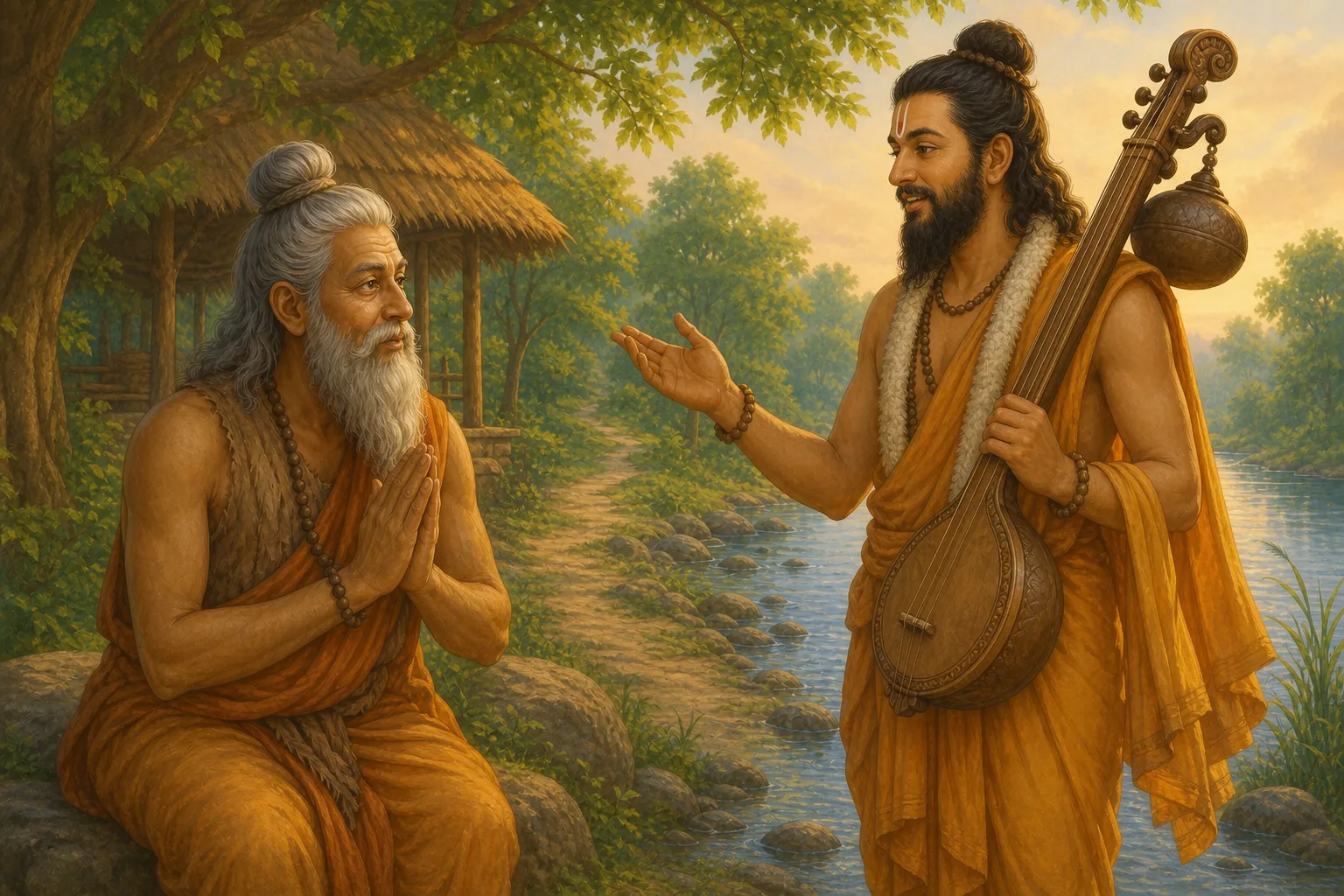
"The qualities you name are rare," he said. "But there is one whose life you should know. His name is Ram, a prince of the Ikshvaku line and the eldest son of King Dasharatha of Ayodhya."
Narada described Ram as strong without being careless with strength, learned without being proud of learning, and slow to anger. He cared for the people of his kingdom and tried to act according to dharma—the difficult work of choosing and fulfilling what is right.
Then Narada told Valmiki the shape of Ram's whole life. He spoke of the coronation that was planned and the exile that took its place. He told how Sita and Lakshman chose to go with Ram into the forest; how Bharat refused to profit from his brother's absence; how Sita was carried away; and how friendship with Hanuman and Sugriva opened a path toward Lanka. He spoke of the search, the ocean crossing, the war, the return to Ayodhya, and Ram's coronation.
It was only an outline, swift as a river seen from high above. Within it lay questions of love, duty, grief, justice, power, and consequence that would take a much longer poem to explore.
After Narada departed, Valmiki walked with his student Bharadvaja to the clear waters of the Tamasa River. The current was gentle, and the water was so transparent that the riverbed could be seen below.
Nearby, two krauncha birds moved together without fear. Suddenly, a hunter's arrow struck one of them. The surviving bird cried out over its fallen companion.
Valmiki was overcome by grief and compassion. Words rushed from him, condemning the needless killing. A moment later he grew still. His sorrow had taken an unexpected form: the words had fallen into a balanced rhythm.
"What I spoke in grief has become a verse," he said to Bharadvaja.
That was the first shloka—a verse born when sorrow found a voice.
Back at the hermitage, Valmiki continued to think about the birds and the rhythm of his words. Then Brahma, the creator, appeared before him. Valmiki rose, welcomed his guest, and offered him a seat.
Brahma told the sage to compose the life of Ram in that new poetic measure. Events Valmiki had not personally witnessed would become clear to him, Brahma said, and the poem would endure as long as mountains stood and rivers flowed.
Valmiki entered deep meditation. He saw the people in Ram's story not as pieces moved across a board, but as people speaking, deciding, hoping, misunderstanding, grieving, and beginning again. He saw public deeds and private conversations, palaces and forest paths, celebrations and losses. He saw that a truthful story must make room for both noble ideals and painful consequences.
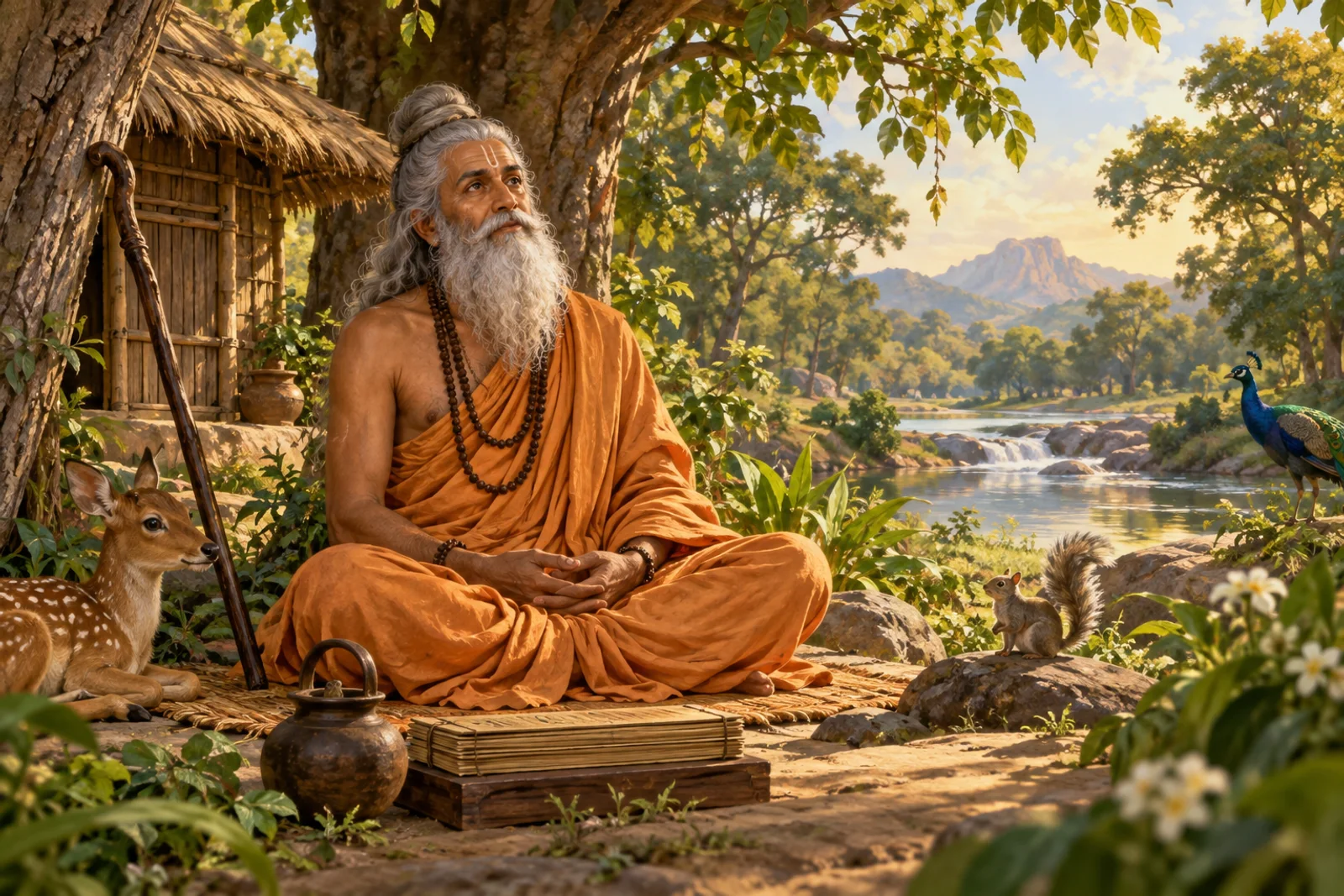
He shaped what he saw into thousands of verses, arranged in books and chapters. The poem held grand journeys and battles, but also quiet moments: a promise remembered, a brother listening, a messenger choosing his words, and a person refusing to abandon someone in sorrow.
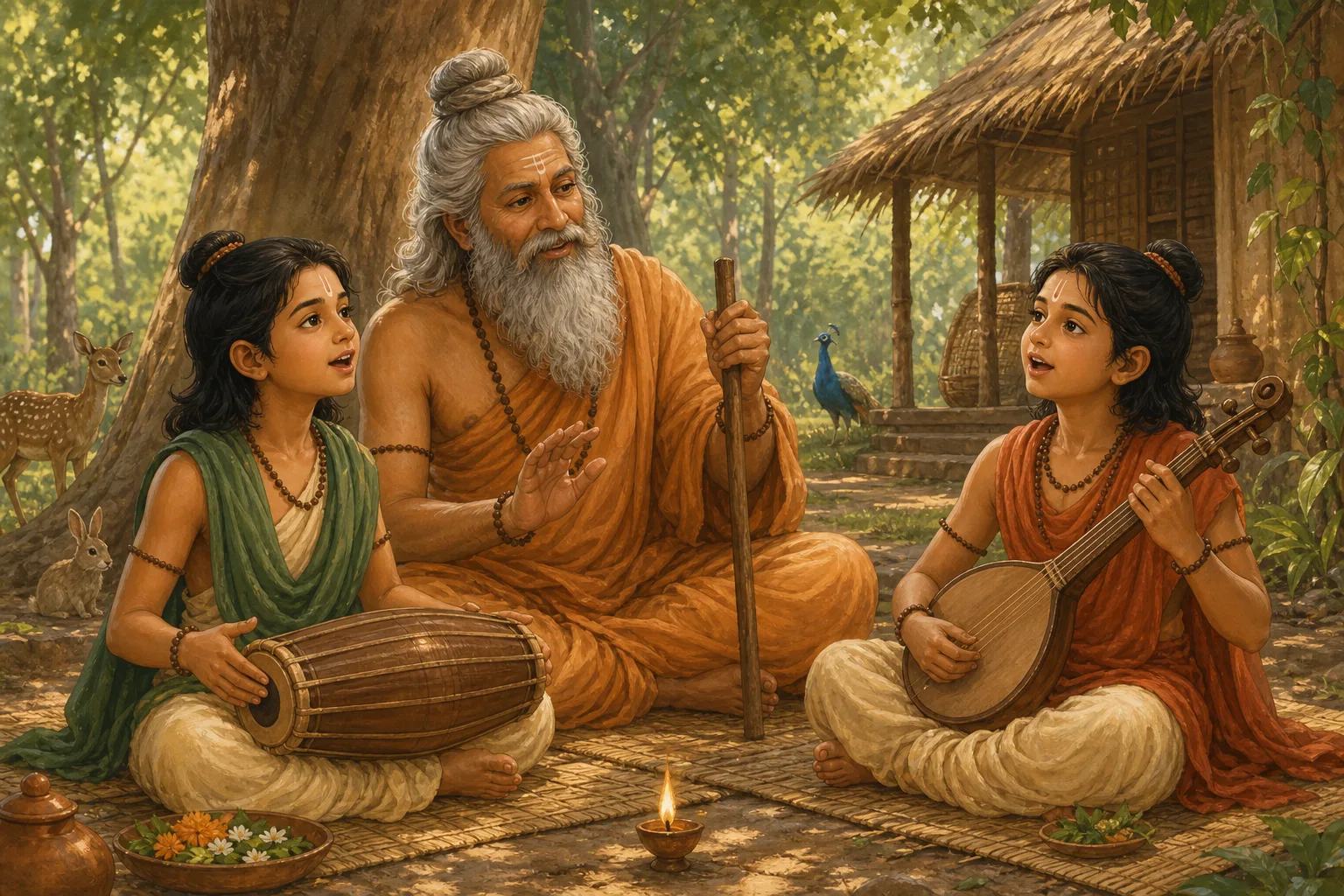
At Valmiki's hermitage lived two young brothers, Luv and Kush. They learned the Ramayana from the sage—its exact words, its melody, its rhythm, and the feelings carried within it. They trained their voices until they could sing together with clarity. They did not hurry through scenes of sadness or turn moments of courage into empty boasting.
The brothers began to perform the poem before gatherings of sages. Listeners were moved because the singers did more than remember the verses: they understood the human feelings inside them.
In time, Luv and Kush carried the song beyond the hermitage. The story travelled from voice to voice. Each listener received a long and complex inheritance—a tale to love, question, remember, and tell again with care.
“A story told with truth and compassion can travel farther than its teller.”
New stories in your inbox
One story every week, and a special tale on festivals. Free, always.
Your email goes to our newsletter provider (beehiiv) so we can send you stories. It is not linked to any child's reading on this site. Unsubscribe any time from the email footer.