Hanuman Enters and Searches Lanka
Ramayana
From the wooded height of Trikuta, Hanuman studied Lanka before entering it. The city stood behind high walls and deep defences. Broad roads, towers, gardens, gateways, and many-storeyed houses shone under the moon. Ravana had built power into the city's very shape; an open assault by one messenger would accomplish nothing.
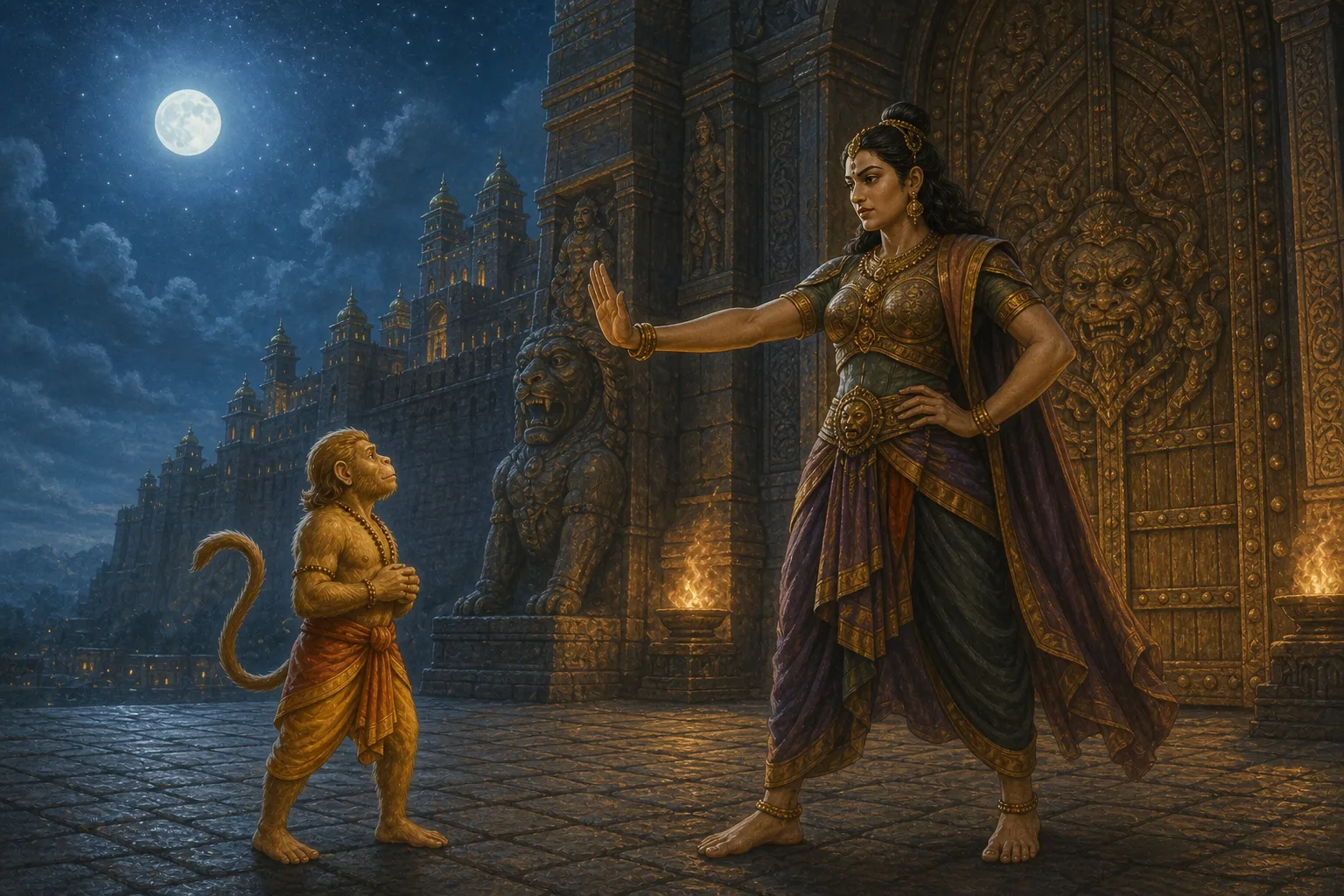
Hanuman reduced himself to a form as small as a cat. He would enter at night, observe before acting, and leave no sign that might place Sita in greater danger. At the northern gate he met Lankini, the guardian spirit of the city. She demanded to know why a stranger was slipping inside.
Hanuman first answered politely, saying that he wished to see the famous city. Lankini attacked when he would not retreat. He answered with one controlled blow, using only enough force to pass. She fell, rose again, and did not continue the fight. Instead, she remembered an old prediction: when a vanara overcame her, the end of Ravana's wrongdoing would be near. She allowed Hanuman to enter.
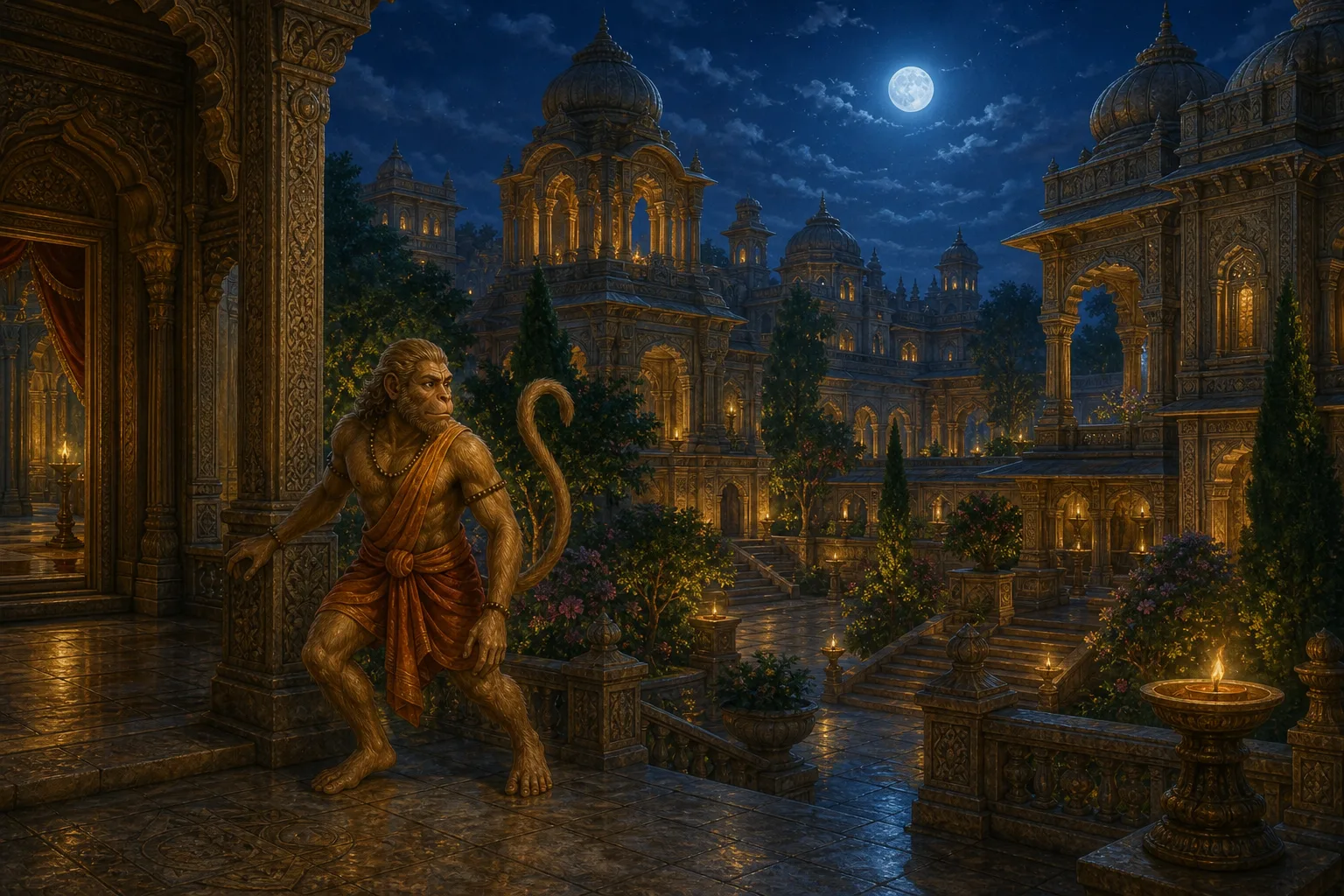
Hanuman stepped over the wall rather than walking proudly through the gate. Inside, he heard music, conversation, ritual recitation, weapons being checked, and families settling for the night. Lanka was not an empty fortress. It held soldiers and officials, but also homes, animals, gardens, craftspeople, and many lives caught within Ravana's rule.
He searched streets, courtyards, towers, and gardens. He saw richly decorated residences belonging to Ravana's commanders and relatives. He entered Ravana's palace, where lamps reflected from gold, crystal, carved wood, and polished floors. The Pushpaka aerial chariot stood there, obtained by Ravana from his half-brother Kubera. Its beauty did not make the way it had been taken just.
The search brought Hanuman into private rooms where people slept. Hanuman paused. Was it wrong to look upon women in their private quarters? Hanuman examined his own intention. He felt no desire to intrude and took no pleasure in what he saw. Sita could only be found by looking wherever a captive might be held. Even so, he remained as unobtrusive as possible and moved on as soon as he knew she was not there.
For a moment he mistook Mandodari, sleeping in royal surroundings, for Sita. He immediately corrected himself. Sita, separated from Ram and held against her will, would not be resting in comfort or wearing the signs of a queen in Ravana's household. The error taught him not to let hope outrun evidence.
He searched kitchens, halls, terraces, underground rooms, ponds, groves, and the spaces around the palace. Again and again he found no sign of Sita. Despair began to press upon him. Perhaps Sampati had been mistaken. Perhaps Sita had died during the journey. Perhaps Hanuman had passed her without recognizing her. Each possibility carried consequences for Ram, Lakshman, Sugriva, Angada, and the searchers waiting across the sea.
Hanuman did not turn uncertainty into a false report. He reviewed what remained unsearched. Beyond the palace stood a carefully guarded grove filled with Ashoka trees. Its protection was unusual, and a captive might be kept away from the ordinary household. He offered a quiet prayer to Ram, Lakshman, Sita, the guardians of the directions, and the powers that supported a truthful mission.
Then he moved toward the grove. Concealed among leaves, he saw a great shimshapa tree, guarded paths, and rakshasi attendants. Beneath the tree sat a woman in worn clothing, thin from sorrow but holding herself with unmistakable dignity.
Hanuman did not rush forward. Finding someone who might be Sita was not the same as proving it. He settled among the branches to watch, listen, and gather signs. The long search through Lanka ended not with a shout of discovery, but with disciplined silence.
“A difficult duty requires both persistence and respect for the boundaries of others.”
New stories in your inbox
One story every week, and a special tale on festivals. Free, always.
Your email goes to our newsletter provider (beehiiv) so we can send you stories. It is not linked to any child's reading on this site. Unsubscribe any time from the email footer.