The Four-Direction Search
Ramayana
When the vanara leaders had assembled, Sugriva transformed a promise into a plan. One group could not search the whole world by following a single road. He divided the effort into four directions, appointed commanders, named places to examine, and set a time for return.
Vinata would lead the eastern party. Sushena, Tara's father, would lead the west. Shatabali would lead the north. The southern search—the direction in which Sugriva had seen Sita carried—was entrusted to young Angada, with Hanuman, the elder Jambavant, Nila, and other experienced companions.
Sugriva described rivers, kingdoms, islands, forests, deserts, mountains, caves, and seas. Some places can be connected with remembered geography; others belong to the poem's vast literary cosmography, where mountains shine, distant peoples live at the world's edges, and the sun's course becomes part of the landscape. These descriptions should be read as the epic's map of wonder and knowledge, not silently relabelled as an exact modern atlas.
He gave every party the same central duty: look carefully, ask those who might have seen a captive traveller, do not pass over difficult terrain merely because it is unfamiliar, and return within one month with an honest account. Finding Sita mattered, but so did knowing where she was not.
Before Hanuman left, Ram drew him aside. Sugriva had identified Hanuman as the person most capable of adapting when strength alone was insufficient. Ram placed his ring in Hanuman's care. If he found Sita, the ring would show that the messenger truly came from Ram.
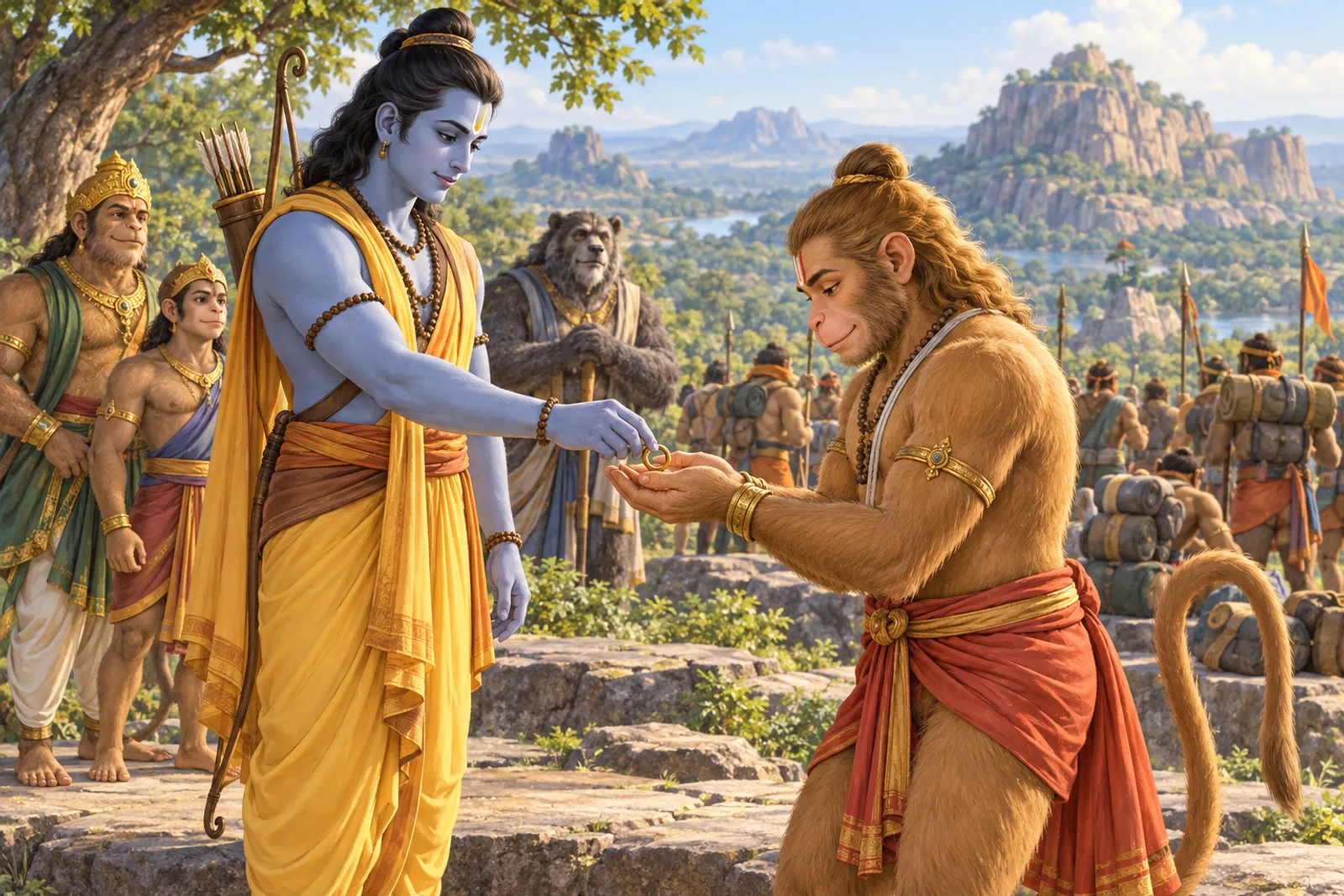
The search parties bowed, separated, and followed the four great routes. The forest terrace emptied into movement.
The southern party crossed the Vindhya region, searched riverbanks and remote settlements, entered forests with little food, and examined caves where a captive might be hidden. They found no reliable trace. Days passed, supplies diminished, and the one-month limit drew near.
In a dry region they came upon a vast opening in the earth. Birds with wet wings flew from it, suggesting water inside. The searchers entered, hoping the hidden place might contain either Sita or a path onward. Darkness swallowed the entrance. They held one another so no one would be lost and moved for a long distance before light appeared.
Within lay Rikshabila, a hidden world of trees, clear pools, fruit, and structures that seemed to glow in the cave. Its beauty did not make it safe to wander without permission. An elderly ascetic named Svayamprabha cared for the place. She asked who they were and why an armed, exhausted company had entered.
Hanuman answered without hiding their purpose. He described Ram's exile, Sita's abduction, Sugriva's promise, and the search deadline. Svayamprabha offered water and food before demanding further effort from travellers who were near collapse. Hospitality restored their ability to think.

The searchers then learned that the cave could not be escaped by simply retracing its paths. Svayamprabha used the spiritual power gained through long discipline to bring them safely outside. She asked them to close their eyes during the passage. When they opened them, they stood near the southern sea, with the Vindhya behind and an immeasurable ocean ahead.
Rescue brought another shock: more time had passed than they understood inside the cave. The deadline had expired.
Angada feared returning without Sita or news. He expected Sugriva to remember that he was Vali's son and punish him for failure. In despair he proposed remaining on the shore and refusing food until death rather than facing the king. Several exhausted companions agreed.
The proposal belongs to the source, but it is a crisis—not a practice to admire or imitate. Hunger and fear had narrowed the group's sense of available choices. Hanuman and Jambavant kept speaking with Angada. A missed deadline did not prove that every path was closed. They could report truthfully, continue searching for a way across the sea, or seek new knowledge from the unfamiliar coast. The group shared water and remained together rather than leaving Angada alone with despair.

As they discussed Jatayu's death and the terrible distance they had travelled, another listener heard them. High on the cliff lived Sampati, an aged bird whose history was tied to Jatayu's. At first his arrival frightened the exhausted vanaras. Yet the name of his brother changed the encounter.
The four-direction plan had not failed because one party missed its date. It had brought the southern searchers to the one shore where a witness could finally tell them what lay across the sea. Their problem was about to change from “Where is Sita?” to “Who can reach her?”
Source and editorial boundary
Primary story based on the Valmiki Ramayana, Kishkindha Kanda, Sargas 40–55. It retains Sugriva's four-direction instructions, the epic geography, the southern party's leadership, Ram's ring, the difficult search, Rikshabila, Svayamprabha's hospitality and rescue, the expired deadline, and Angada's proposal to fast until death.
The geography is identified as literary cosmography where appropriate rather than forced into modern coordinates. The threatened fast is retained as evidence of fear and exhaustion, but explicitly treated as a dangerous crisis; the illustration shows companionship, water, and counsel rather than self-harm.
References used for the series record
- Valmiki, Ramayana, Kishkindha Kanda 40–55, checked through the IIT Kanpur verse-level presentation: https://www.valmiki.iitk.ac.in/
- Ralph T. H. Griffith, public-domain English Ramayana, Kishkindha Kanda: https://en.wikisource.org/wiki/The_Ramayana
“A difficult search needs clear responsibilities, truthful reporting, care for exhausted companions, and the courage to revise a failed plan.”