Hermitages of the Dandaka Forest
Ramayana
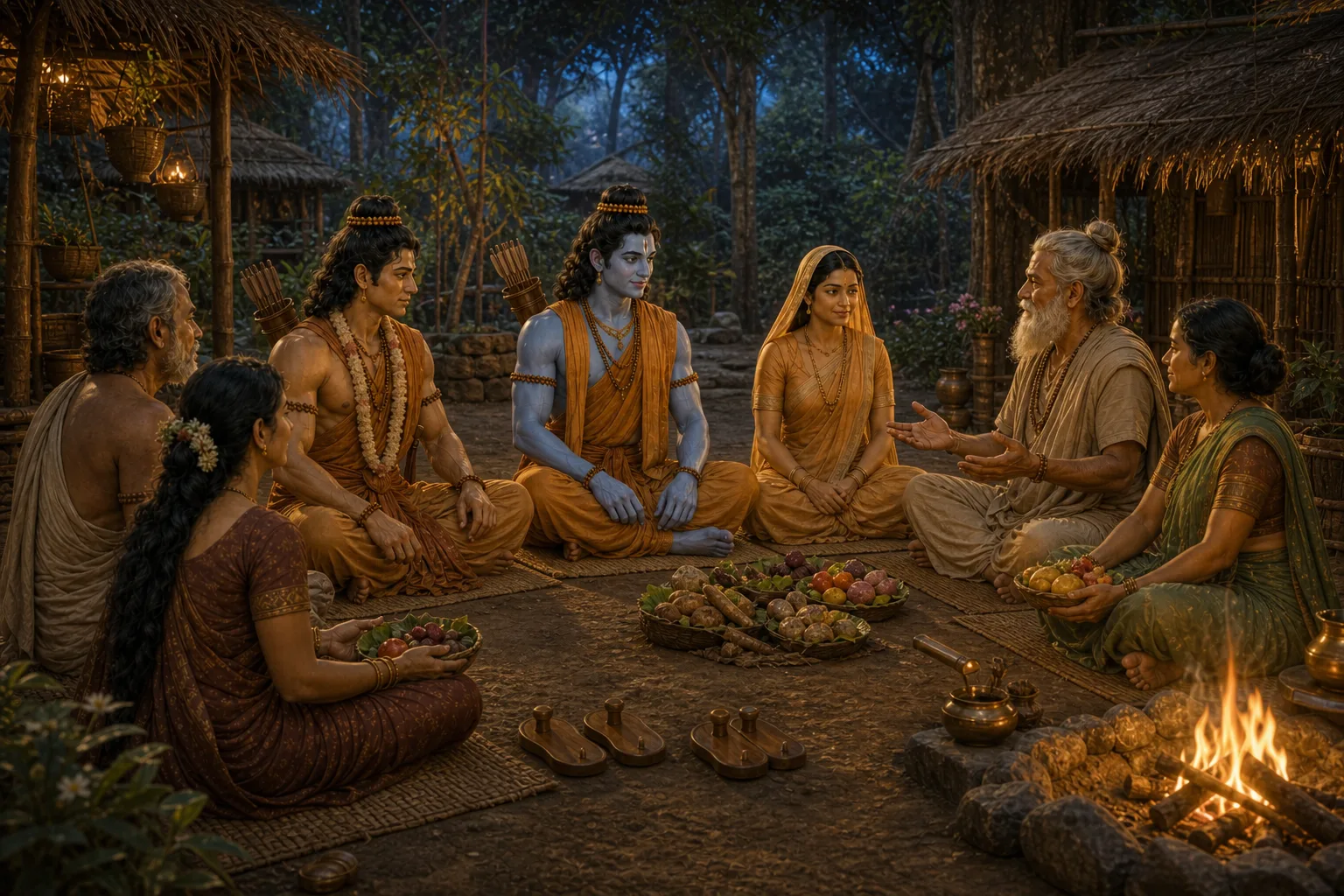
Beyond Chitrakuta, Ram, Sita, and Lakshman entered the deep Dandaka forest. It was not an empty wilderness. Ascetics lived in many hermitages, tended sacred fires, gathered forest food, studied, and welcomed travellers. Deer moved without fear near the paths, and birds called above the pools. The residents offered the three visitors roots, fruit, flowers, and a safe place to rest.
Not every meeting was peaceful. A powerful forest warrior named Viradha blocked their way and seized Sita by force. Ram and Lakshman first ordered him to release her and then used their arrows. A boon prevented weapons from killing him. In the struggle, the brothers broke his arms and restrained him beneath the earth—a violent episode from the ancient poem presented here without bodily detail. Defeated, Viradha recovered an earlier memory. He said that he was the gandharva Tumburu, trapped in this form by a curse. He directed the travellers toward Sage Sarabhanga and was released from the curse.
Near Sarabhanga's hermitage, Ram glimpsed Indra's celestial chariot departing. The elderly sage explained that he had waited to see Ram. He then entered a ritual fire, leaving his aged body and, in the poem, rising in a radiant youthful form toward a higher world. This difficult scene belongs to an ancient ascetic tradition; it must not be treated as an action for a child or adult to imitate.
Ascetics gathered there showed Ram the remains of people killed in attacks and asked for protection. Violent bands had entered hermitages, destroyed food, and taken lives. Ram promised to defend them. Yet the word rakshasa cannot responsibly be extended to every unfamiliar forest resident or distinct community. Accountability in this story belongs to specific harmful acts—not to appearance, ancestry, or the fact of living in a forest.
The travellers reached Sage Sutikshna's hermitage and received affectionate hospitality. The next day, Ram spoke of visiting the many communities of Dandaka. Before they continued, Sita raised an important question. Falsehood, desire for another person's partner, and hostility without cause, she said, can draw the mind away from dharma. Ram was far from the first two, but constantly carrying weapons might invite the third. As fuel kept beside fire easily ignites, weapons can feed anger and suspicion. Exile was also a time for restraint; holding a bow must not turn every stranger into an enemy.

Ram did not dismiss Sita's counsel. He answered that he would not abandon his promise to protect people who had sought help, yet neither was his purpose to search for battle without cause. Their discussion did not end with one easy victor. Sita named a necessary limit, and Ram named a responsibility. They carried both ideas forward—remaining watchful without declaring difference itself a crime. Lakshman heard the exchange too. Protection could require drawing a bow, but it could also require knowing when not to draw it.
For years they moved from hermitage to hermitage, staying for months in some places and a full year in others. They saw mountains, rivers, lotus-filled lakes, and forests alive with animals and birds. At Lake Panchapsara they heard music without seeing its source, and the ascetic Dharmabhrit related its old story. Nearly ten years of exile passed in this way. Eventually they returned to Sutikshna and asked permission to visit the renowned Sage Agastya.
They first stayed with Agastya's brother. Along the road, Ram recounted the old story of Ilvala and Vatapi's deadly deception and how Agastya had ended it. That was an account of particular wrongdoers in the past, not a description of every person living before them. The following day they approached Agastya's hermitage. The calm of the animals and trees signalled that they were near. Lakshman announced their arrival, and the three were received with honour.
Agastya gave Ram a great bow associated with Vishnu, two inexhaustible quivers, a sword, and armour. These weapons were not ornaments or permission to dominate the forest; they were entrusted for defence against genuine danger. Agastya praised Sita's steadfastness through the difficult journey. The source poem places an unfair generalization about women around this praise. This retelling does not teach that prejudice as truth. One person's constancy does not require insulting an entire gender for comparison.

Ram asked for a place with water, trees, and food where Sita could live contentedly. Agastya recommended Panchavati beside the Godavari, a beautiful and practical area around five great banyan trees. On the way, the travellers saw an enormous old vulture. The brothers were cautious at first; in an unfamiliar forest, trusting every appearance immediately would not be wise. Then the bird spoke gently: “Ram, know me as a friend of your father.”
He was Jatayu, son of Aruna and Shyeni, younger brother of Sampati, and an old companion of Dasharatha. He mourned the king's death and offered to help guard Sita whenever Ram and Lakshman were away. Ram embraced him with the respect due to a father's friend. Jatayu did not replace anyone's responsibility; he became an elderly ally who knew the forest.

At Panchavati, Ram selected ground near the Godavari but high enough to be safe from flooding, with level land and access to water, fruit, flowers, and firewood. Lakshman built a strong leaf cottage from timber, bamboo, grass, and clay. Ram praised his skill and service. Sita organized the dwelling, and the three observed a simple rite before entering their new home.
Autumn passed and winter arrived. One cold morning they walked toward the Godavari. Lakshman described the ripe fields, mist, icy water, and Bharat enduring a restrained life far away at Nandigrama. In his sorrow he criticized Kaikeyi, but Ram stopped him, asking that their mother not be belittled and that they speak instead of Bharat's gentle words. Their home at Panchavati was not the end of exile. It was a pause before greater trials—a place where listening, restraint, and cooperation became their most necessary preparation.
Source
Primary story based on the Valmiki Ramayana, Aranya Kanda, Sargas 1–16. It retains the entry into Dandaka, Viradha's attack and release, Sarabhanga's ritual death, the sages' request, Sita and Ram's debate about weapons, the long hermitage journey, Agastya's gifts, Jatayu's introduction, the Panchavati dwelling, and the winter conversation about Bharat and Kaikeyi. Violence is direct but non-graphic; “rakshasa” is not generalized to forest peoples; Sarabhanga's act is not presented for imitation; and the source's gender stereotype is identified rather than repeated as truth.
“Strength protects best when it listens first, distinguishes danger from difference, and accepts limits.”