Vishvamitra, Tataka, and the Celestial Weapons
Ramayana
The road passed a quiet place remembered for an old story of Kama. Beyond it the trees grew tangled and the villages stood empty. Vishvamitra began to tell them about Tataka.
Their road passed a quiet place associated with the ancient story of Kama, then entered a region where the trees grew tangled and villages had been abandoned. Vishvamitra told them that the forest was troubled by Tataka.
Tataka had not begun life as the terrifying figure the travellers now feared. She was born with unusual strength and later married Sunda. After violence, loss, and a curse, she and her son Maricha became dangerous inhabitants of the forest. People remembered her through the harm she caused, while the grief and transformations behind that harm remained part of the history.
Vishvamitra ordered Ram to stop her attacks. Ram hesitated. He had been taught to protect life, and Tataka was a woman. The sage answered that a ruler's duty could not be decided by a person's gender alone when many lives were in immediate danger.
Ram first tried to prevent Tataka from attacking again without killing her. He drew his bow, and its sound rolled through the forest. Tataka rushed forward, hurling stones and hiding herself in dust and darkness. Lakshman defended the path while Ram tried to disable her. As evening approached, Vishvamitra warned that her power of concealment would grow stronger.
Ram released a final arrow, and Tataka fell.
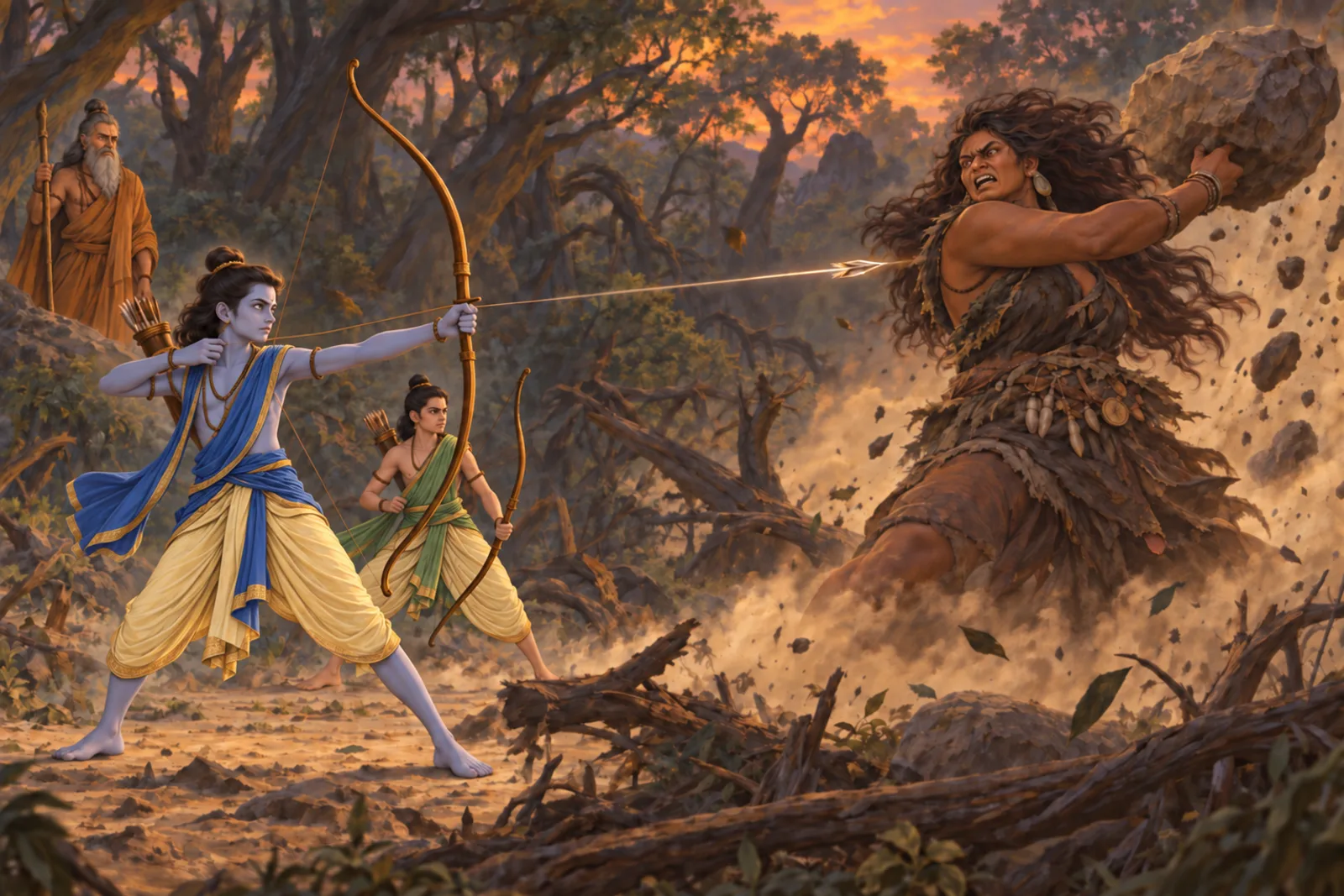
The forest became still. Ram had completed the command given to him, but he had also crossed a serious threshold: he now knew that possessing power meant carrying the weight of its use.
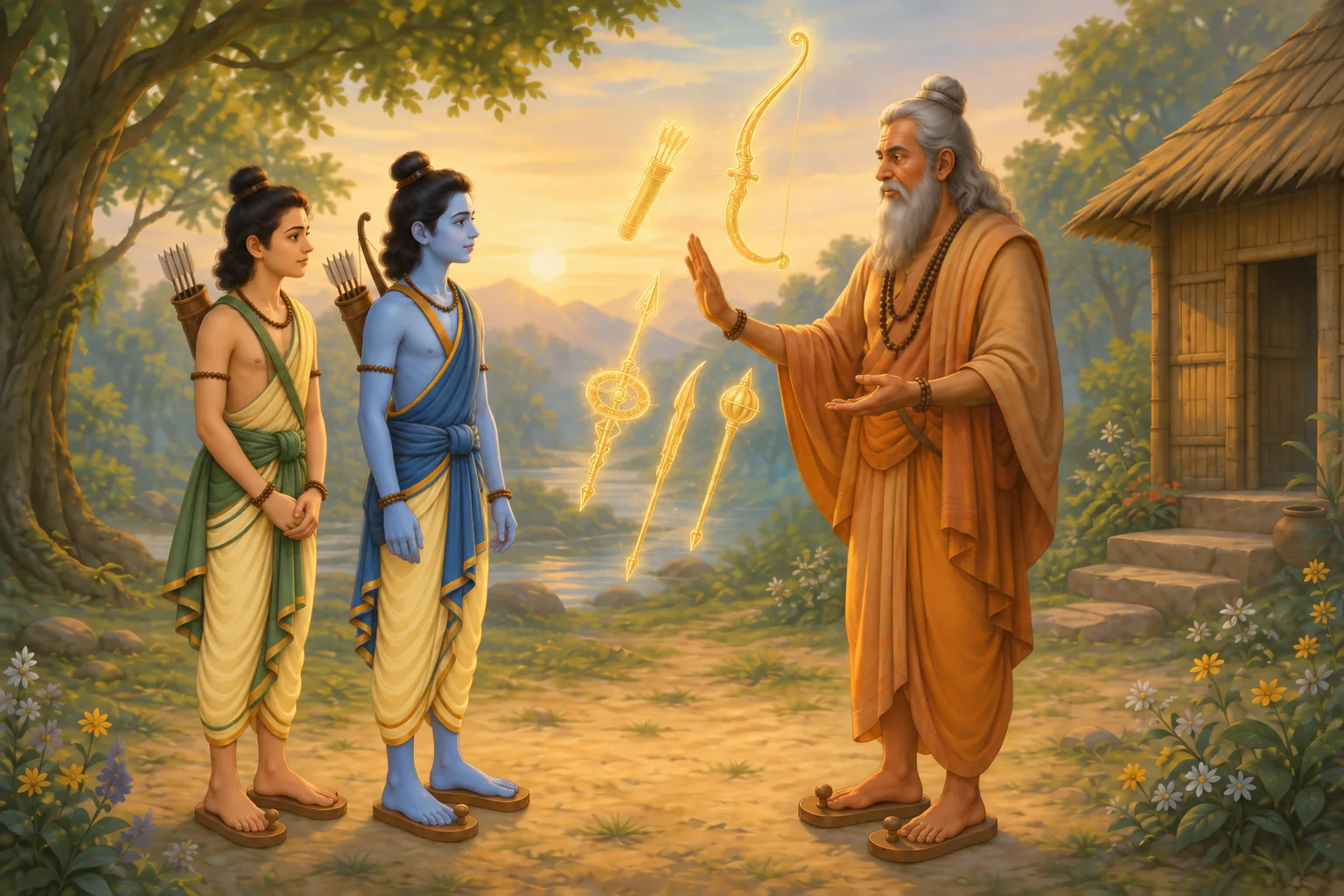
The next morning Vishvamitra entrusted him with celestial weapons known by many names and forms. Some could scatter armies, create fire or wind, bring sleep, confusion, rain, or restraint. Others could answer and withdraw those forces. Ram learned not only how to summon them but also how to call them back. The person worthy of a weapon, the sage taught, must understand when not to release it.
The weapons appeared before Ram in symbolic forms and promised to answer when remembered. Ram accepted them respectfully and then asked for the knowledge that could neutralize them. Lakshman listened beside him.
As they continued, they reached Siddhashrama, a hermitage connected with Vishnu's earlier appearance as Vamana. There Vishvamitra's unfinished observance awaited protection.
Ram and Lakshman had left Ayodhya as beloved princes. They arrived at the hermitage as students beginning to understand that courage, obedience, judgment, and restraint do not always pull in the same direction.
“Courage is strongest when it listens carefully, understands responsibility, and uses power with restraint.”
New stories in your inbox
One story every week, and a special tale on festivals. Free, always.
Your email goes to our newsletter provider (beehiiv) so we can send you stories. It is not linked to any child's reading on this site. Unsubscribe any time from the email footer.