Hanuman Remembers His Strength
Ramayana
Sampati's far sight had answered the searchers' first question. Sita was alive in Lanka across the southern sea. The answer created a new problem: someone had to cross the enormous distance, enter a guarded island, find Sita without endangering her, and return with reliable news.
The vanara leaders gathered on the shore and spoke honestly about the distance each could leap. Gaja offered ten yojanas, Gavaksha twenty, Sharabha thirty, and others progressively more. With every offer it grew plainer that the ocean was wider than ordinary effort could cross.
Jambavant remembered the strength of his youth. He said that when Vishnu took the vast Trivikrama form and crossed the worlds, Jambavant had moved around him with extraordinary speed. Age had reduced what he could safely offer. He believed he could cross much of the sea, but not complete the journey and return. His honesty was not cowardice. A mission fails if someone reaches the far shore but cannot carry the message home.
Angada believed he might reach Lanka. He was uncertain that he could leap back. As leader of the party, he was willing to risk himself, but Jambavant warned against spending the commander before considering every member's capacity.
One person had said almost nothing. Hanuman sat among the others, listening.
Jambavant turned to him. He did not flatter Hanuman by claiming the crossing would be easy. He reminded him that the group needed more than distance: the messenger must change size when needed, read unfamiliar people, resist distraction, speak with care, distinguish Sita from the inhabitants of Lanka, carry Ram's sign, and return. Hanuman had already shown those qualities when he first approached Ram and Lakshman.
Jambavant then recounted the history of Hanuman's strength. Hanuman was born to Anjana, and Vayu, the wind, was connected with his birth and protected him. As a small child, Hanuman saw the rising sun and mistook it for a brilliant fruit. With fearless energy he leapt toward it through the sky.
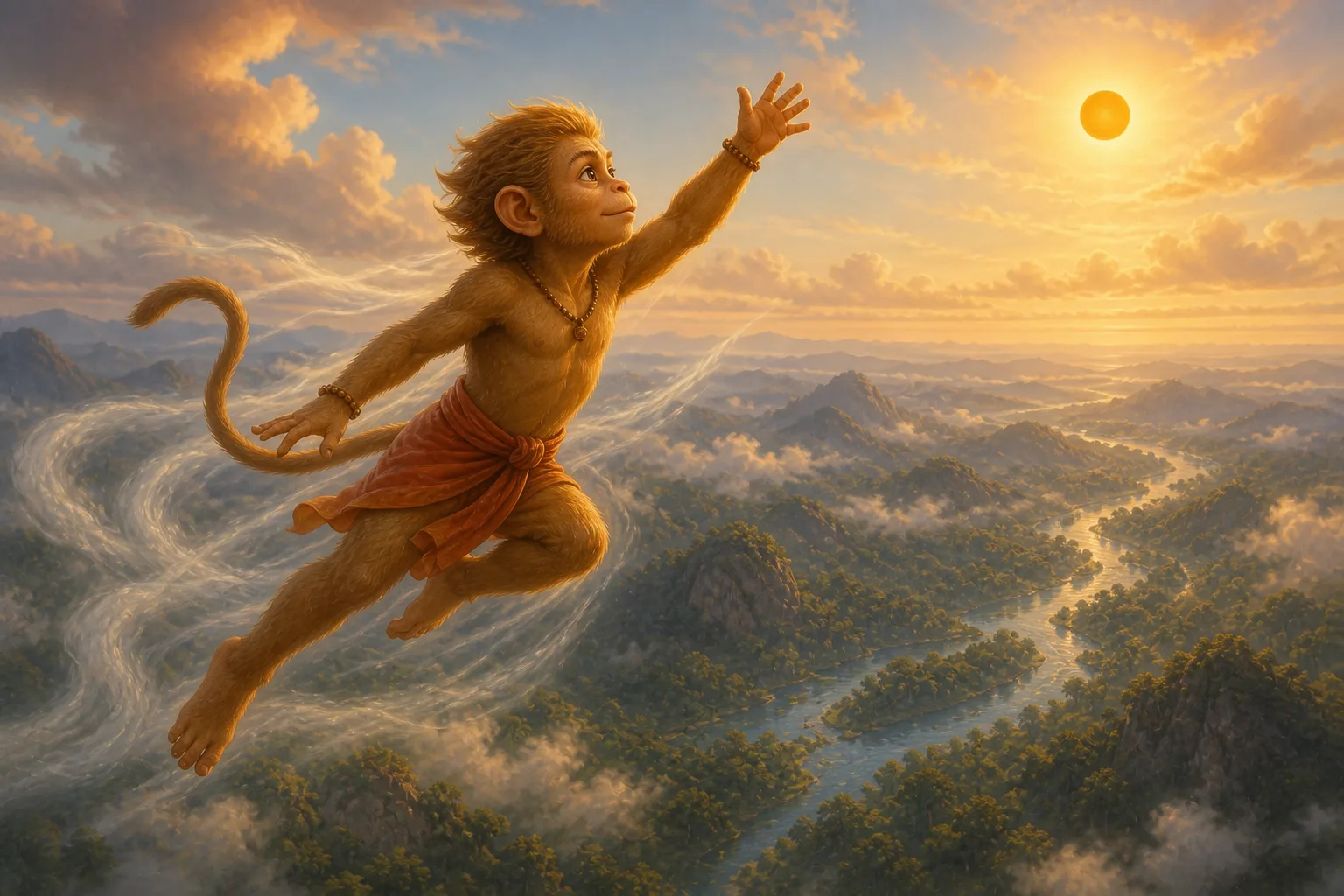
The childhood flight disturbed the order of the heavens. Indra struck the child with the thunderbolt, and Hanuman fell upon a mountain, injuring his jaw. Vayu withdrew in grief, and without the wind living beings struggled for breath. The devas came to make peace. They restored the child and granted protections: fire would not easily harm him, water and weapons would not readily defeat him, and he would possess endurance, intelligence, speed, and the ability to choose his form.
From that broken jaw he took his name: Hanuman. Even after the injury, the child's courage and vitality remained. The devas granted him boons, and he grew into a being of extraordinary strength.
Hanuman had not forgotten what he could do. Among older leaders and an appointed prince, he had simply not put himself forward until Jambavant named why he was the one.
As Jambavant spoke, Hanuman's posture changed. He looked from the elders to the ocean and then toward the invisible island beyond it. He accepted that refusing to offer a needed ability could be as mistaken as boasting of an ability one did not possess.
Hanuman stood and assured the party that he would cross the sea, find Sita, observe Lanka, deliver Ram's sign, and return. His body grew huge, ready for the leap, but his purpose stayed precise. He was not crossing to display strength. He was carrying the work of Ram, the trust of Sugriva, the leadership of Angada, Jambavant's counsel, Sampati's knowledge, and the hope of every exhausted searcher.
The party moved to Mount Mahendra, whose height gave a clear place to begin. Hanuman studied the wind and the line of the horizon. He asked his companions to wait for his return and told them not to surrender to fear while he was gone.
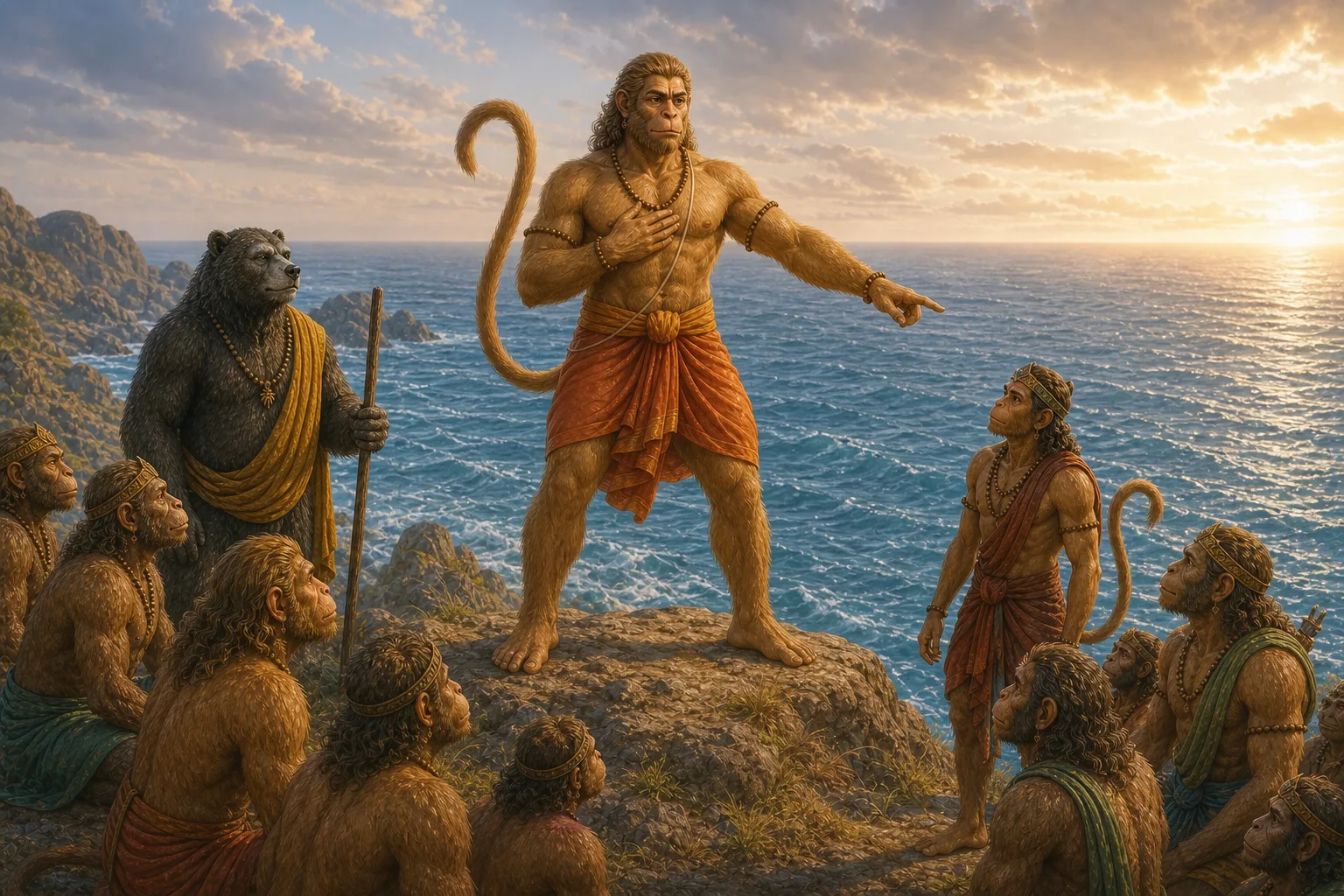
He pressed his feet against the mountain, gathered his limbs, and concentrated his mind upon Sita and Ram. Trees trembled in the rising wind. The sea stretched ahead.
“Good guidance does not create another person's strength; it helps them recognize, direct, and responsibly offer what is already theirs.”
New stories in your inbox
One story every week, and a special tale on festivals. Free, always.
Your email goes to our newsletter provider (beehiiv) so we can send you stories. It is not linked to any child's reading on this site. Unsubscribe any time from the email footer.