Vali, Sugriva, and Tara
Ramayana
After seeing Sita's ornaments, Ram repeated his promise to help Sugriva. But before acting, he asked for the whole account of the quarrel with Vali. Sugriva's first request had described injustice; it had not yet explained how two brothers who once trusted each other became enemies.
Sugriva began with a night when a powerful challenger named Mayavi came to Kishkindha and called Vali out to fight. Vali rushed after him. Sugriva followed, unwilling to let his brother face danger alone. Mayavi fled into a vast mountain cave. Vali ordered Sugriva to wait outside and entered after him.
Sugriva waited. Days became weeks and months. In the poem, he says that an entire year passed. At last he heard terrible sounds and saw ominous foam emerge from the darkness, but he did not hear Vali's voice. Believing his brother had died and fearing that Mayavi would escape, Sugriva rolled a great boulder across the entrance. He returned to Kishkindha in grief. When the ministers learned what had happened, they placed him on the vacant throne.
Sugriva had been wrong about Vali's death. Vali had defeated Mayavi and eventually forced his way out. When he returned and found Sugriva ruling, he interpreted the blocked cave and coronation as deliberate betrayal. Sugriva tried to explain the long wait and his mistaken conclusion, but Vali would not accept it. He drove Sugriva from the kingdom, pursued him from refuge to refuge, and kept Sugriva's wife Ruma separated from him within Vali's control.
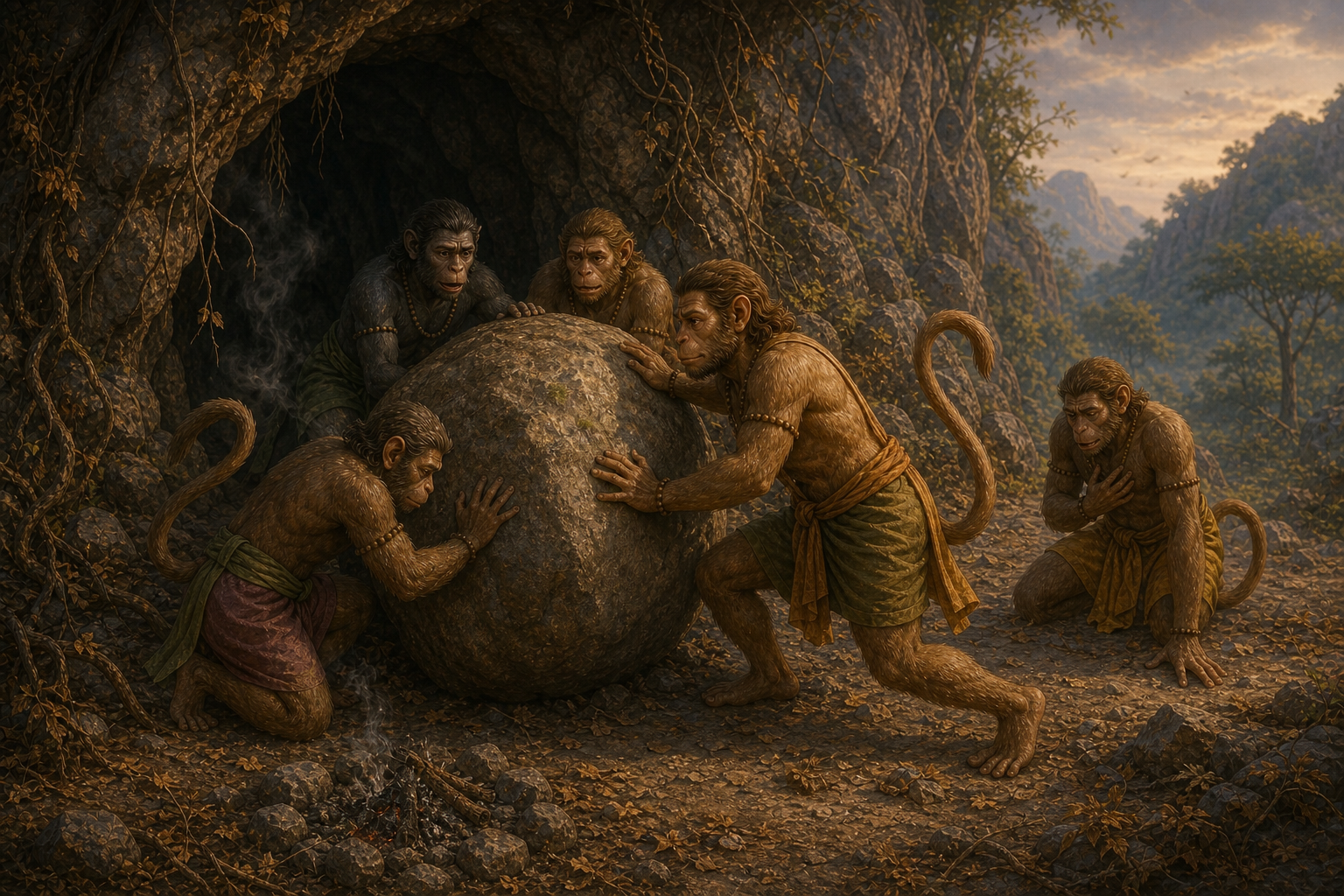
Only Rishyamuka offered safety, because an old curse prevented Vali from entering its boundary. Sugriva's fear was therefore not invented, but neither had the conflict begun as a simple plan to steal a throne. A terrible mistake had been interpreted through anger; power then turned that anger into continuing punishment.
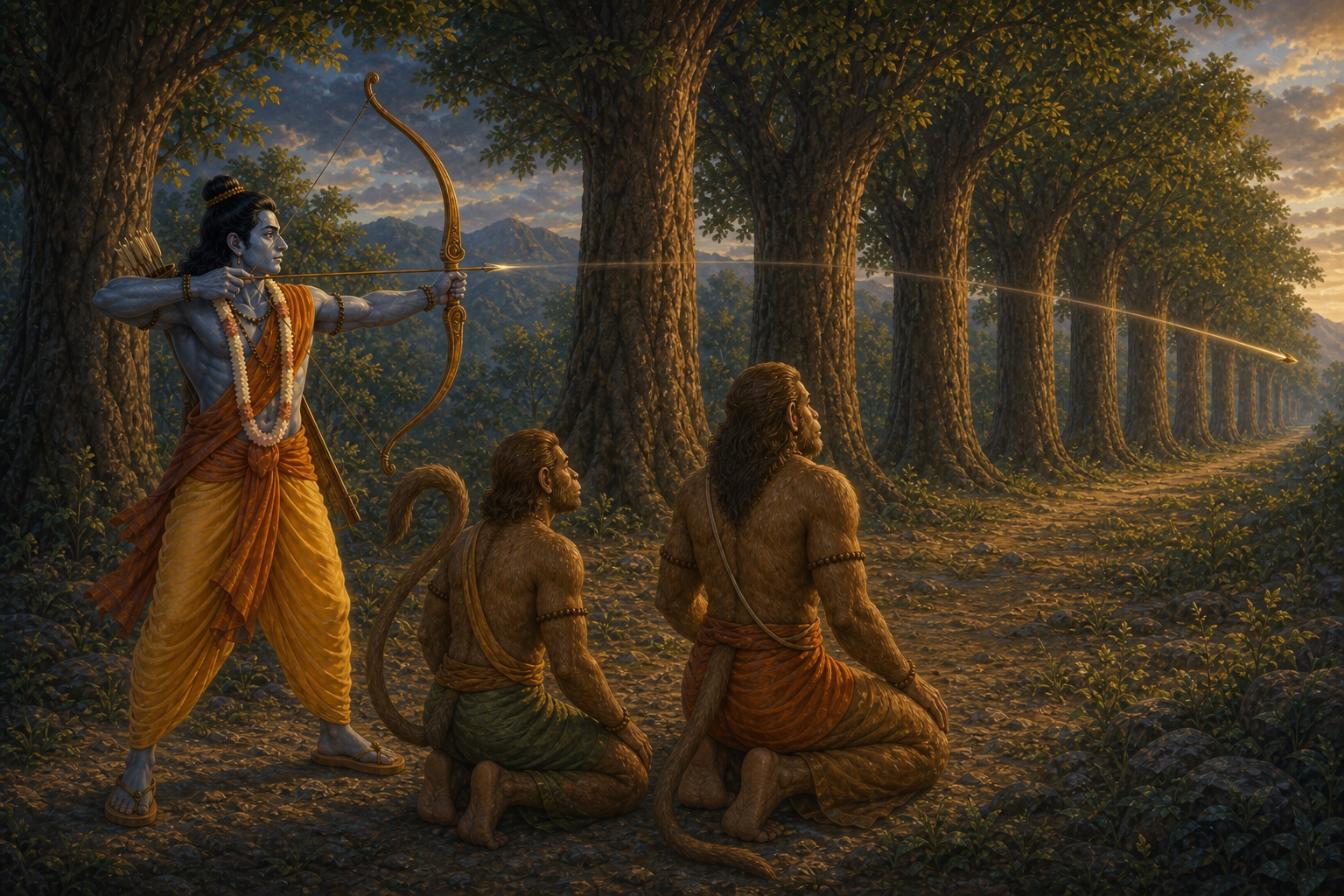
Ram said that Vali's treatment of Sugriva and Ruma required an answer. Sugriva still feared that no warrior could defeat his brother. To show that his promise was not empty, Ram sent an arrow through seven sala trees standing in a line. The single shaft passed onward with controlled force and returned after completing its path. Sugriva's doubt changed to confidence.
Sugriva went to Kishkindha and challenged Vali. In their first encounter the brothers looked so alike while wrestling that Ram could not safely distinguish them. He did not release an arrow. Sugriva escaped badly hurt and angrily accused Ram of abandoning him. Ram explained that shooting without certainty might have killed the wrong brother. Lakshman placed a flowering garland around Sugriva's neck so that he could be recognized in a second encounter.
When Sugriva called again, Tara urged Vali to stop and investigate. She had learned that Sugriva had found powerful allies: Ram and Lakshman of Ayodhya. A brother who returned so soon after defeat, she reasoned, must have new confidence for a cause. She asked Vali to restore peace, recognize Sugriva as heir, and avoid a battle whose full circumstances he did not understand.
Vali did not treat Tara as foolish. He acknowledged her intelligence and said he did not believe Ram would attack someone who had not challenged him. Yet pride and anger outweighed caution. He promised that he meant only to defeat Sugriva, then went out through the gate.
The brothers fought again. Ram watched from concealment among the trees, now able to identify Sugriva by the garland. He released one arrow. It struck Vali, ending the combat. The story does not need a picture of the wound to preserve what happened: Ram killed Vali while Vali was fighting someone else and had not seen Ram take position against him.
Vali remained conscious long enough to demand an answer. He asked why Ram, famous for righteousness, had attacked from concealment. Vali had not invaded Ayodhya or challenged Ram personally. If Ram needed help finding Sita, Vali argued, he could have asked; Vali claimed he might have found Ravana himself. Why had Ram judged and punished him without first speaking to him?
Ram answered that the rulers of his house exercised authority in the forest as well as the city, and that Bharata now upheld that authority. He accused Vali of violating the proper limits between brothers by keeping Ruma from Sugriva. He also argued that a warrior pursuing dangerous forest prey was not required to announce every shot. Within the poem's royal and social reasoning, these claims justify the act.
Yet Vali's questions do not disappear simply because Ram answers them. Readers and Ramayana traditions have debated the concealed shot, the reach of royal authority, whether Vali received a fair hearing, and whether Ram's hunting comparison is adequate. A child-facing retelling should not erase either the poem's defence or the objection spoken by the dying Vali.
Vali's anger gradually eased. He acknowledged the wrong done to Sugriva and turned toward what would happen after his death. He asked Ram and Sugriva to protect his son Angada, who was brave but still young and would now lose his father. He asked that Tara's wisdom be respected. He gave Sugriva the gold chain he wore and urged him not to repeat their cycle of suspicion.
Tara and Angada came into the clearing. Tara's grief was direct and profound. She had warned against the battle, and now the consequence she feared lay before her. She lamented Vali's death, Angada's loss, and the sudden change awaiting Kishkindha. No speech could make that grief disappear.
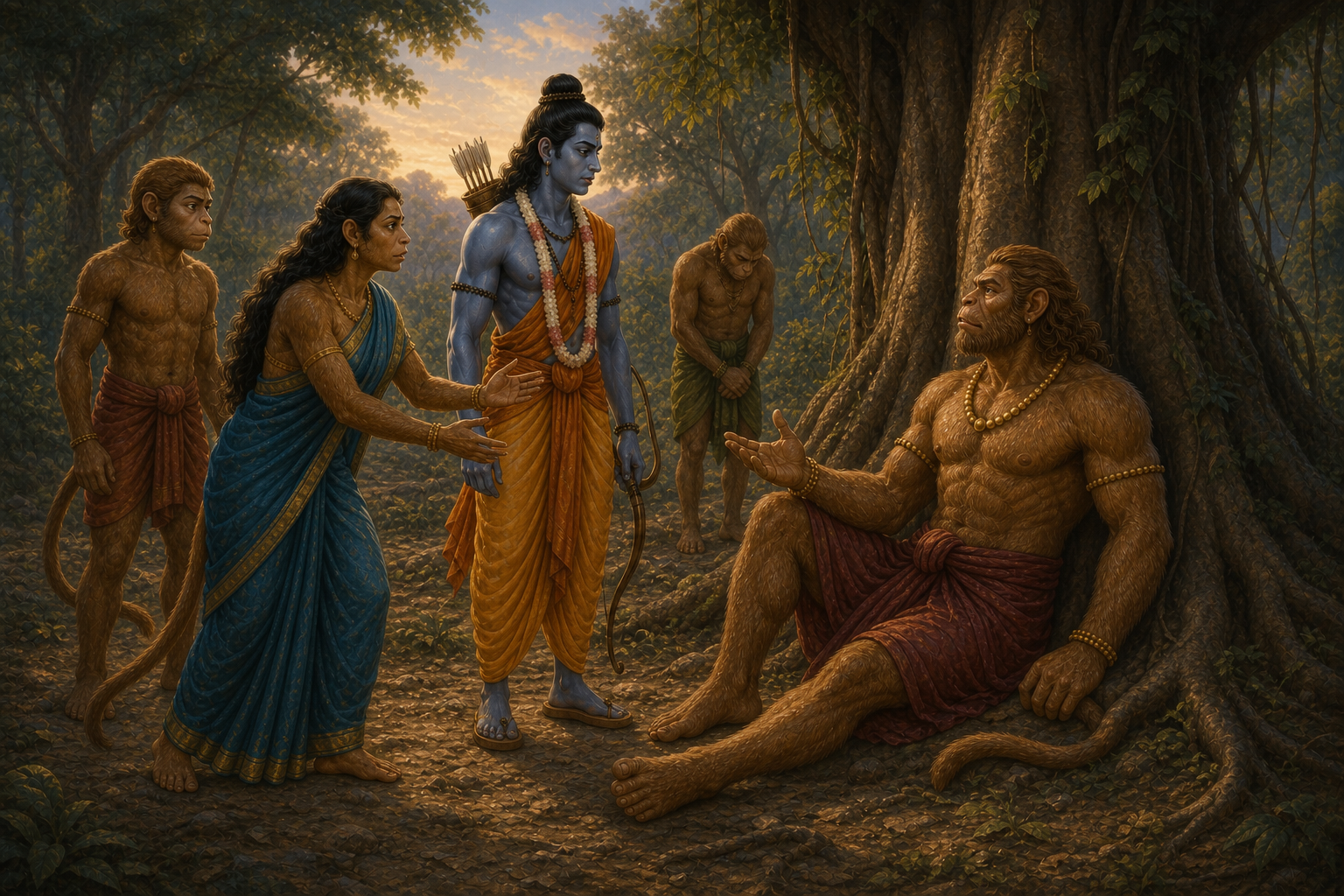
Vali died, and the community prepared his funeral with honour. The story retains his death without describing the body or rites in gory detail. Tara, Angada, Sugriva, Hanuman, and the people of Kishkindha walked through grief that belonged to them, not merely to Ram's plan.
Sugriva was installed as king, and Angada was named heir. These arrangements did not prove that every choice leading to them had been beyond question. They placed a responsibility upon Sugriva: to protect the family of the brother with whom he had fought, to listen to Tara, and to fulfil the promise to search for Sita.
Ram did not enter the city during his exile. He and Lakshman remained outside, waiting for the rainy season and for Sugriva's search to begin. The alliance had restored a kingdom, but it had also left grief and an unresolved ethical argument in its path. Kishkindha would have to carry both.
Source and editorial boundary
Primary story based on the Valmiki Ramayana, Kishkindha Kanda, Sargas 9–26. It retains the cave misunderstanding, Sugriva's coronation and expulsion, Ruma's enforced separation, Ram's demonstrations of strength, the failed first challenge, Tara's counsel, the concealed shot, Vali's objections, Ram's answer, Vali's concern for Angada and Tara, his death, funeral, Sugriva's installation, and Angada's appointment.
The adaptation does not present Vali's death graphically and does not treat the poem's justification as the end of ethical review. It also avoids treating Ruma as property; her forced separation is named as a wrong while adult marital details are not expanded. This is a new child-facing adaptation, not a direct translation.
References used for the series record
- Valmiki, Ramayana, Kishkindha Kanda 9–26, checked through the IIT Kanpur verse-level presentation: https://www.valmiki.iitk.ac.in/
- Ralph T. H. Griffith, public-domain English Ramayana, Kishkindha Kanda: https://en.wikisource.org/wiki/The_Ramayana
“Power does not remove the duty to hear objections, examine causes, and care for those who must live with a decision's consequences.”