Vishvavati: The Guardian of Wind and Water
Singhasan Battisi
King Bhoj had found the golden throne of Vikramaditya beneath an old mound, and each of its thirty-two carved guardians stopped him with a story before he could sit.
Vishvavati awoke upon the fourteenth step.
"A wise invitation does not demand that a guest cause harm merely to prove his presence," she told Bhoj. "Hear how Vikram learned this from wind and water."
Vikram planned a great sacred gathering for the welfare of his kingdom. Kings, scholars, sages, and guests from distant lands were invited. He also wished to honour the powers of nature.
With the betals' help, Vikram travelled to Mount Sumeru to invite Vayu, lord of the wind. The air grew so fierce that trees bent and dust filled the sky, yet Vikram continued until Vayu spoke without taking a visible form.
"Your courage and devotion please me," said Vayu. "But if I come to your gathering with my full strength, houses will fall, fields will be scattered, and living creatures will suffer. I am already present in every breath and every moving leaf. Accept my blessing instead."
Vayu blessed Vikram's land with timely air, healthy cattle, and abundant crops. Vikram understood that a wise refusal could itself be an act of care. He thanked Vayu and returned.

Meanwhile, Vikram entrusted a learned Brahmin with the invitation to Samudra, lord of the sea. The scholar travelled to the shore, stood respectfully before the waves, and delivered the king's message.
The sea answered, "If I bring my whole presence inland, towns and fields will disappear beneath the water. Yet I am present in every vessel of water used in the ceremony. Carry my blessing to Vikram."
As tokens of goodwill, Samudra gave the messenger five precious gems and a magnificent swift horse able to cover great distances with extraordinary speed.
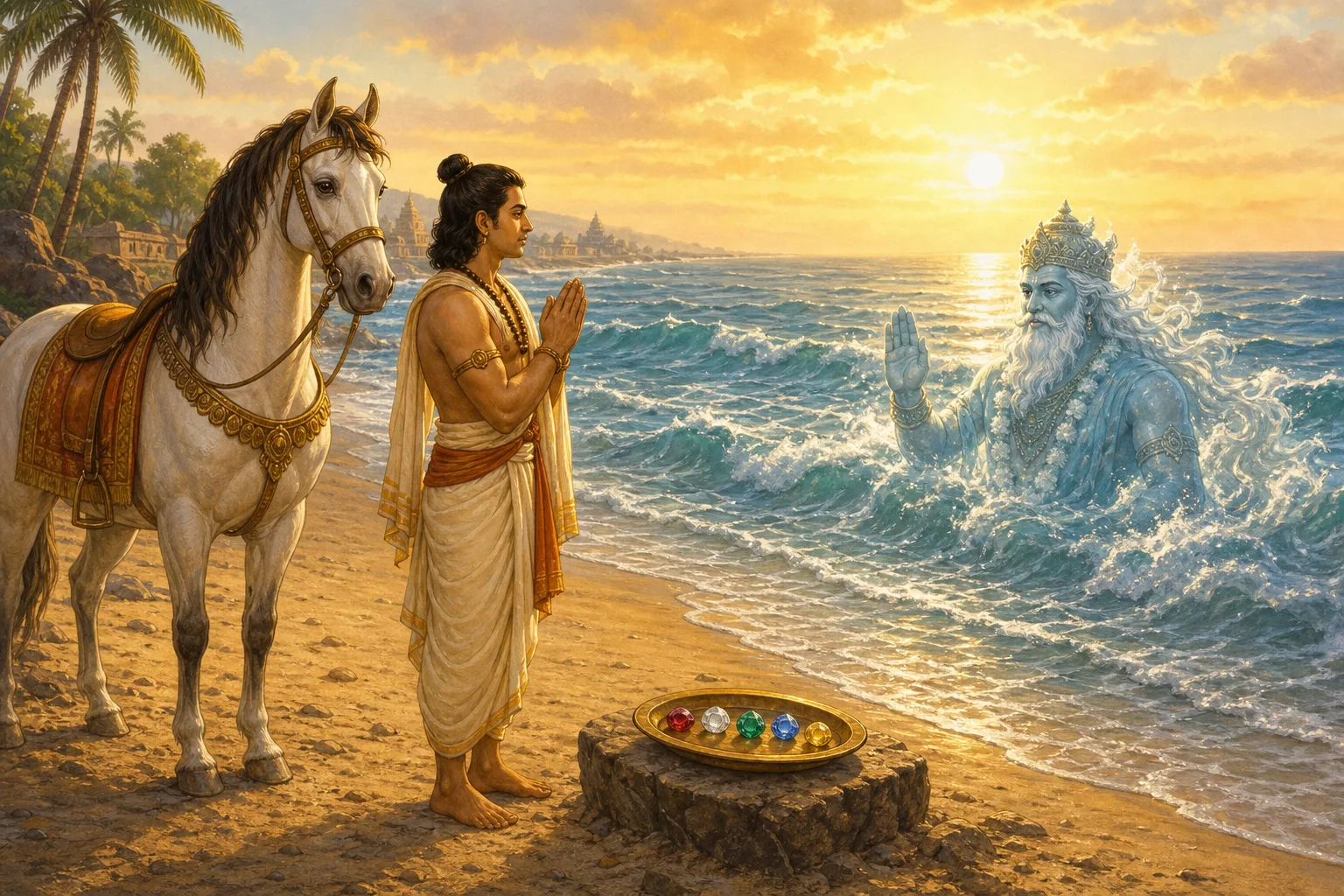
The Brahmin began the return journey. He cared for the horse attentively, gave it rest and water, and spoke of it with affection when he reached Ujjain. Then he placed the reins and gems before Vikram and repeated the sea's message exactly, without pretending that the invitation had been accepted.
Vikram was pleased by his honesty and service.
"The difficult road was yours," the king said. "The horse carried you, and you have already treated it as a trusted companion. The gems and horse came through your mission; therefore they are yours."
The Brahmin protested that they had been sent to the king, but Vikram insisted. He accepted the blessings of wind and sea without demanding dangerous displays, and he honoured the messenger who had carried the invitation faithfully.
At the gathering, clean water filled every vessel and a gentle breeze cooled the guests. Vikram remembered that the great powers had indeed attended—in the forms that sustained life rather than endangered it.
Vishvavati asked Bhoj, "Can you accept a thoughtful refusal, recognize presence without spectacle, and let a faithful messenger keep the gifts placed in his care?"
King Bhoj stepped back.
Moral: Respecting nature means welcoming its life-giving presence without demanding a harmful display of power.
“Respecting nature means welcoming its gifts without demanding a harmful display of power.”
New stories in your inbox
One story every week, and a special tale on festivals. Free, always.
Your email goes to our newsletter provider (beehiiv) so we can send you stories. It is not linked to any child's reading on this site. Unsubscribe any time from the email footer.