Anupavati: The Guardian of Careful Judgment
Singhasan Battisi
King Bhoj had found the golden throne of Vikramaditya beneath an old mound, and each of its thirty-two carved guardians stopped him with a story before he could sit.
On the fifteenth step, Anupavati awoke.
"A ruler who mistakes suspicion for proof may destroy the very wisdom his kingdom needs," she warned Bhoj. "Vikram once learned this after judging too quickly."
A gifted artist and scholar lived in Vikram's capital. His knowledge of painting, astronomy, and the signs of the human body was extraordinary. When Vikram wished to keep a portrait of the queen near him during public duties, the artist was summoned.
He worked with such skill that the finished picture seemed alive. Every feature and ornament was represented faithfully. While examining it, Vikram noticed a tiny mark painted upon the queen's thigh—a mark normally hidden beneath her clothing.
Suspicion overtook him. "How could the artist know this unless he had seen what he should never have seen?"
Without questioning the artist or the queen, Vikram ordered that the man be executed and that proof of the punishment be brought back.
The chief minister was troubled. He knew the artist's disciplined character and believed that unusual knowledge was not evidence of misconduct. Outside the court, he stopped the executioner.
"Bring the eyes of a deer as the requested proof," he said. "I will keep the artist hidden until truth can be established."
Some days later, Vikram's son went hunting alone. Deep in the forest he saw a lion and climbed a tree. A bear was already resting among its branches. The prince trembled, but the bear said, "You have sought shelter here. I will not harm someone who has come under my protection."
Night fell. They agreed to watch in turns. While the prince slept, the lion tried to persuade the bear to push him down. The bear refused.
"Betraying one who trusts us is a grave wrong," he said.
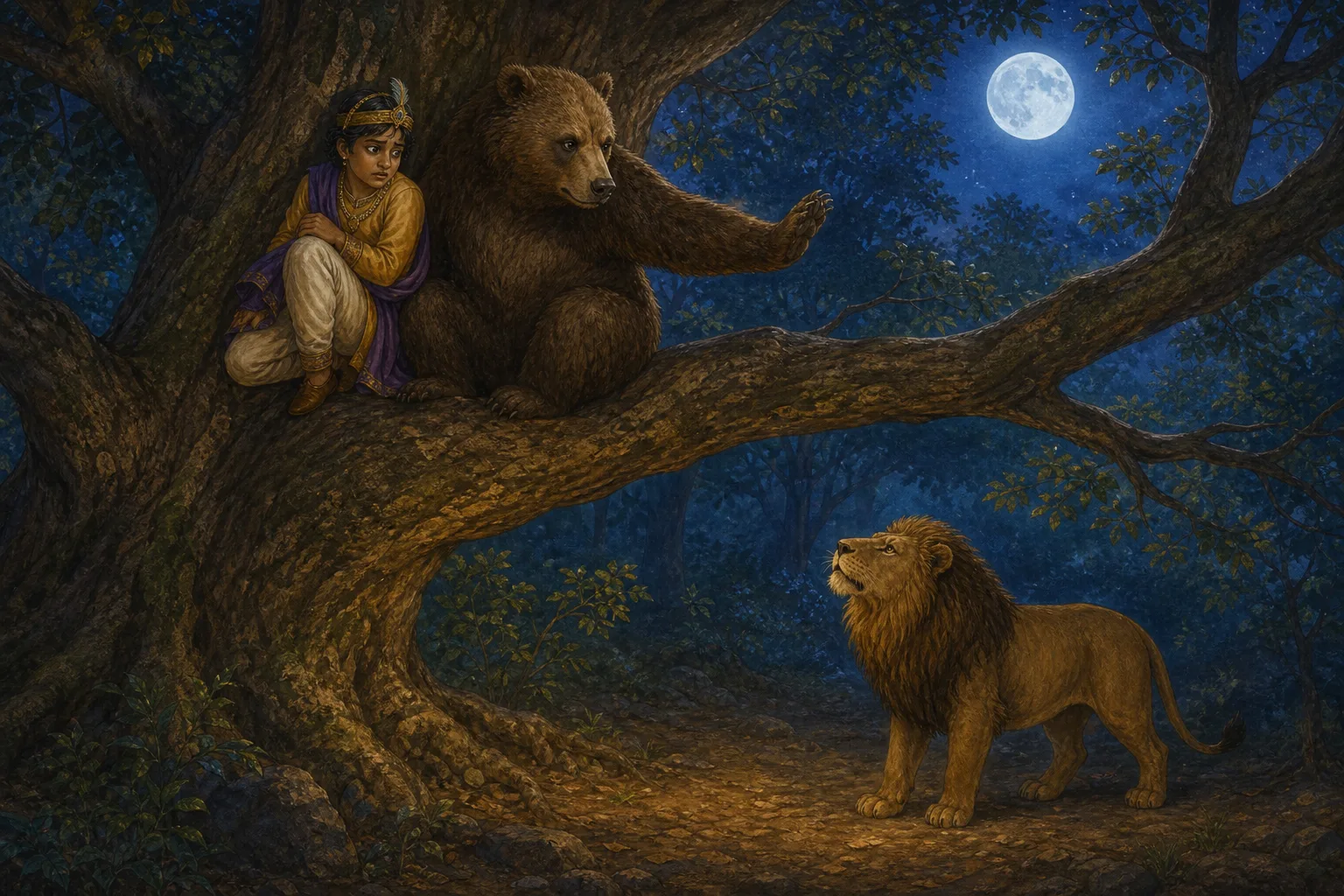
Later the bear slept and the prince kept watch. The lion whispered that the bear would surely attack when he woke. Frightened by the lie, the prince tried to push the bear from the branch. The bear woke just in time and saved himself.
"I protected you, yet fear made you betray me," the bear said sadly. He did not kill the prince, but the shock of his own conduct left the young man unable to speak clearly or respond to anyone.
The prince returned to the palace in distress. Physicians, astrologers, and healers tried to help, but none understood what had happened.
The minister remembered the hidden artist's powers of observation. Disguised as the minister's learned daughter-in-law and seated behind a curtain, the artist studied the prince's movements. Then he narrated the story of a lion, a bear, and a frightened prince who had broken a promise of protection.
As each detail was spoken, the prince recognized his own actions. At last he cried out and confessed the truth. With the secret burden released, his speech and awareness returned.
Vikram was amazed. "How could you know what happened in the forest?"
The disguised visitor explained that careful observation, study, and disciplined inference revealed truths that ordinary sight missed. Then the artist removed the disguise.
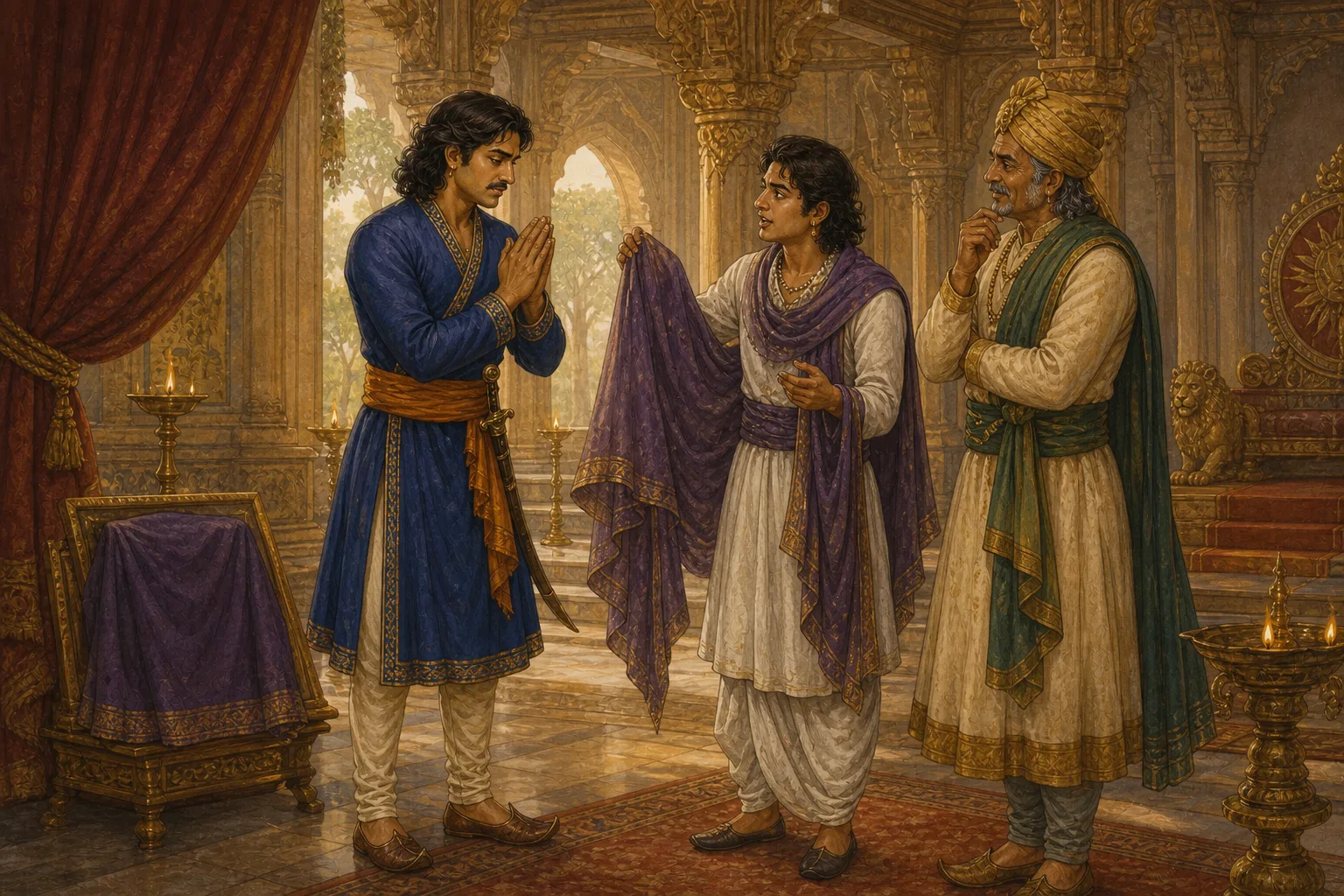
Vikram understood his mistake. The artist had inferred the queen's hidden mark through the same learned skill; he had not behaved dishonourably. The king apologized publicly, restored him to honour, rewarded the minister for preventing an unjust death, and gave the artist an important place among his advisers.
He also comforted the prince while holding him responsible for betraying the bear's trust. Fear explained the mistake, but did not make it right.
Anupavati asked Bhoj, "When an unusual fact frightens you, will you punish first—or question, investigate, and leave room for knowledge greater than your own?"
King Bhoj lowered his foot.
Moral: Suspicion is not proof; careful investigation protects both justice and wisdom.
“Unusual knowledge is not proof of wrongdoing; investigate before judging.”
New stories in your inbox
One story every week, and a special tale on festivals. Free, always.
Your email goes to our newsletter provider (beehiiv) so we can send you stories. It is not linked to any child's reading on this site. Unsubscribe any time from the email footer.