Ratnamanjari: The First Guardian of the Golden Throne
Singhasan Battisi
King Bhoj stood before the golden throne that had been discovered beneath an ancient mound. Thirty-two beautifully carved guardians surrounded its seat. When the king placed one foot on the first step, laughter rang through the hall.
"Who laughed?" King Bhoj demanded. "Why should I not sit here?"
One figure came to life. "I am Ratnamanjari, the first guardian of this throne," she said. "Anger will not answer your question. First hear how Vikramaditya earned the right to rule."
Long ago, King Gandharvasen ruled Ambavati. Among his sons were Shankha, Vikram, and Bharthari. Shankha was the eldest, but Vikram was admired for courage, patience, and sound judgment. Astrologers studying the princes' futures said that Vikram's fame would one day travel far beyond Ambavati.
Instead of learning from his brother, Shankha became afraid of him. His jealousy brought terrible harm to the royal family, and he seized the kingdom. Vikram left the city so that the struggle would not place more innocent people in danger.
Beside a quiet forest lake, Vikram built a small shelter. He prayed at a shrine of Lord Shiva, lived simply, and trained his mind to remain steady through hunger, loneliness, and fear. He did not spend those days planning revenge. He considered what separates a ruler who merely holds power from one who protects a kingdom.
When Shankha learned where Vikram was living, he came with a magician and prepared a hidden trap at the shrine. The magician invited Vikram to take part in a ceremony.
"Bow low before the shrine," he instructed.
Vikram noticed strange marks on the ground and movement behind a pillar. "I do not know the proper form," he replied calmly. "Please demonstrate it first."
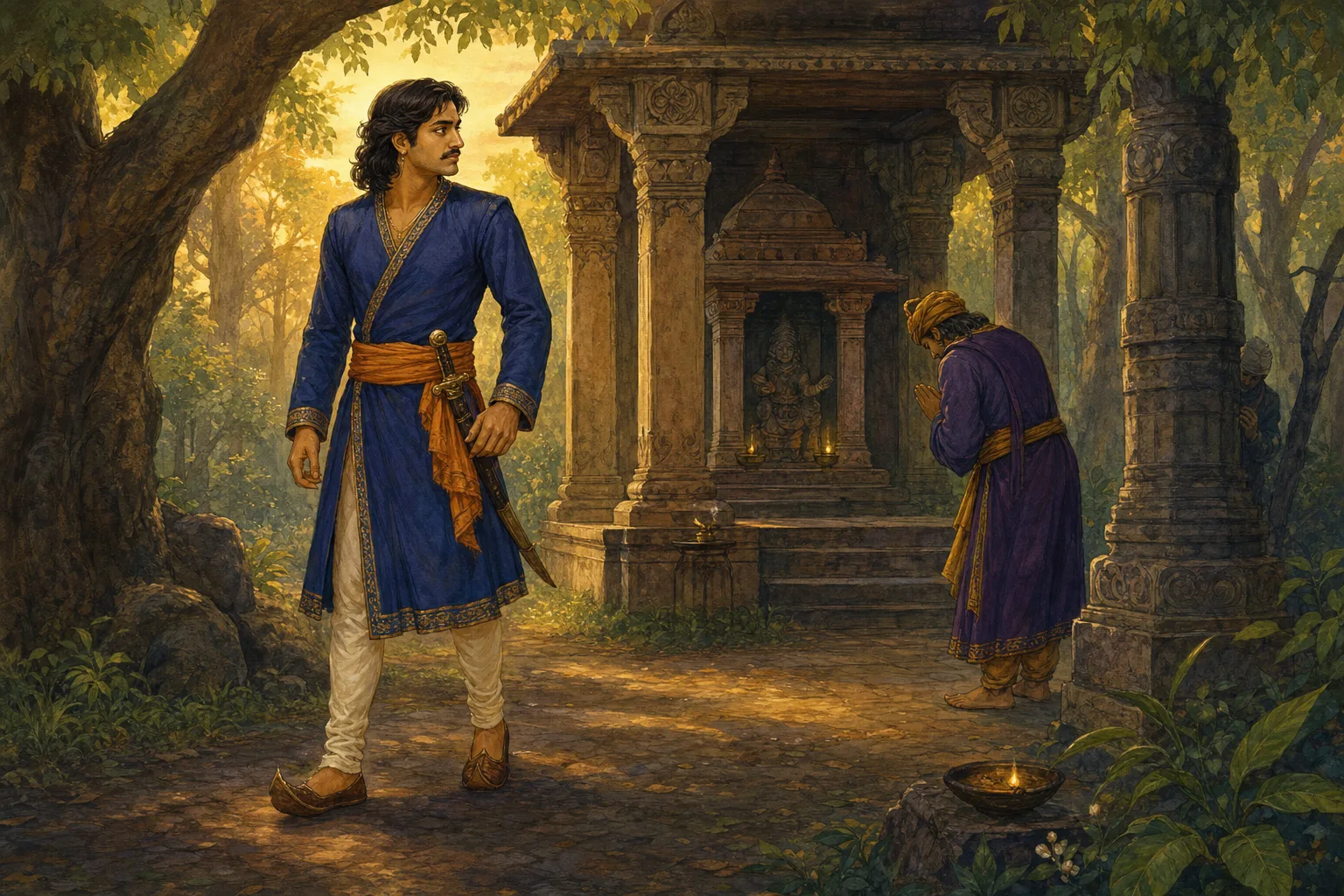
As the magician bent down, the trap was exposed. Vikram escaped it and confronted Shankha. The brothers fought, and Vikram ended Shankha's unjust rule. The danger is remembered in the old tale, but Vikram did not celebrate it. He returned to Ambavati to repair what jealousy had broken.
He reopened the court to people who had been afraid to speak, restored order, and asked his ministers to judge disputes without favour. Neighbouring rulers began to respect him, yet Vikram knew that victory alone did not make his authority secure.
Some time later, while travelling through a distant forest, Vikram became separated from his companions. From the top of a tree he saw a splendid city beyond the woods. At that moment a crow swooped past and splashed his face. Irritated and tired, Vikram ordered the local crows caught until the bold bird was found.
Before long, two crows carried a message to Tutavaran, the wise minister of King Bahubal. Tutavaran possessed magical knowledge and sometimes travelled in the shape of a crow. He came to Vikram and admitted, "I was the bird. I saw pride beginning to rise in you and acted too sharply to test it. The other birds are innocent."
Vikram recognized that his order had been unfair. He released the whole flock at once. Instead of punishing Tutavaran for speaking honestly, he invited him to sit nearby and explain what he knew.
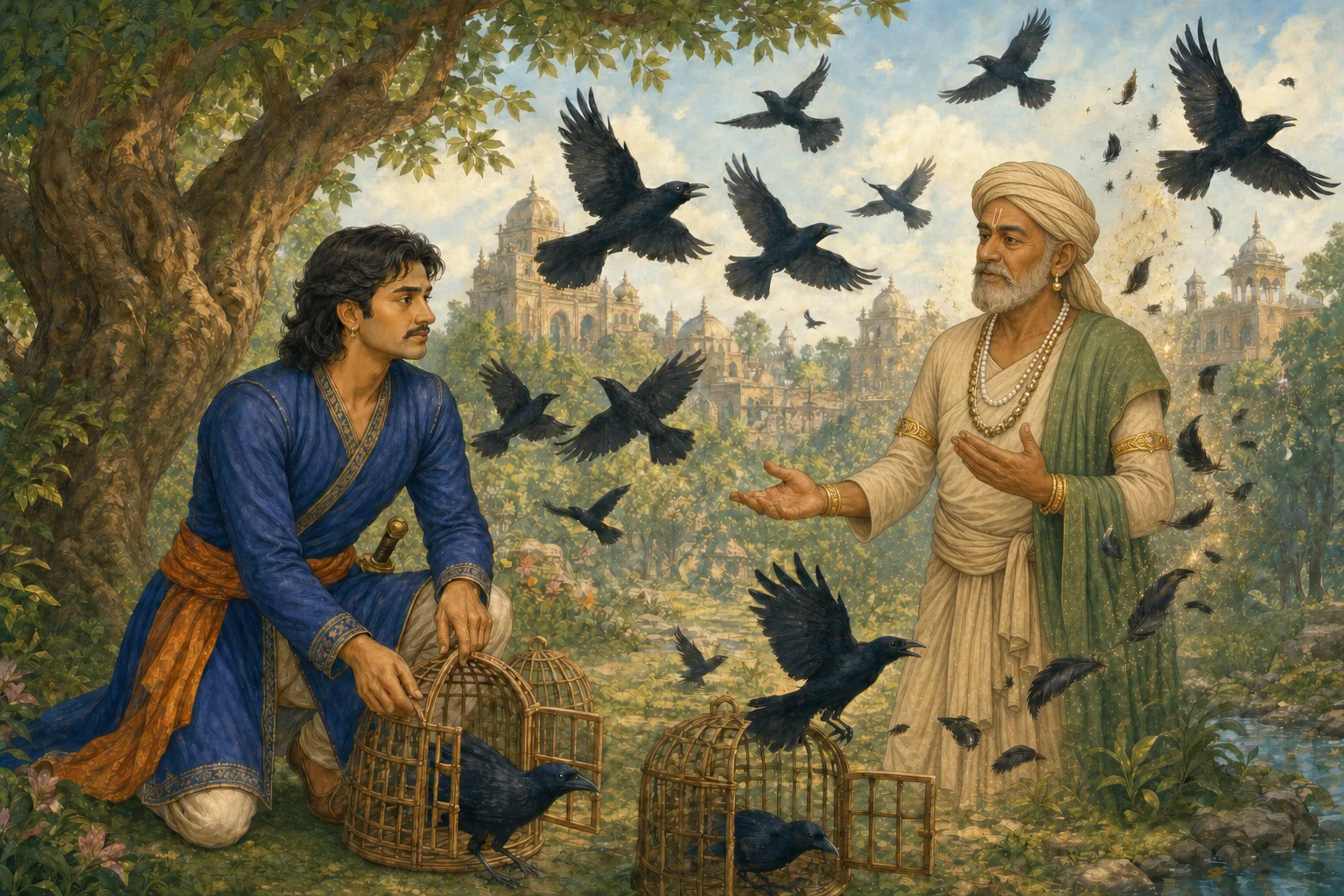
Tutavaran told him, "Your father once served my king and was his trusted friend. King Bahubal is an ancient and powerful ruler. If he recognizes you and performs your royal consecration, your rule will gain the blessing of lawful friendship rather than fear. Go to him with humility."
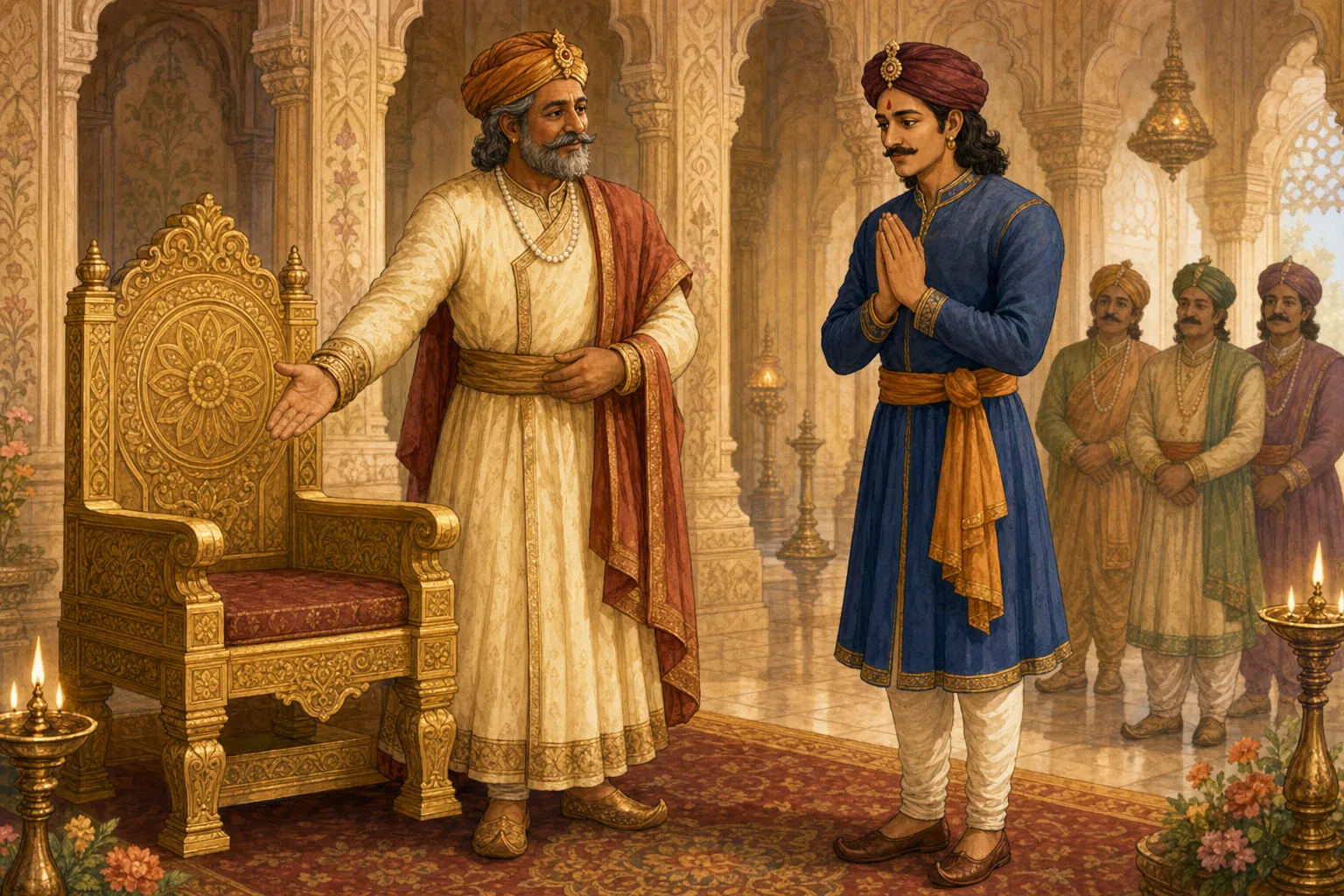
Vikram accepted the advice. Tutavaran led him to King Bahubal's court, where Bahubal welcomed the son of his old friend. Vikram stayed several days but asked for neither riches nor territory. When he was ready to leave, Bahubal said, "Ask freely for a gift."
At Tutavaran's suggestion, Vikram asked for the wondrous golden throne in Bahubal's treasury. Tradition said that Lord Shiva had first given it to Indra and that it had later come to Bahubal. Thirty-two enchanted guardians stood around it, and every step reminded its ruler of a different virtue.
Bahubal agreed. He placed the royal mark on Vikram's forehead, seated him upon the throne, and entrusted it to him with jewels and blessings.
Vikram returned to Ambavati as Vikramaditya. He governed so that travellers could cross the kingdom safely and ordinary people could bring complaints before the court. When he later began a new calendar for his realm, he marked the year with public gifts, relief for struggling farmers, and support for those without food or shelter. He wanted the celebration to ease burdens, not merely praise his name.
Ratnamanjari looked at King Bhoj. "Vikramaditya survived jealousy, corrected his own unfair order, accepted wise counsel, and used honour to serve others. Do you seek only his throne, or are you ready for all of those duties?"
King Bhoj lowered his foot. "I will think before I climb," he said. For that day, he did not try to sit on the golden throne.
Moral: A throne does not make a ruler worthy; courage, wisdom, and service do.
“A throne does not make a ruler worthy; courage, wisdom, and service do.”
New stories in your inbox
One story every week, and a special tale on festivals. Free, always.
Your email goes to our newsletter provider (beehiiv) so we can send you stories. It is not linked to any child's reading on this site. Unsubscribe any time from the email footer.