Pushpavati: The Guardian of the Flying Horse
Singhasan Battisi
When King Bhoj reached the eighth step, Pushpavati opened her eyes.
"A marvellous invention can carry a ruler farther than wisdom has prepared him to go," she said. "Hear how Vikramaditya survived wonder, loneliness, and temptation—and used cleverness to restore another person's freedom."
One day an elderly craftworker came to Vikram's court with a wooden horse. Its joints, reins, and hidden mechanisms had been made with extraordinary skill.
"It needs no grass or water," the craftworker said. "It can race over the ground and rise into the air. But its controls require patience. Learn them before you attempt a long flight."
Vikram watched the horse circle the courtyard and leap lightly above the walls. Impressed, he paid the craftworker generously. His minister thought the price too high for an object made of wood, but Vikram replied that years of knowledge deserved respect.
For several days Vikram studied the controls. Then delight overcame caution. He urged the horse higher and faster. It flew beyond the city, crossed the sea, and carried him over an unfamiliar forest. A hidden part jammed. Horse and rider struck the branches of a great tree, and Vikram fell through the leaves. He was badly shaken but alive; the wooden horse was broken.
For days Vikram searched for a road. The forest was so thick that daylight barely reached the ground. He heard lions and wild animals in the distance, slept in sheltered places, and marked trees so he would not walk in circles. At last he found a clearing with a spring, a tall tree, and a strange monkey that repeatedly climbed and descended as though begging him to notice.
Beyond the tree stood a secluded dwelling. Vikram hid and observed before entering. At midday a hermit arrived. He drew water from one well and sprinkled it over the monkey. Instantly she became a young woman. Later he used water from another well, and she became a monkey again before he left for his cave.
When the hermit was gone, Vikram repeated what he had seen. The young woman appeared, frightened and ashamed. Vikram kept a respectful distance and introduced himself.
She explained that she was a princess, born to a celestial mother named Pushpavati. When she was twelve, she disobeyed an important instruction. In anger, her parents placed her under the hermit's control. He kept her in monkey form whenever he was absent. A year had passed, and she had begun to believe she would never be free.
"I will help you leave," Vikram promised. "But I will not steal you away only to place you under another person's command."

They made a careful plan. The next morning the princess returned to monkey form before the hermit arrived. When he changed her back, she respectfully asked for a blessing. The hermit, pleased by her manner, gave her a magical lotus.
"Each day this flower will produce a precious jewel," he said. "Guard it well."
After he departed, Vikram restored the princess once more. She showed him the lotus, and a jewel appeared exactly as promised. Vikram called his trusted magical helpers. They carried Vikram and the princess safely across the sea toward Ujjain.
As they travelled, the princess worried that Vikram would demand her gratitude forever. Vikram answered, "Helping you does not make your future mine to decide. In Ujjain you will be protected, and you may choose where you wish to live."
Near the city they passed a poor family's home. A child standing at the doorway saw the shining lotus and began to cry for the beautiful flower. The princess hesitated. Its daily jewel could have secured her comfort after a year of captivity.
Vikram gently asked whether she wished to keep it. The choice was hers.
The princess considered the child's worn clothes and the uncertain future of the household. Then she smiled and placed the lotus in the child's hands. Vikram explained to the family that its gift should be used carefully for food, shelter, and learning.
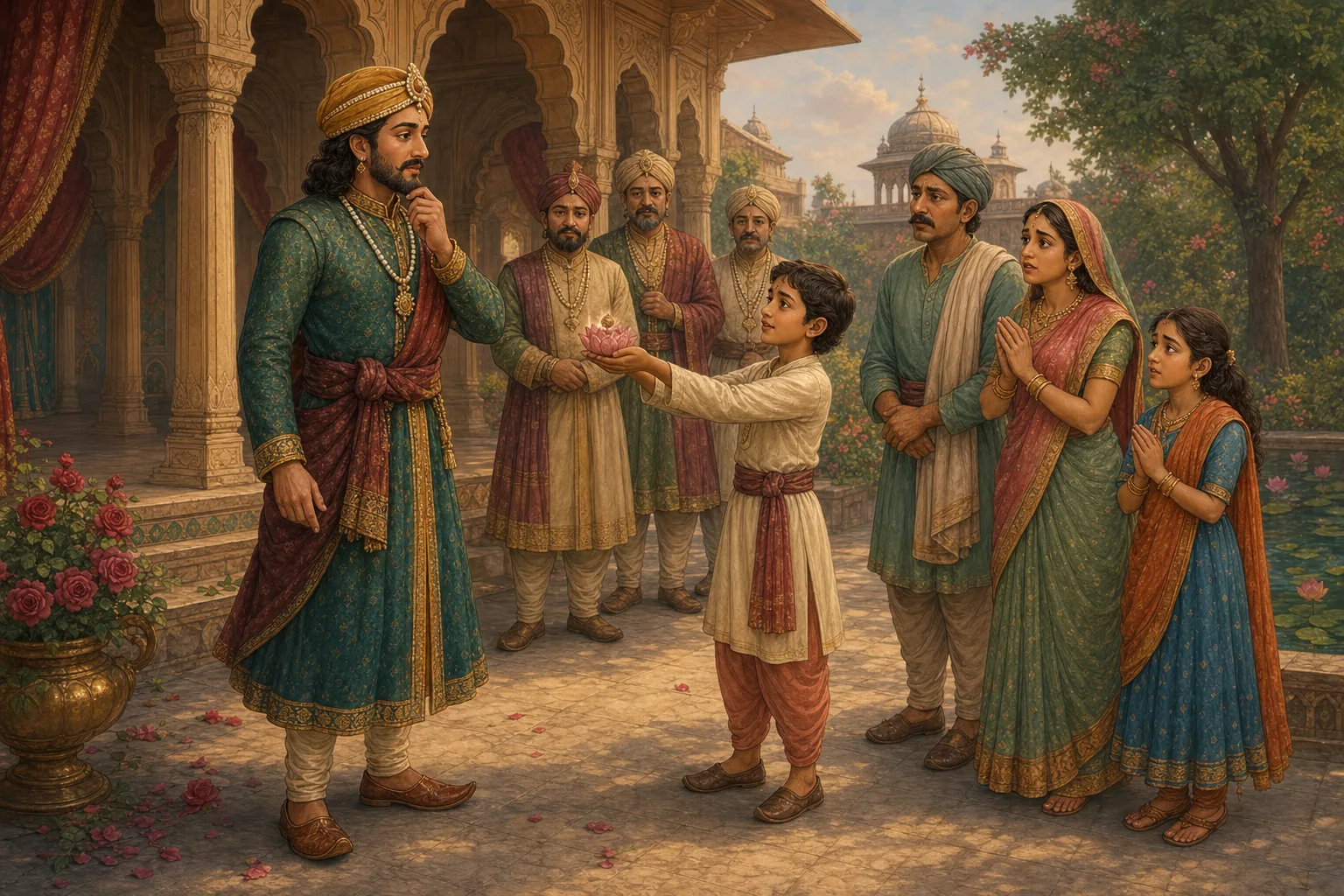
Later a city guard heard that the poor family possessed valuable jewels. Suspecting theft, he brought the child's father before the court. Vikram did not allow punishment based on appearance. He asked questions, listened to the whole account, and confirmed that the lotus had been freely given. He ordered the man released and warned the officials that poverty was not proof of guilt.
The family used the lotus gradually instead of flooding the market with jewels. The princess began a new life in freedom. Vikram repaired neither the wooden horse nor his pride with treasure. The broken invention had carried him into danger, but attention, restraint, and respect had brought everyone home.
Pushpavati asked King Bhoj, "If your cleverness rescued someone, could you protect that person's freedom afterward—and could you believe a poor family before believing suspicion?"
King Bhoj stepped back.
Moral: Cleverness is most admirable when it protects freedom and asks for nothing in return.
“Cleverness is most admirable when it protects freedom and asks for nothing in return.”
New stories in your inbox
One story every week, and a special tale on festivals. Free, always.
Your email goes to our newsletter provider (beehiiv) so we can send you stories. It is not linked to any child's reading on this site. Unsubscribe any time from the email footer.