Karunavati: The Guardian of the Hidden Past
Singhasan Battisi
King Bhoj had found the golden throne of Vikramaditya beneath an old mound, and each of its thirty-two carved guardians stopped him with a story before he could sit.
Karunavati awoke on the twenty-third step. When Vikram took responsibility for the kingdom, he reorganized the court and selected twenty capable officials for different duties. Some became judges, some supervised the city, some guarded the treasury, and some advised the army. He did not dismiss the experienced former chief minister, but the man felt uncertain and asked himself how he might prove that experience still served the realm.
At first former colleagues continued to gather at the minister's house and discuss the new arrangements. He soon asked them to stop. "The king may think we are forming a court behind his court," he warned. "Serve openly in the offices he has entrusted to you." Left alone, he did not plot against the new officials. He looked for a difficult service through which honest experience might speak for itself.
While praying waist-deep in the Narmada, the minister saw an extraordinary flower floating downstream. He offered it to Vikram. Delighted, the king asked him to discover its source—not as punishment, but as a difficult test of observation and courage.

The command frightened him. A flower might have travelled from a place no person could reach, yet failure could cost him his place in the kingdom. After a sleepless night he summoned a skilled carpenter and commissioned a sturdy boat able to move against the current. When the craft was ready, he rewarded the maker generously instead of treating expertise as a servant's obligation.
He loaded food, water, rope, lamps, and simple tools, then said an uncertain farewell to his family. "If I return, we shall meet with gratitude," he told them. "If I do not, remember that I went to complete a duty I accepted." The household wept, but the minister did not turn their love into a reason to abandon his word.
For many days he travelled upstream, watching both banks for the tree that could have borne the flower. When provisions ran low, he moored the boat and continued on foot through a forest echoing with elephants and lions. The cries sometimes came so near that his courage faltered, yet he marked his path and moved carefully rather than rushing blindly. Farther on he climbed a mountain rising from the river and followed more of the same flowers to a remote shrine.
There an ascetic figure hung upside down by chains in deep penance, body thinned by austerity. Each drop that fell into the stream became a flower. Nearby twenty silent attendants remained fixed in meditation, their ritual vessels beside them. The minister's fear changed into wonder. He observed carefully, harmed no one, and did not interrupt the penance merely to satisfy curiosity. He collected only flowers already floating in the stream, noted the shrine, the mountain, the twenty vessels, and the route, then began the long return. His family had watched the road for days; their relief was the first reward of his homecoming.
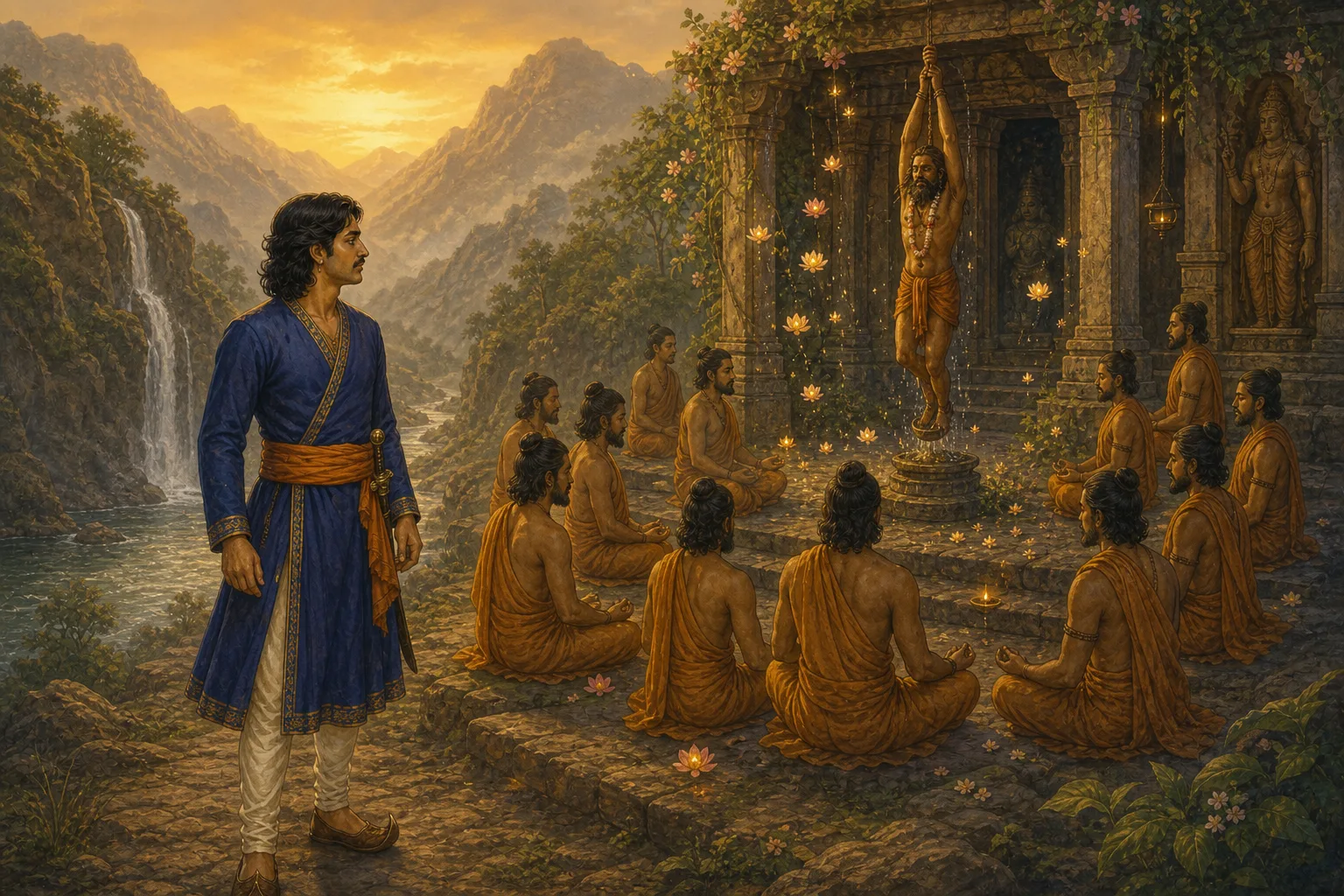
Vikram welcomed him warmly and asked him to describe the journey before displaying the flowers. The minister gave facts in their order and admitted where he did not know the meaning. Vikram valued that honesty as much as the success.
He explained the vision as a symbolic picture of past effort: the ascetic represented the king's earlier discipline, while the twenty attendants represented loyal service whose results had carried forward into the present court. Vikram did not use this idea to excuse mistakes. "If past effort has given me power," he said, "it has also given me greater duty now."
He restored the minister as chief adviser and entrusted him with broad responsibility, asking him to work openly with the newer officials. The minister's persistence, not flattery, had shown his value.
Karunavati asked Bhoj, "Can you learn from the past without avoiding today's duty?" Bhoj stepped back.
Moral: Power becomes safer when a ruler understands its roots and accepts responsibility for its use.
“Power becomes safer when a ruler understands its roots and accepts responsibility for its use.”
New stories in your inbox
One story every week, and a special tale on festivals. Free, always.
Your email goes to our newsletter provider (beehiiv) so we can send you stories. It is not linked to any child's reading on this site. Unsubscribe any time from the email footer.