Lilavati: The Guardian of Effort and Fortune
Singhasan Battisi
King Bhoj approached the fifth step of the golden throne. A guardian dressed in mustard and wine-red opened her eyes.
"I am Lilavati, guardian of effort and fortune," she said. "Before you climb, tell me: does success come from determined work, or from circumstances no person can command?"
King Bhoj began to answer, but Lilavati raised one hand. "Vikramaditya was once asked the same question. He did not settle it with a clever sentence."
Two mysterious visitors had come to Vikram's court, each certain that he represented the greater power. One praised effort: strength, skill, discipline, and the courage to act. The other praised fortune: the unexpected meeting, favourable wind, inherited opportunity, and timely help that no plan can guarantee. They had carried their argument from court to court without finding a judge they trusted.
Vikram listened to both. "Return in six months," he said. "A ruler should not decide such a question merely because an answer sounds wise."
He dressed as an ordinary traveller and left Ujjain quietly. Near the sea he entered a prosperous trading city and asked a wealthy merchant for employment.
"What work can you do?" the merchant asked.
"When true difficulty arrives, I can be useful," Vikram replied. He requested an astonishing wage, and the curious merchant agreed to test him.
Each day Vikram divided what he received. He offered one portion in worship and learning, another to families in need, and used the rest to feed hungry people. When little remained for him, he ate simple food and slept among the other workers. He helped count bundles, load carts, study the weather, and listen to sailors. The merchant wondered why such a capable servant kept so little for himself.
At last the merchant prepared a ship for a distant voyage. "You promised to help when the road became difficult," he reminded Vikram.
"Then this is when I should come," Vikram answered.
Days later a fierce storm caught the ship. The crew lowered the anchor, but it became wedged beneath the water. When the storm eased, they could neither lift the anchor nor move safely. The merchant remembered Vikram's promise and asked for his aid.
Vikram tied a rope around himself, entered the rough water, and found the anchor caught among heavy rocks. Working beneath the surface, he freed it and signalled for the sailors to pull. The anchor rose—but wind filled the sails before Vikram could climb back. The frightened crew struggled to turn the ship, yet the current carried it away.
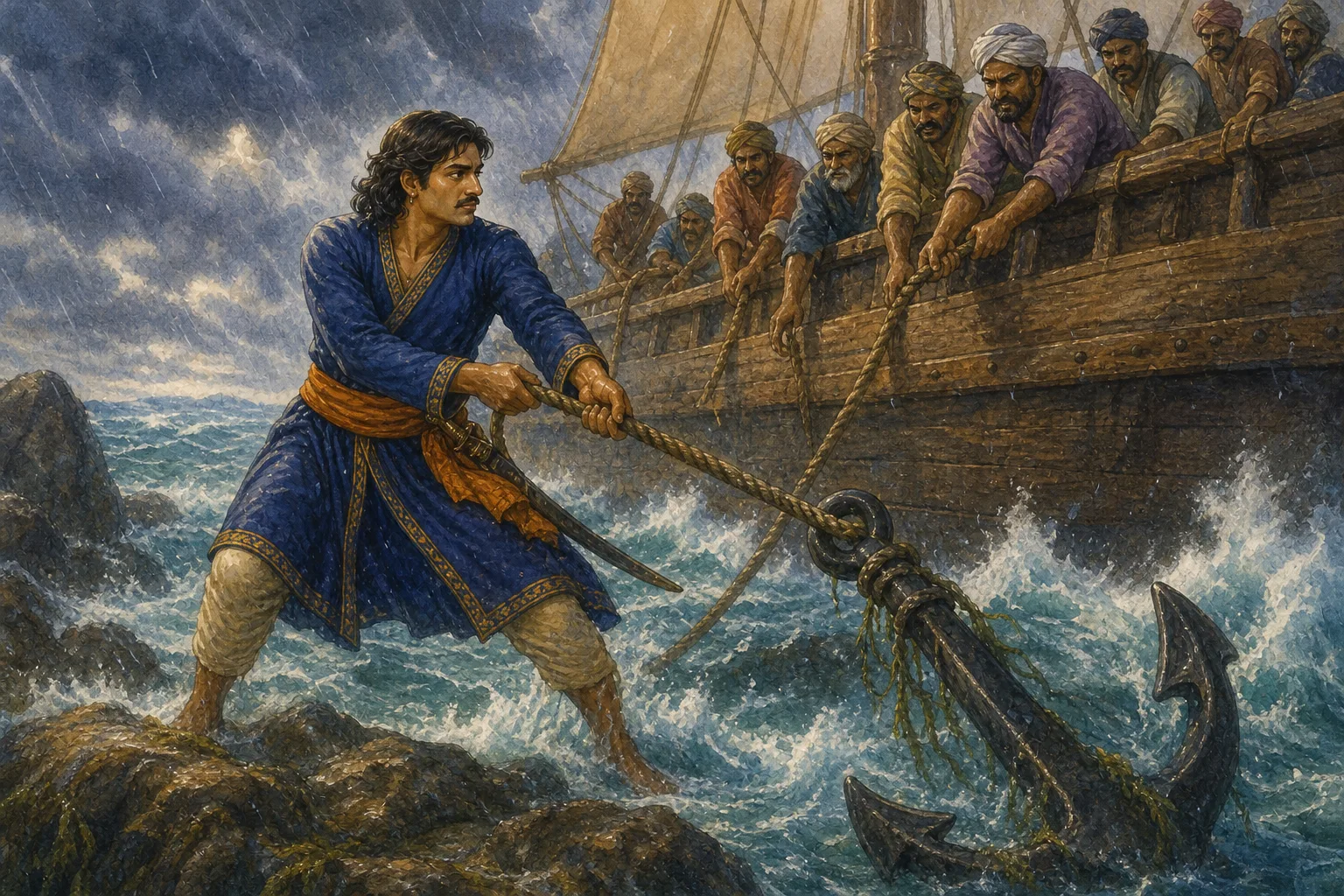
Vikram reached the shore alone. His clothes were soaked, he had no horse, and no companion knew where he was. Still, he did not sit blaming fate. He found a path, marked the direction of the sun, and walked until he saw the gate of a remarkable city.
Words above the gate announced that Princess Singhavati would welcome a traveller named Vikram. The message astonished him. Inside, Singhavati and her companions received him as someone long expected. Vikram rested there, and in time Singhavati explained that his arrival had been foretold. She also warned him that comfort could become another kind of trap if he forgot the people waiting for him at home.
Her honesty awakened him. The storm and this strange welcome had not been his choices. Yet he still had to choose what to do next. Singhavati showed him a swift horse kept in the royal stables. With her help, Vikram began the journey toward Ujjain.
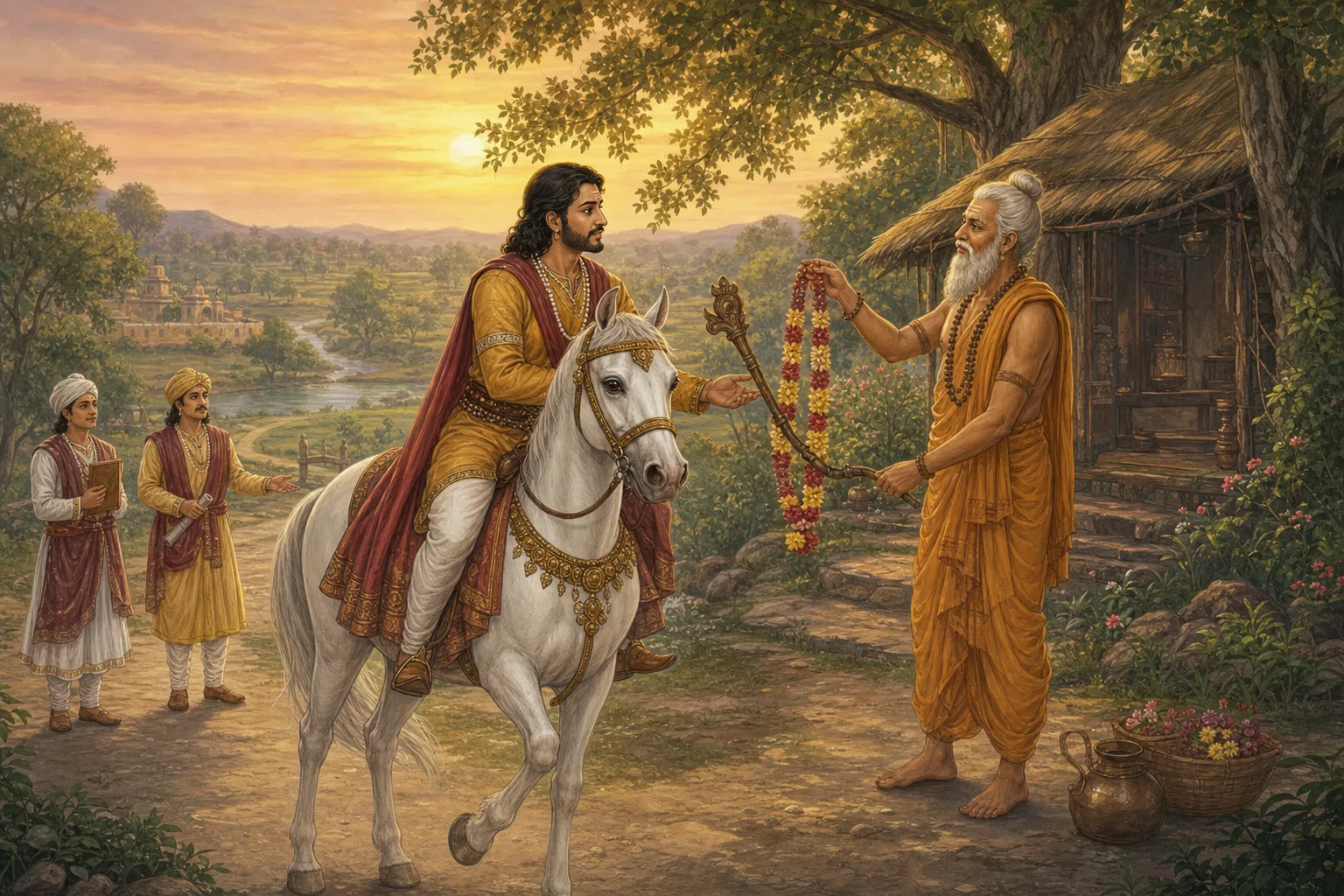
Beside a river he met a sage deep in meditation. When the sage opened his eyes, he recognized Vikram's patience through hardship. He gave him a protective flower garland and a staff with unusual powers. The garland could help its wearer travel unnoticed when danger required it. At different hours, the staff could provide useful necessities and offer protection during the night.
Near Ujjain, Vikram met a scholar and a poet who had waited many days at his court. The scholar needed security to continue teaching and studying. The poet needed a dependable way to support his household while preserving his art. Vikram did not display the marvellous gifts as trophies. He gave the useful staff to one and the protective garland to the other, carefully explaining their powers.
Six months passed. The two visitors returned and again asked which of them was greater.
Vikram said, "My effort helped free the ship, cross an unknown land, and find the road home. But I did not command the storm, the distant shore, Singhavati's warning, the swift horse, or the sage's gifts. Fortune opened doors, but a closed or frightened mind could have wasted every one of them. Effort needs opportunity, and opportunity needs action. Neither deserves all the praise."
The visitors accepted his judgment because it came from experience rather than pride.
Lilavati looked at King Bhoj. "Can you work with all your strength and still admit how much help, timing, and kindness shaped your success?"
King Bhoj lowered his foot. "I will consider that before I climb," he said.
Moral: Work with courage, and remember that no success is created by effort—or luck—alone.
“Work with courage, and remember that no success is created by effort—or luck—alone.”
New stories in your inbox
One story every week, and a special tale on festivals. Free, always.
Your email goes to our newsletter provider (beehiiv) so we can send you stories. It is not linked to any child's reading on this site. Unsubscribe any time from the email footer.