When Rama Fell
Adbhuta Ramayana
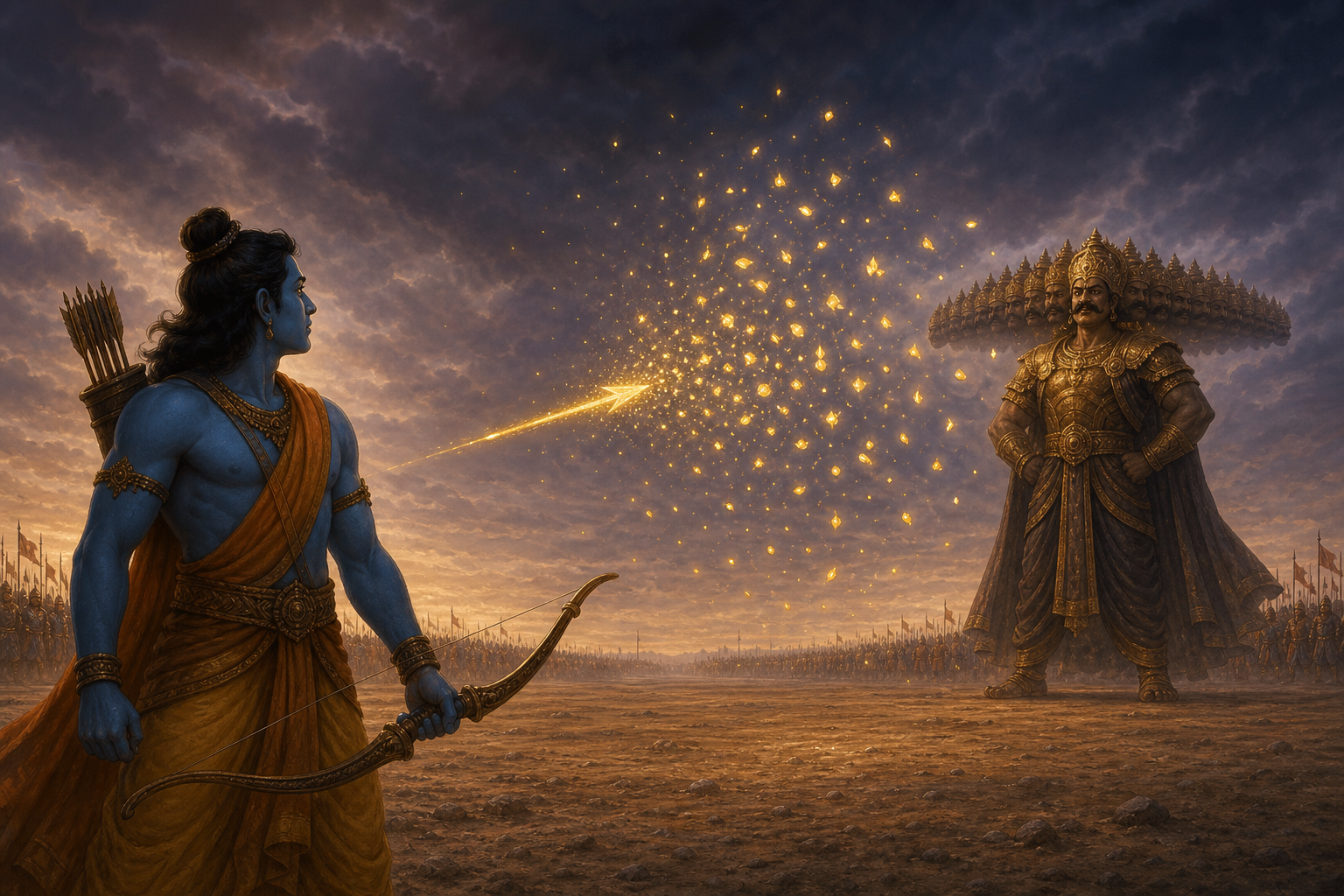
Rama faced Sahasra Ravana on the emptied field. He drew the bow that had carried him through the war in Lanka and invoked a Brahmastra associated with the sage Agastya.
The celestial arrow blazed across Pushkara. Rama expected even the thousand-headed ruler to respect its power.
Sahasra Ravana caught it in his hand.
Before Rama's astonished eyes, he broke the weapon as though it were a dry reed. The sound was small compared with the shock it carried. A certainty built from earlier victory cracked with the arrow.
The duel continued. Rama released shafts with discipline and extraordinary skill. Sahasra Ravana answered them without yielding. He mocked the fame of Lanka's conqueror and tried to turn surprise into confusion.
Rama remembered Sita's warning about fighting only to defend a reputation. Yet knowing a danger in advance did not make the experience of failure easy.
For one moment his attention divided between the opponent before him and the question rising inside: What if the power that defeated Ravana is not enough here?
Sahasra Ravana seized that opening. His arrow struck Rama, and Rama fell unconscious.
The battlefield seemed to stop. The hero whom sages had praised as unconquerable lay still. The Adbhuta Ramayana does not hide or explain away this reversal.
Sita looked at Rama. Grief moved through her, joined by fierce protective power. She had named the danger in Ayodhya, guided the journey with her knowledge, warned against pride, and watched the duel reach its crisis.
Rama's fall did not make his earlier courage false. It revealed the limit of a story in which one hero must accomplish everything alone.
Strength is not diminished when it receives power through relationship. Consciousness without Shakti cannot complete action—an idea the next sargas would make visible with overwhelming force.
Sahasra Ravana turned toward Sita as though the struggle had ended. He saw the companion of a fallen warrior and failed to recognize the reality standing before him.
Sita rose.
The power Valmiki had named at the beginning—Prakriti, Shakti, the energy by which creation, protection, and transformation become possible—would no longer remain hidden within a role others had assigned her.
Rama lay unconscious. The decisive movement of the Adbhuta Ramayana was about to belong to Sita.
“Real courage includes accepting that even the strong may need another's power.”