The Ramayana That Was Still Hidden
Adbhuta Ramayana
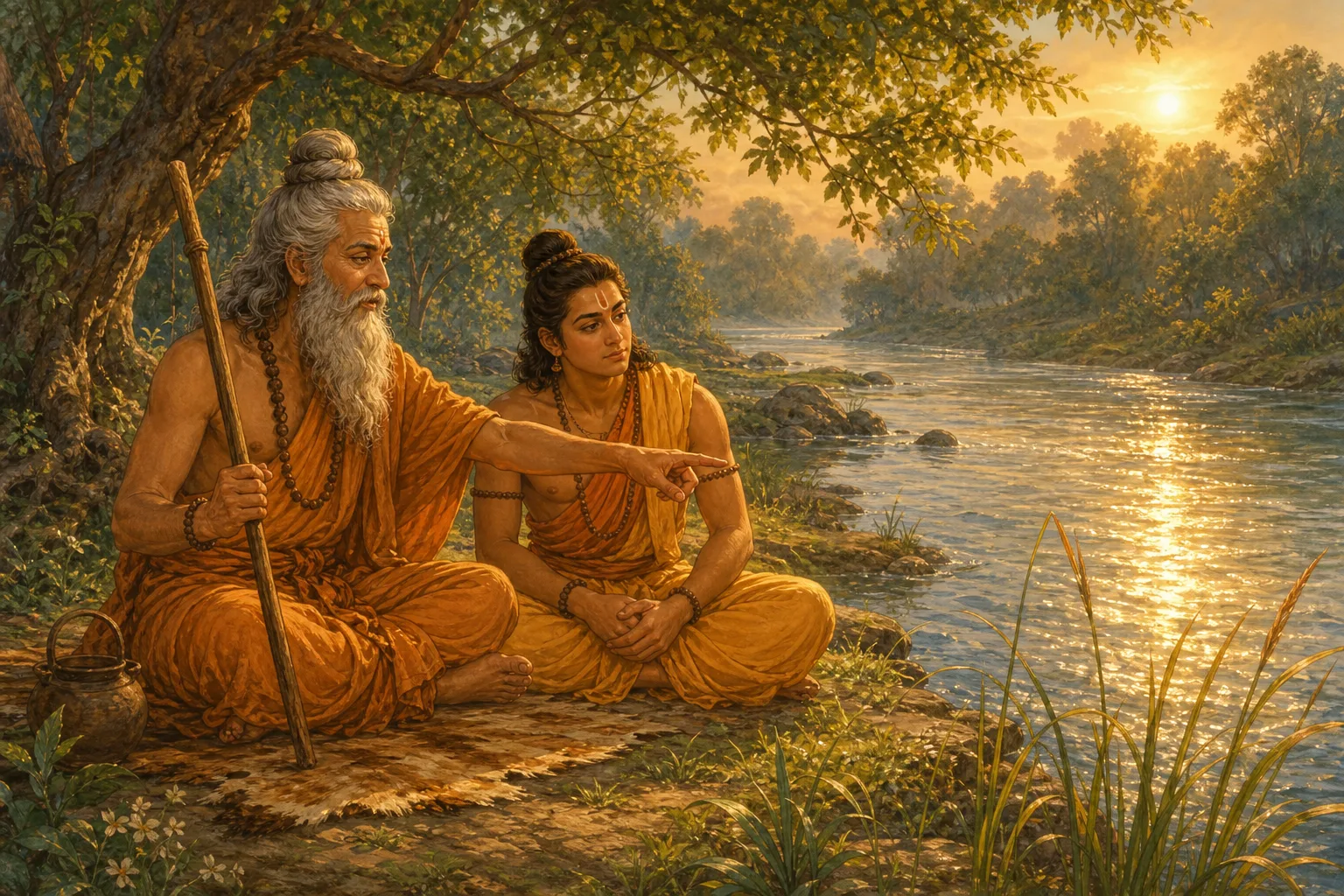
The sun had only begun to warm the banks of the Tamasa River when Bharadvaja found his teacher seated beneath a spreading tree. Valmiki's morning prayers were complete. Birds called from the reeds, and the river moved so quietly that every small sound seemed important.
Bharadvaja had listened to the Ramayana with devotion. He knew of Ayodhya and the forest exile, of Hanuman's leap, of the battle in Lanka, and of Ram and Sita's return. Yet one question had stayed with him.
He bowed and said, "Master, people speak of a Ramayana far greater than the portion known in our world. Are there events and teachings that we have not heard?"
Valmiki studied his student before answering. "Why do you wish to know?"
The question surprised Bharadvaja. After a moment he said, "Not so that I may boast of knowing a secret. I want to understand Ram and Sita more fully. I fear that when I think I already know a story, I stop listening."
Valmiki smiled. That was the answer of a true student.
He explained that the familiar Ramayana was not false or incomplete in the ordinary sense. It illuminated exile, duty, friendship, loss, courage, war, and return. The telling he was about to share turned the listener toward something that could be overlooked when Sita was remembered only as the person for whom others searched.
"Sita is Prakriti," Valmiki said, "the living power through which the universe acts. Ram is the consciousness that knows, and Sita is the power by which knowing becomes creation, protection, and transformation. They may appear as two, just as a flame and its light may be named separately. Yet light is never truly apart from flame."
Bharadvaja watched sunlight tremble upon the river. "Then is Sita's quietness also power?"
"Yes—but do not make the opposite mistake," replied Valmiki. "Gentleness is powerful, and fierce protection can also be sacred. One does not cancel the other. This telling will show Sita enduring, knowing, choosing, protecting, and finally revealing a form that even Ram has not fully understood."
The sage also gave a warning. Different Ramayanas had travelled through different communities and centuries, illuminating different questions. A newly heard telling should never be used to mock another or to claim that only one community had preserved truth.
"Listen carefully to the tradition named here," he said. "Keep its wonders distinct. Compare with humility."
The hidden account would begin before Ram's birth, pass through stories of devotion and sacred music, and lead beyond the victory in Lanka to a greater Ravana ruling from Pushkara. At the heart of that final struggle would stand Sita—not as the prize of a battle, but as its decisive power.
Bharadvaja folded his hands. He let go of the wish to fit every new idea immediately into what he already knew.
Valmiki drew a slow breath and began.
Beside the quiet river, an ancient story opened in a new direction. It did not erase the Ramayana Bharadvaja loved. It taught him to return to that story with wider eyes—and to notice the power that had been present all along.
“A familiar story may still hold truths we have not yet learned to see.”
New stories in your inbox
One story every week, and a special tale on festivals. Free, always.
Your email goes to our newsletter provider (beehiiv) so we can send you stories. It is not linked to any child's reading on this site. Unsubscribe any time from the email footer.