Two Sages and One Promise
Adbhuta Ramayana
Princess Shrimati grew up in King Ambarisha's palace surrounded by music, debate, and the daily work of government. She learned poetry and sacred traditions, but she also sat quietly near the court when her father heard disputes. She noticed that the loudest voice was not always the most truthful one.
Visitors praised her beauty. Ambarisha was proud of her calm judgment and her habit of asking what a decision would mean for people who were not present in the room.
One afternoon the sages Narada and Parvata arrived together. Both were welcomed with water, food, and honoured seats. During their conversation with the king, Narada announced that he wished to marry Shrimati.
Before Ambarisha could answer, Parvata said, "I have come with the same wish."
The warmth left the room. The king respected both sages. If he chose one, the other might feel insulted. More importantly, neither request could replace Shrimati's own decision.
Ambarisha answered carefully. "My daughter is not a gift that I can award. We will hold a svayamvara, a ceremony at which she will choose whether and whom she wishes to marry. She will place the garland herself."
Shrimati agreed. "I will listen to counsel," she told her father, "but the choice must be mine."
The king's decision should have reminded both sages that Shrimati might freely prefer someone else—or no one at all. Instead rivalry clouded their wisdom.
Narada privately approached Vishnu. "At the ceremony," he requested, "make Parvata appear to Shrimati with a monkey's face. Then she will certainly choose me."
Unknown to him, Parvata came separately with the same request about Narada.
Vishnu listened to each sage. He did not promise either of them Shrimati's hand. He simply allowed their schemes to lead toward a lesson neither expected.
As preparations began, palace courtyards filled with garlands and lamps. Musicians practised while cooks prepared food for visitors. Narada imagined Parvata alone looking foolish. Parvata pictured the same fate for Narada. Each was so busy planning the other's embarrassment that neither asked what kind of husband behaves this way before a marriage has even begun.
Shrimati prepared in another part of the palace. Her attendants wondered whether she felt afraid.
"I am concerned," she admitted, "but not because two respected sages are waiting. I am concerned that everyone will watch my choice and then tell a story about what they think I saw. I must trust my own eyes and mind."
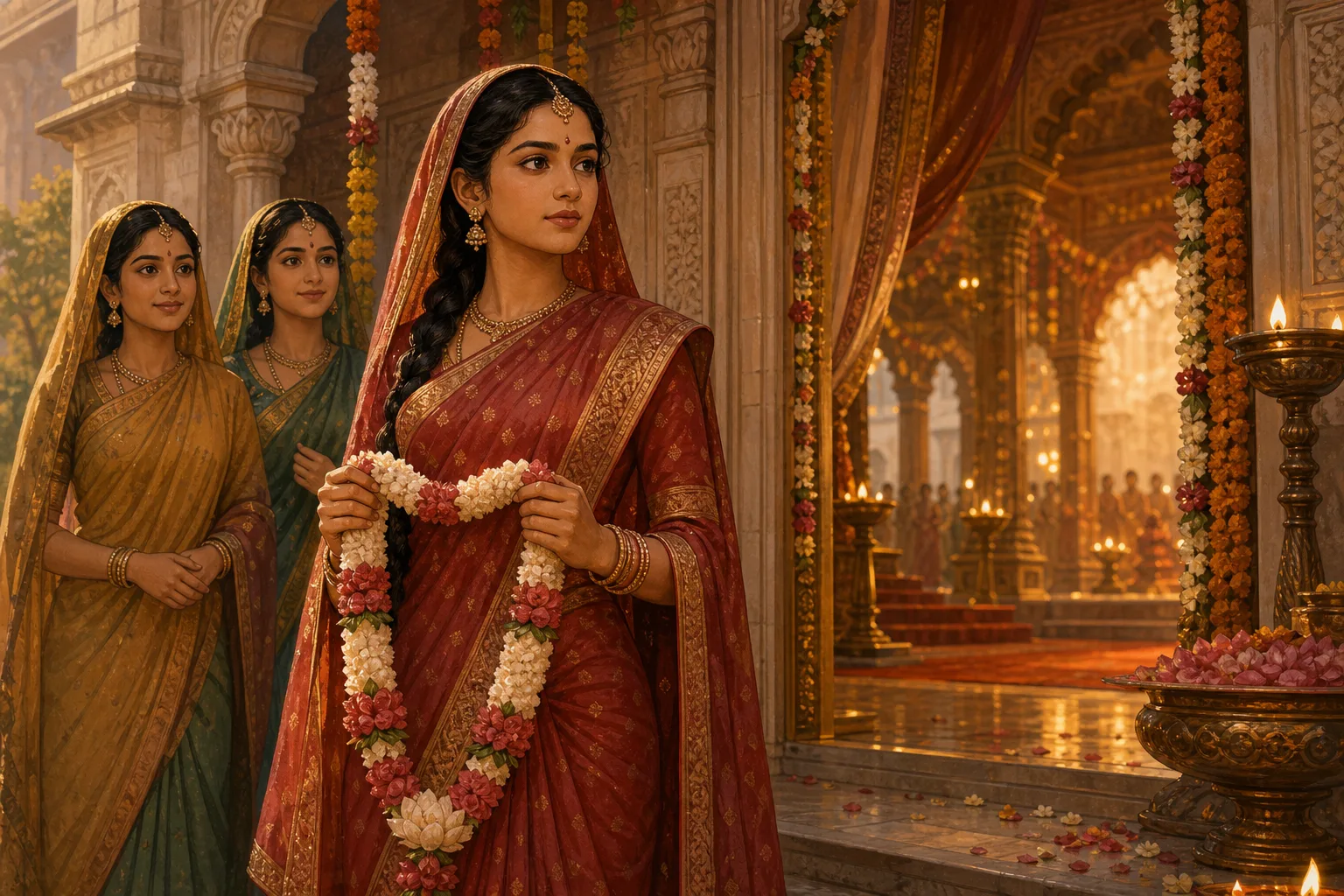
When the day arrived, guests filled the great hall. Narada and Parvata took their places, each wearing an expression of complete confidence.
Shrimati stood outside holding the wedding garland. The sages had turned the ceremony into a contest between themselves, but she was not its trophy. Whatever bewildering sight awaited her, the next step belonged to her.
“No one should be treated as a prize in another person's rivalry.”
New stories in your inbox
One story every week, and a special tale on festivals. Free, always.
Your email goes to our newsletter provider (beehiiv) so we can send you stories. It is not linked to any child's reading on this site. Unsubscribe any time from the email footer.