Rama Describes the Cosmic Self
Adbhuta Ramayana
Hanuman asked Rama to speak more directly about his deepest nature. Rama looked across the forest and invited him to notice how many forms surrounded them—trees, insects, stone, water, sunlight, and the lives hidden beyond sight.
“The highest reality is not limited to this body called Rama,” he said. “I am the ground of what has been, what is, and what will be. Yet these words should not make you ignore the person sitting before you.”
Hanuman struggled with the scale of the statement. “How can the immeasurable be present in one form?”
Rama pointed to sunlight entering through gaps in the leaves. It appeared as many bright shapes on the earth, though its source was not divided into separate suns.
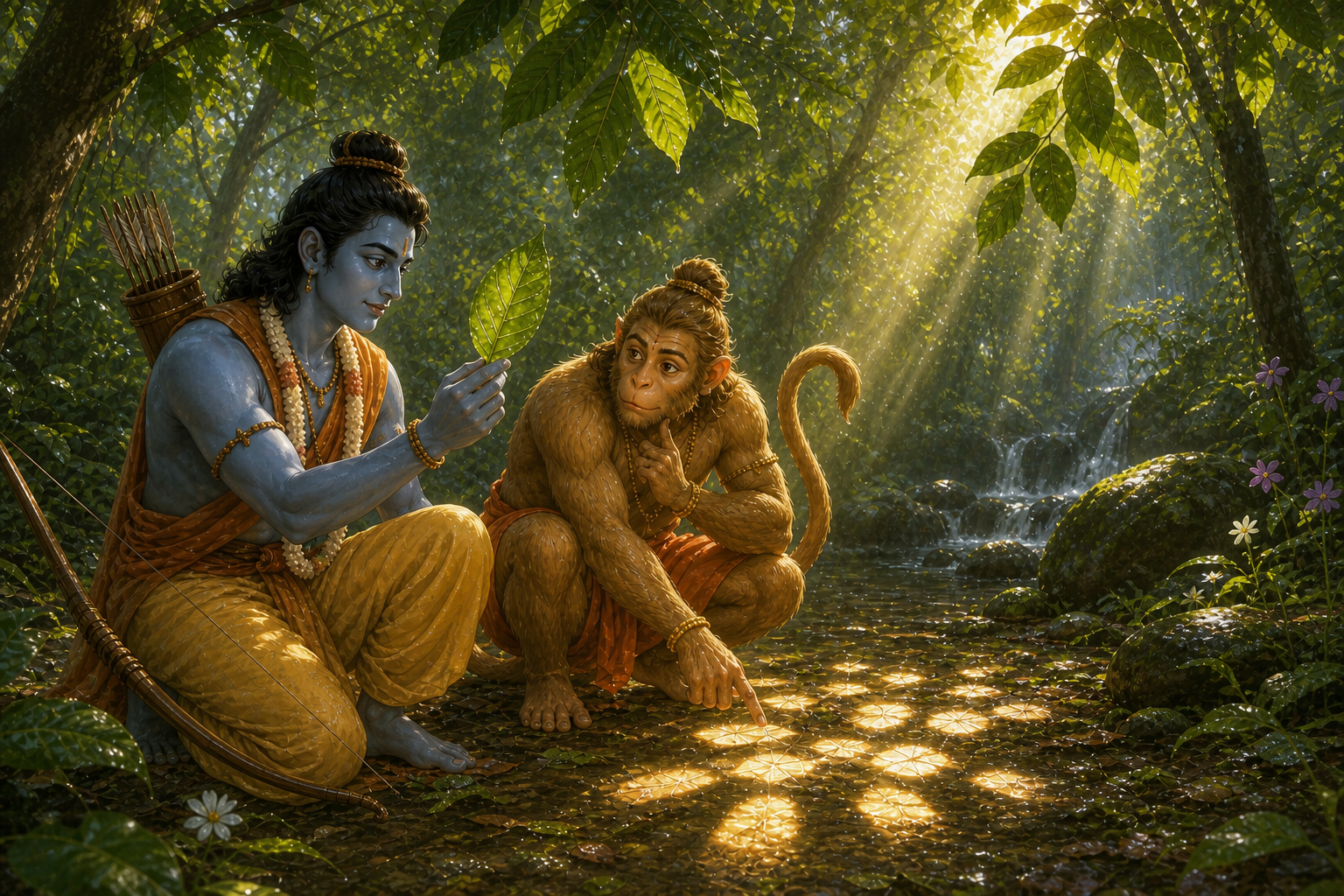
“A form can reveal without containing the whole,” he explained. “The mistake is not loving a form. The mistake is believing that truth must end at the boundary we can see.”
He spoke of time, creation, preservation, and dissolution as movements held within the deepest reality. Every being depended upon that ground, though each lived a distinct story and carried distinct responsibilities.
Hanuman asked whether such knowledge made individual effort meaningless.
“No,” Rama said. “A wave belongs to the ocean and still rises in a particular place. Your actions matter. The truth of unity does not erase consequence.”
That answer relieved Hanuman. If philosophy had declared that rescue and harm were identical, it would have contradicted the compassion guiding their search for Sita.
Rama explained that the cosmic self could not be mastered like an object placed in the hand. It could be approached through insight, devotion, disciplined practice, and grace. Words pointed toward it but could not exhaust it.
For a moment Hanuman imagined every sound of the forest occurring within one vast awareness. His own breath did not disappear; it joined a reality larger than his separate fear.
Then Rama brought the teaching back to the path before them. “Tomorrow we still meet Sugriva. We still keep our promises. We still search for Sita.”
Hanuman understood. A vision of vastness was not meant to leave him staring at the sky while someone needed help. It was meant to free action from small pride.
He rose and lifted his folded hands. The forest had become a lesson without ceasing to be a forest. The cosmic teaching had widened his understanding, and responsibility gave that understanding somewhere to stand.
“Humility grows when we remember that no single person contains the whole.”