A Remedy Worse Than the Disease
Panchatantra
Beside a lotus pond stood an old banyan tree. A family of herons nested high in its branches. They loved the cool shade and the sparkling water below.
But a snake lived among the roots. Whenever the parent herons flew away for food, it climbed toward the nest and frightened the chicks. The herons chased it back again and again, yet it always returned.
At last, the worried father heron asked a crab for advice.
The crab thought quickly. “A mongoose lives beyond the reeds,” he said. “Leave a trail of fish from its den to the snake’s hole. The mongoose will follow the trail and drive the snake away.”
The heron was so relieved to hear a plan that he did not ask what might happen afterward. He placed the fish just as the crab had suggested.
The mongoose followed the scent. It found the snake near the banyan roots, and after a fierce hissing quarrel, the snake fled far into the forest.
The herons cheered. Their problem seemed solved.
Then the mongoose lifted its nose. It smelled the chicks above. Having reached the banyan tree, it began circling the trunk and searching for a way up.
The father heron’s joy vanished. The new danger was even bolder than the old one.
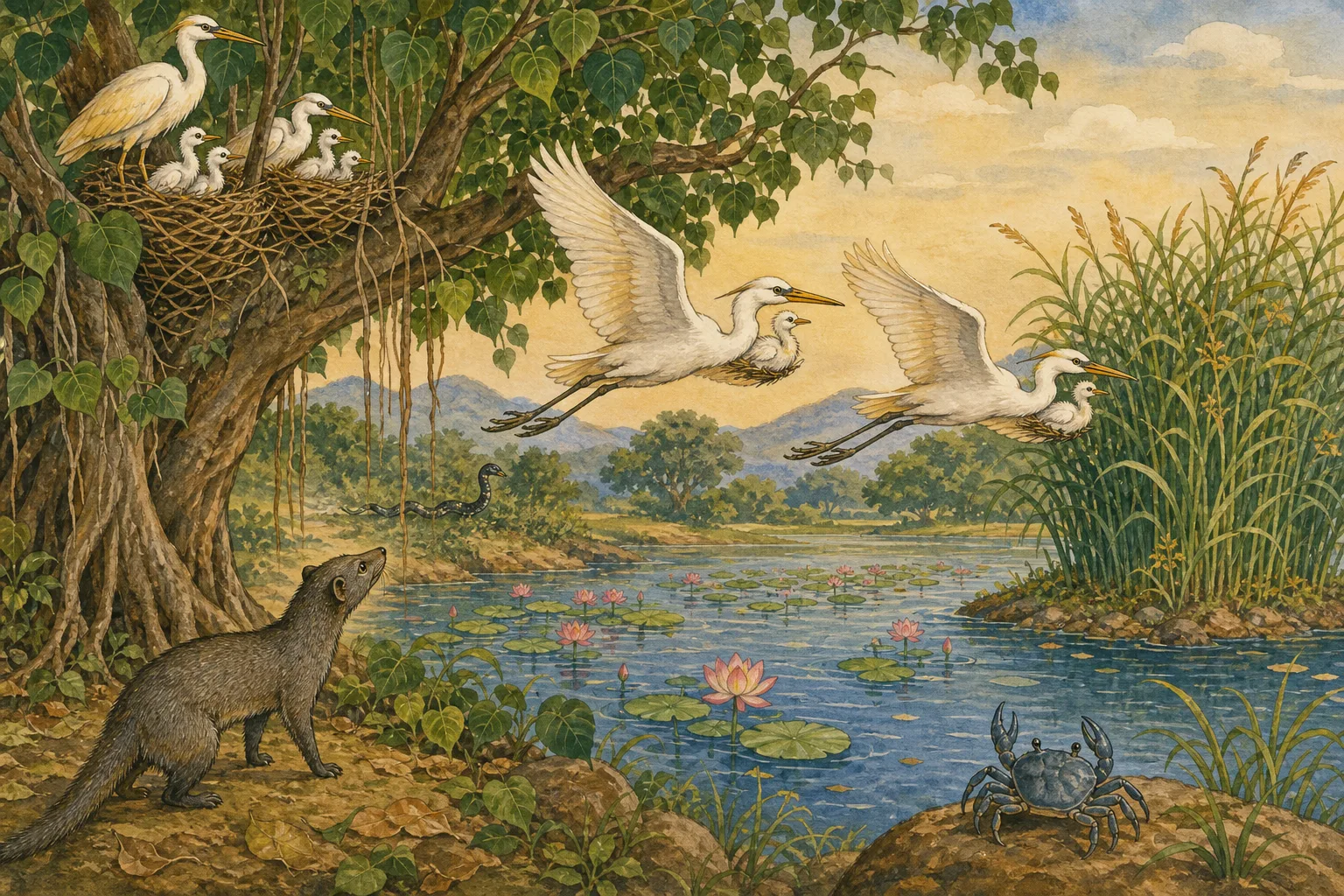
The mother heron acted at once. She called the other birds, and together they carried the chicks to a small island hidden among thick reeds. The mongoose could not cross the deep, muddy water.
When the family was safe, the crab lowered his eyes. “I thought only about removing the snake,” he admitted. “I did not think about what the mongoose would do next.”
“Nor did I,” said the father heron. “I accepted the first answer because I was afraid.”
The herons built a new nest on the reed island, where the pond itself guarded them. They learned to examine every plan from beginning to end.
The snake never returned, and the mongoose eventually wandered away. From then on, whenever the animals faced a problem, they asked not only, “Will this work?” but also, “What may happen after it works?”
“Before solving one problem, consider what new problems the solution may create.”
New stories in your inbox
One story every week, and a special tale on festivals. Free, always.
Your email goes to our newsletter provider (beehiiv) so we can send you stories. It is not linked to any child's reading on this site. Unsubscribe any time from the email footer.