1.2 The Jackal And The Drum
Panchatantra
Beneath the banyan tree, the lion Pingalaka was still thinking about the unknown bellow he had heard across the Yamuna. Damanaka said, “Your Majesty, we should not be frightened by a loud sound alone. First we must discover its cause. A jackal once learned this very lesson.”
Long ago, a hungry jackal wandered far through the forest in search of food. At last, he entered a clearing where a king’s army had camped many years before. The place was peaceful now. Grass covered the old wheels, and vines climbed over trees and forgotten equipment.
Suddenly—BOOM!
A deep sound rolled across the clearing. The jackal froze. His ears stood upright and his tail dropped low.
“What made that noise?” he wondered. “A huge and terrible creature must be hiding nearby. I should run at once!”
He was about to turn away when he stopped. Apart from the sound, he had seen no creature and heard no footsteps.
“If I flee without learning the truth, every strange noise will frighten me,” he told himself. “I will watch from a safe distance and discover where it comes from.”
Keeping low behind the tall grass, the jackal crept forward. For a while, everything was quiet. Then a gust of wind swept through the clearing. A flexible branch bent down and struck the hide of a great war-drum beneath the tree.
BOOM!
The jackal jumped again, but this time he did not run. He watched closely. When the wind settled, the branch lifted away and the sound stopped. When the wind returned, the branch touched the drum—and the deep rumble came again.
“So it is not the roar of a creature,” the jackal said with relief. “It is only the wind, the branch, and the drum.”
He moved nearer, sniffed the drum, and gently tapped it with one paw. Boom-boom! This time the sound made him smile.
The drum was so large that another thought entered his mind. “Perhaps it is packed with food. Why else would it have such a grand voice?”
He widened a loose split along its side and peered inside. There was no creature and no feast—only an empty space, wood, and hide.
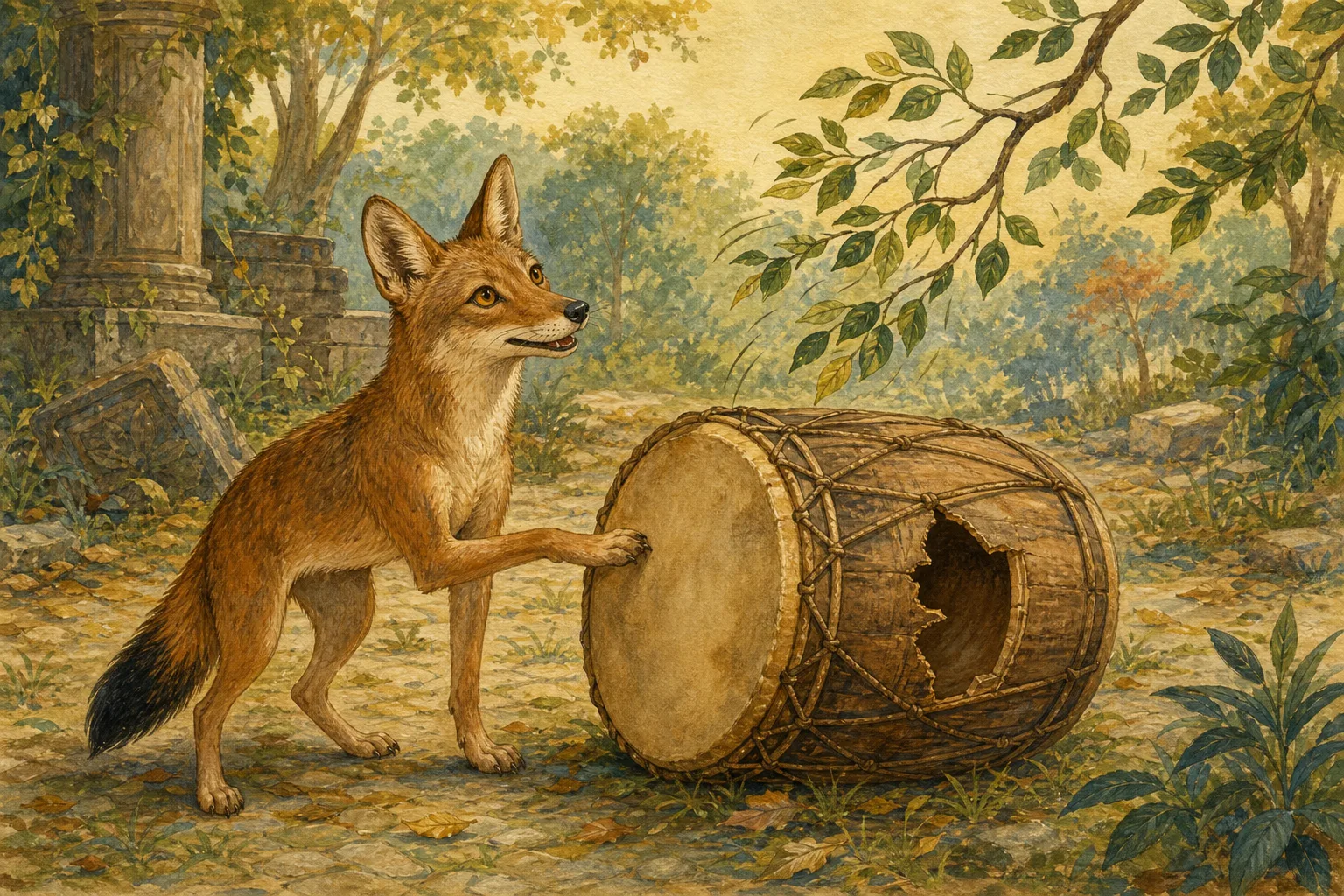
The jackal laughed at himself. “First I heard a noise and imagined the worst. Then I heard the same noise and imagined a great reward. The truth was much simpler than either guess.”
He continued on his way without fear. He had not found a meal, but he had gained something useful: the wisdom to examine the unknown before being ruled by it.
Damanaka finished the tale and said to Pingalaka, “That is why we should not judge strength by sound alone. If you permit me, I will discover who is calling across the Yamuna.”
Pingalaka agreed. Damanaka carefully followed the sound and found Sanjeevaka, the healthy white bull, grazing on tender grass. When he returned, he told the lion, “The voice that startled the forest belongs to a bull. He is strong, but he did not come to attack us.”
Pingalaka breathed more easily. Damanaka obtained a promise of safe conduct from both lion and bull. Now he prepared to bring them face to face—and the frame story of the Panchatantra took a new turn.
Moral: A loud sound is not proof of danger. Pause, observe, and learn the truth before fear guides your actions.
“A loud sound is not proof of danger. Pause, observe, and learn the truth before fear guides your actions.”
New stories in your inbox
One story every week, and a special tale on festivals. Free, always.
Your email goes to our newsletter provider (beehiiv) so we can send you stories. It is not linked to any child's reading on this site. Unsubscribe any time from the email footer.