The Town That Slept by Day
Kāśī Majilī Kathalu
At midday, Manisiddhu and Shounaka approached a settlement where every door was shut. No hammer rang from the smithy. No grain seller called from the market. Even the tea stall was dark.
"Has everyone vanished?" Shounaka whispered.
A woman opened a window and laughed. "It is our rest day. The market will open tomorrow."
The quiet street reminded Manisiddhu of another town—one that had been ordered to sleep every day while the sun shone.
In that town lived King Kaninudu, who enjoyed new ideas. Some were useful. He planted shade trees beside roads and asked builders to repair wells before summer.
But one evening, as lamps were being lit, the king looked across his palace balcony.
"Every kingdom works by day and sleeps by night," he said. "Mine should be different. From now on, everyone will sleep during the day and work at night."
His minister, Amara, spoke carefully. "Your Majesty, night work suits guards, astronomers, and some bakers. But farmers need sunlight to see their crops. Children need regular rest. Traders must meet travellers when they arrive."
"They will adjust," said the king. "People always doubt a bold idea."
The order went out.
On the first morning, guards rang bells telling everyone to go to bed. Goats bleated outside closed gates. Roosters crowed to empty lanes. Children pulled blankets over their heads, though sunlight slipped through every crack.
At night, the market opened.
A cloth merchant held blue fabric near an oil lamp. "Is this indigo or green?" asked a customer.
"Certainly," the merchant replied, because he could not tell either.
Farmers carried lamps into their fields. One carefully watered a row of weeds. Another stepped into an irrigation ditch he could not see.
The town's bakers tried to work at midnight, but the grain carts arrived after sunrise, when the gates were closed. Potters shaped clay at night, yet could not judge whether their pots were drying evenly. Children nodded over their lessons. Dogs barked at every unusual sound, while owls and bats fled the sudden noise.
Travellers reached the town in daylight and found no food, water, or open stable. By the time the shops opened at night, the travellers had continued elsewhere.
Minister Amara collected these reports and returned to the king.
"People resist change," the king said. "Give them time."
"Then let us test the rule properly," Amara replied. "Spend one full day and night following it as an ordinary resident would. If it works well, your confidence will be strengthened."
The king agreed.
At sunrise, he entered a small house near the market and tried to sleep. Carts from beyond the town rattled past. Birds called. Heat gathered beneath the roof. By noon, he had turned his pillow over twelve times.
At sunset, tired but determined, he went to work with a farmer.
"Which plants need water?" the king asked.
"The ones with curling leaves," said the farmer. "But in this light, we cannot see them clearly."
Later, the king helped a baker. The flour had arrived late, so no dough was ready. At the market, a traveller asked for medicine, but the healer had gone to gather herbs and could not identify them safely in darkness.
Near midnight, the king met a group of children trying to learn arithmetic.
"If four mangoes—" their teacher began.
One child's head sank onto the desk.
Another murmured, "May the four mangoes please go to sleep?"
The king almost smiled, but then he saw how exhausted they were.
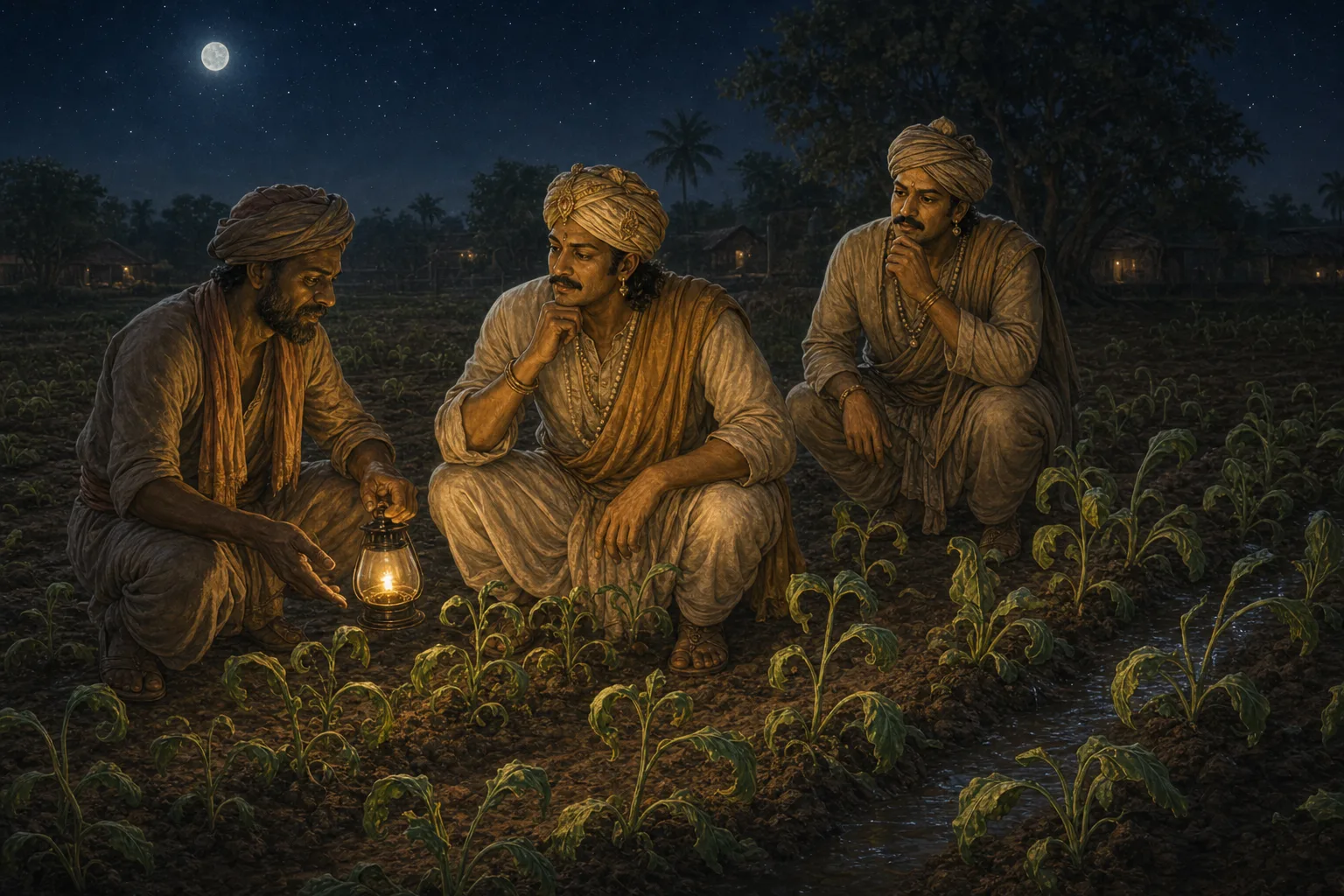
Before dawn, a potter showed him a batch of cracked bowls. A stable keeper explained that horses arriving by day had gone without care. A watchman said the crowded night streets made it harder, not easier, to hear signs of danger.
When the sun rose, King Kaninudu was too tired to think clearly. At last he understood: his order did not fail because people lacked imagination. It failed because he had ignored how their work fitted together.
That evening, he gathered the town.
"I wanted our kingdom to be remarkable," he said. "Instead, I made daily life harder. I was wrong."
He restored the usual rhythm: most work by day, rest by night, with sensible exceptions for those whose tasks required different hours.
Then he formed a council of farmers, craftspeople, traders, teachers, healers, and workers. Before a future law affected the whole town, the council would ask: Who will this help? Who will it burden? What might happen that we have not noticed?
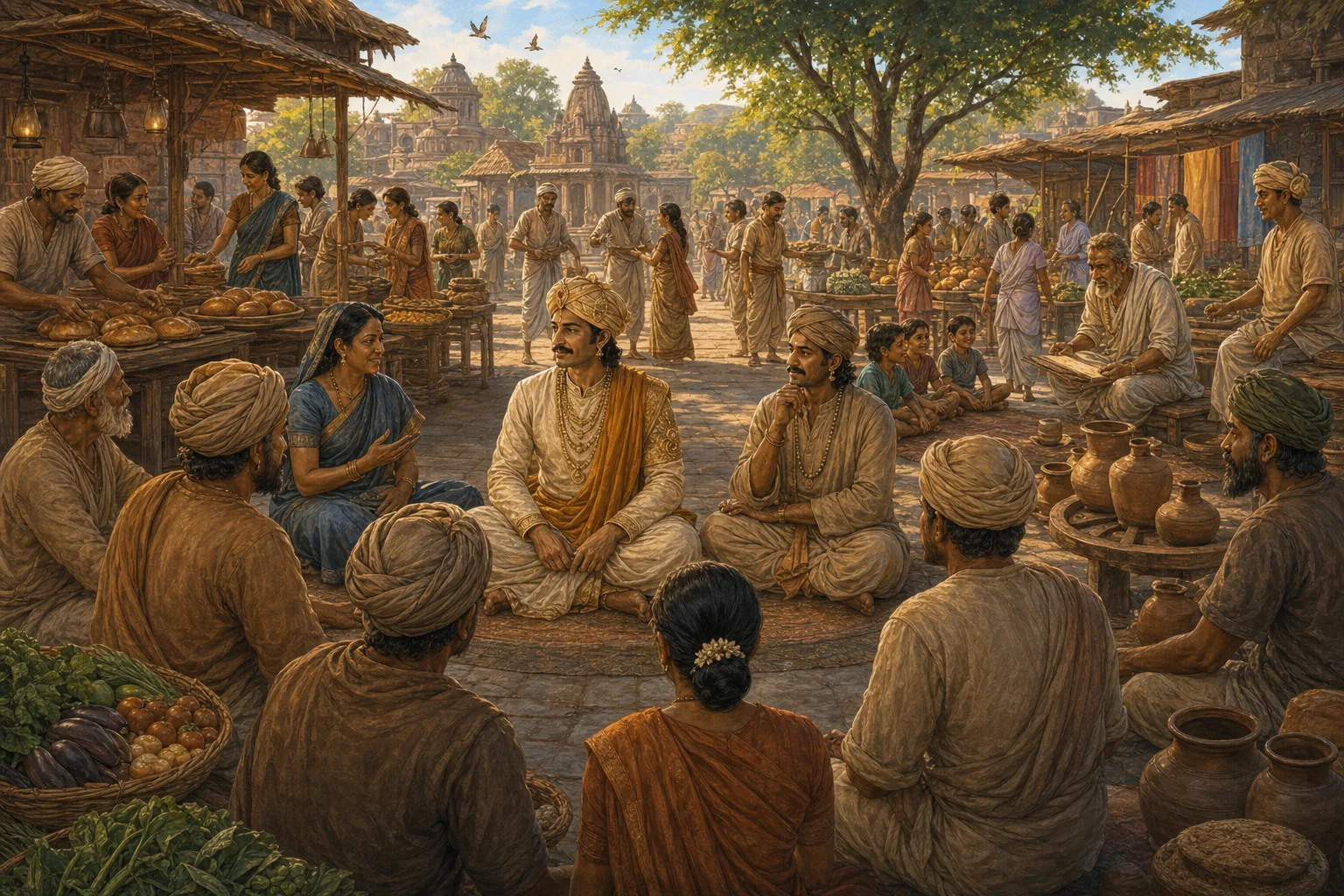
Soon the market filled again with colour in the sun. Children arrived at lessons awake. Farmers could see their fields, and night creatures returned to quiet lanes.
Back in the settlement, Shounaka listened as a shopkeeper lifted the shutters for the afternoon.
"The king's best decision was not his first one," Shounaka said. "It was admitting the first one was wrong."
"Correcting a mistake is also part of leadership," Manisiddhu replied.
They bought fruit for the road and continued toward Kāśī beneath the clear daylight.
New stories in your inbox
One story every week, and a special tale on festivals. Free, always.
Your email goes to our newsletter provider (beehiiv) so we can send you stories. It is not linked to any child's reading on this site. Unsubscribe any time from the email footer.