The Storytelling Gem
Kāśī Majilī Kathalu
Before Manisiddhu became a traveller, he lived in a quiet learning retreat beside a grove of neem and tamarind trees. At dawn, birds called from the branches. In the evening, students filled clay lamps and sat with their teacher beneath an open veranda.
Manisiddhu loved lessons, but his teacher did not begin with long speeches.
“Today,” the teacher would say, “listen.”
So Manisiddhu listened to the gardener explain why young plants needed shade. He listened to a potter tap a water jar and hear a tiny crack. He listened to two children disagree over a game, then discover that each had understood the rules differently.
On another day, the teacher said, “Observe.”
Manisiddhu noticed which path became slippery after rain. He saw that an old visitor rubbed her hands when the morning was cold, though she never complained. He watched ants find a new way around a fallen leaf.
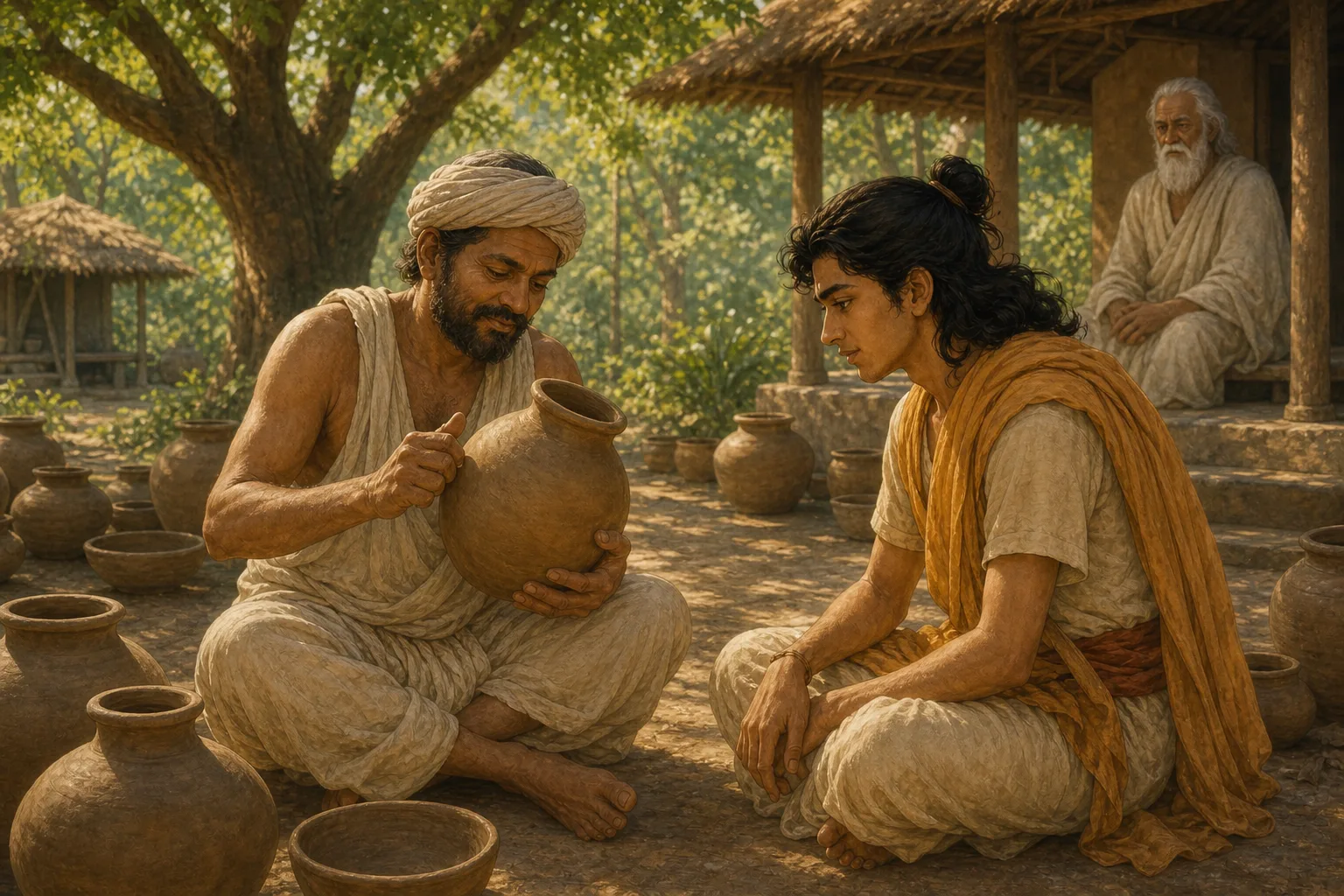
Only after listening and observing did the teacher ask him to speak.
At first, Manisiddhu wanted to answer every question quickly. Once, when a farmer came worried about a missing calf, Manisiddhu offered three clever guesses.
The farmer shook his head. “I have already looked in those places.”
The teacher asked, “What did you forget?”
Manisiddhu thought. Then he sat beside the farmer and asked him to describe the calf: what it liked to eat, whether it feared loud noises, and where it had wandered before.
“She always follows the smell of sesame leaves,” the farmer said at last.
They found the calf near a field where sesame plants grew. Manisiddhu returned dusty and relieved.
“Knowledge is useful,” his teacher told him, “but attention shows us where to use it.”
The seasons turned. Manisiddhu learned poems, histories, songs, and many old tales. More importantly, he learned that the same story could comfort one listener, warn another, and help two quarrelling friends see each other more clearly.
At last came the day when his studies were complete.
His teacher called him to the veranda. On a folded square of cotton lay a gem no bigger than the nail of Manisiddhu’s thumb. It was smooth and pale, with a warm glimmer deep inside.
“Is it magical?” Manisiddhu whispered.
His teacher smiled. “Hold it and look at the old walking staff by the wall.”
Manisiddhu took the gem. It did not shout an answer. No vision burst before him. Yet the worn staff suddenly caught his attention: the polished place where a hand had held it, the red dust in a crack, and a thin strand of mountain grass caught beneath its cord.
“It has travelled far,” he said. “Perhaps its owner crossed red-earth roads and high meadows.”
“Perhaps,” said his teacher. “The gem cannot tell you everything, and neither can I. It helps a patient mind notice the threads from which a story may be woven. You must still ask, listen, check what you can, and admit what you do not know.”
Manisiddhu turned the gem in his palm. “Then why give it to me?”
“Because stories are not only entertainment,” the teacher replied. “A story can open a door in someone’s mind. It can also close one if told carelessly. Carry this as a reminder: knowledge should help people, not make you feel greater than them.”
The next morning, Manisiddhu packed a spare cloth, a water cup, and a little food in a shoulder bag. He placed the gem in a small pouch close to his heart.
He had decided to travel toward Kāśī, the ancient city beside the Ganga. He would learn from the people and places along the road. When a question deserved more than a quick reply, he would answer, if he could, with a story.
At the edge of the retreat, he bowed to his teacher.
“What if I choose the wrong story?” he asked.
“Then listen again,” said the teacher. “A good storyteller is always a student.”
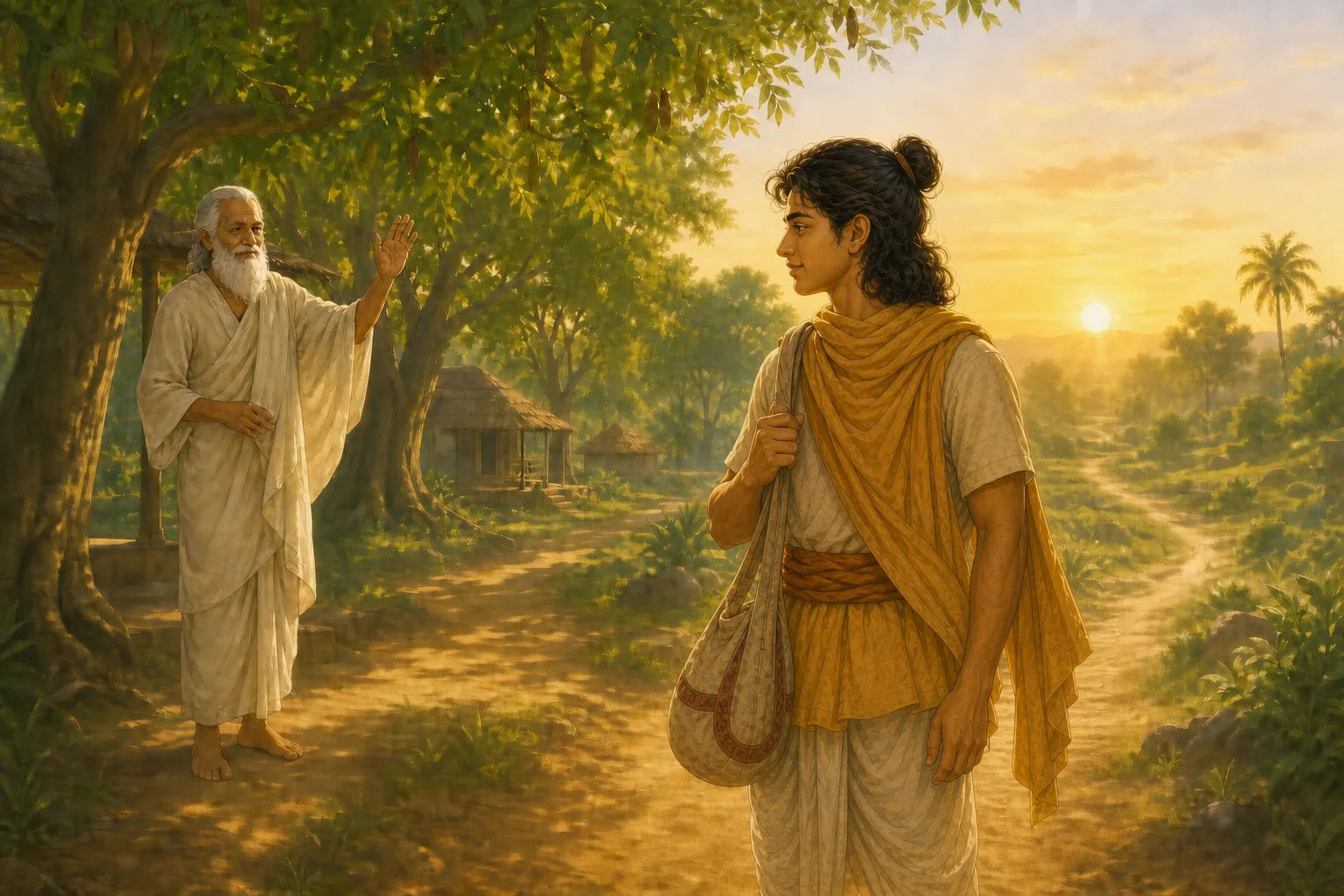
Manisiddhu stepped onto the morning road. The world beyond the grove was bright and wide. He felt wonder, and also the gentle weight of responsibility.
The little gem did not pull him toward any secret. It simply caught the sunlight as he walked, reminding him to keep his eyes open and his judgments kind.
Ahead lay villages, rivers, forests, and questions he had not yet imagined.
And beyond them, Kāśī.
New stories in your inbox
One story every week, and a special tale on festivals. Free, always.
Your email goes to our newsletter provider (beehiiv) so we can send you stories. It is not linked to any child's reading on this site. Unsubscribe any time from the email footer.