Manisiddhu and the Curious Cowherd
Kāśī Majilī Kathalu
Several days after leaving his teacher, Manisiddhu crossed a broad stretch of grazing land. The afternoon sun shone fiercely, and the road divided around a low, rocky hill.
Manisiddhu chose the wider path.
"That way has no water," called a voice behind him.
He turned. A boy stood among a small herd of cattle, holding a walking stick. His clothes were simple, his feet dusty, and his eyes bright with interest.
"The narrow path reaches a stream," the boy said. "The wide one reaches three thorn bushes and a great deal of disappointment."
Manisiddhu laughed and thanked him. Together they guided the cattle toward the stream, where shade trembled beneath tamarind leaves.
The boy's name was Kotappa. Before Manisiddhu had filled his cup, Kotappa had asked where he came from, where he was going, why his bag looked so light, and whether Kāśī was truly as far away as people said.
Then he saw a pale gleam at the opening of Manisiddhu's pouch.
"What is that? A diamond? A star-stone? Does it show buried treasure? Can it speak? Does it know where my brown calf hides when it is time to go home?"
Manisiddhu closed the pouch gently. "It is a storytelling gem."
Kotappa leaned closer. "So it tells stories?"
"Not by itself."
"Then what does it do?"
"It reminds me to notice the stories around me."
Kotappa looked doubtful. "I notice things without a gem."
Manisiddhu nearly answered too quickly. Then he remembered his teacher's first lesson.
"What have you noticed today?" he asked.
Kotappa pointed upstream. "The water is cloudy because it rained near the hills last night. Green parrots flew east at noon, so there are ripe guavas near the next village. That cow with the white ear will limp if we take the stony path. And the wind has changed. We should not sit beneath this tree for long."
The sky was still blue, but Manisiddhu listened. Soon a dark line of clouds rose above the western ridge.
They moved the herd to a shallow cave. Rain swept across the grass moments later.
"You were right," Manisiddhu said.
Kotappa grinned. "The ants were carrying their eggs uphill."
As rain drummed on the rock, Kotappa asked about the learning retreat. Manisiddhu described the lessons, the old tales, and the teacher who had given him the gem.
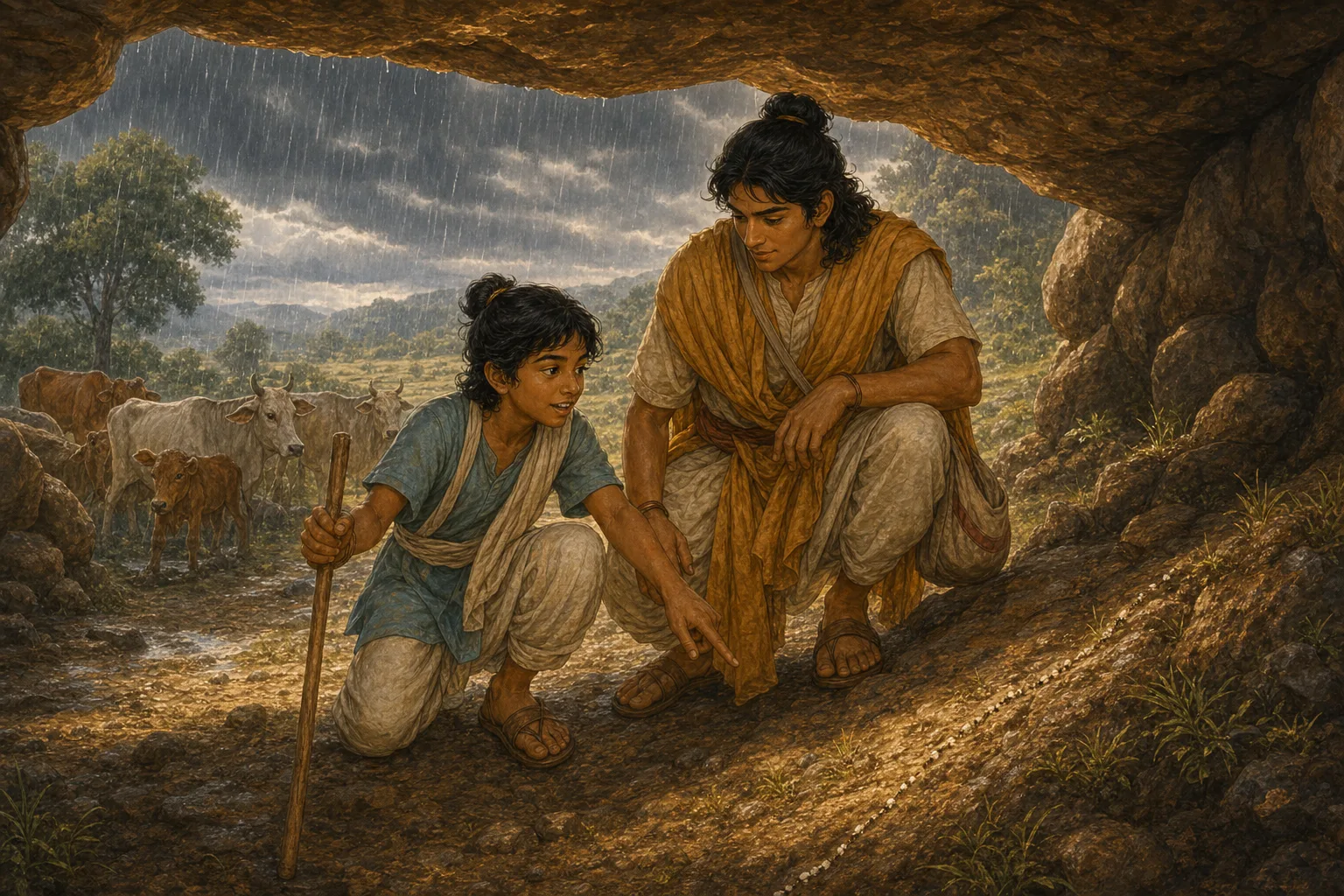
Kotappa's grin faded. "I have not studied in a place like that."
"You have studied these fields," Manisiddhu replied. "You read clouds, tracks, birds, and cattle. A traveller who ignored what you know would soon be thirsty, lost, or caught in a storm."
Kotappa considered this. "Could someone learn both kinds of knowledge?"
"I hope so. I am trying."
When the rain ended, they walked toward Kotappa's village. At a muddy crossing, Manisiddhu stepped forward, but Kotappa stopped him.
"The middle looks firm because sand covers it," he said. "Step where the reeds grow."
Manisiddhu followed and crossed safely. A little later, Kotappa puzzled over marks on a broken stone beside the road. Manisiddhu explained that they were part of an old boundary sign and told how travellers used landmarks before roads had mile markers.
By sunset, each had answered almost as many questions as he had asked.
At the village edge, Kotappa became quiet.
"I want to see what lies beyond these fields," he said. "May I travel with you for a while? I can find paths and water. I can care for animals. And I ask useful questions—most of the time."
Manisiddhu did not treat the request lightly. They spoke with Kotappa's family and the elders who cared for him. They discussed the route, the work, and how news would be sent home. Only when everyone was satisfied did the two prepare to leave together.
They made an agreement beneath the same tamarind tree.
Kotappa would teach Manisiddhu about the land and practical life. Manisiddhu would answer important questions through stories whenever a story could help. Both would listen when the other had something to teach. And neither would pretend to know what he did not.
"A proper agreement should have a proper beginning," Manisiddhu said. "On the journey, may I call you Shounaka? It is an affectionate name for a devoted listener and seeker of stories."
Kotappa tested the sound. "Shou-na-ka." Then he smiled. "Yes—but I am still Kotappa too."
"Always," said Manisiddhu.
At dawn, Kotappa—now also Shounaka—said farewell to his family. He carried a small cloth bag and his familiar walking stick. Manisiddhu carried the gem.
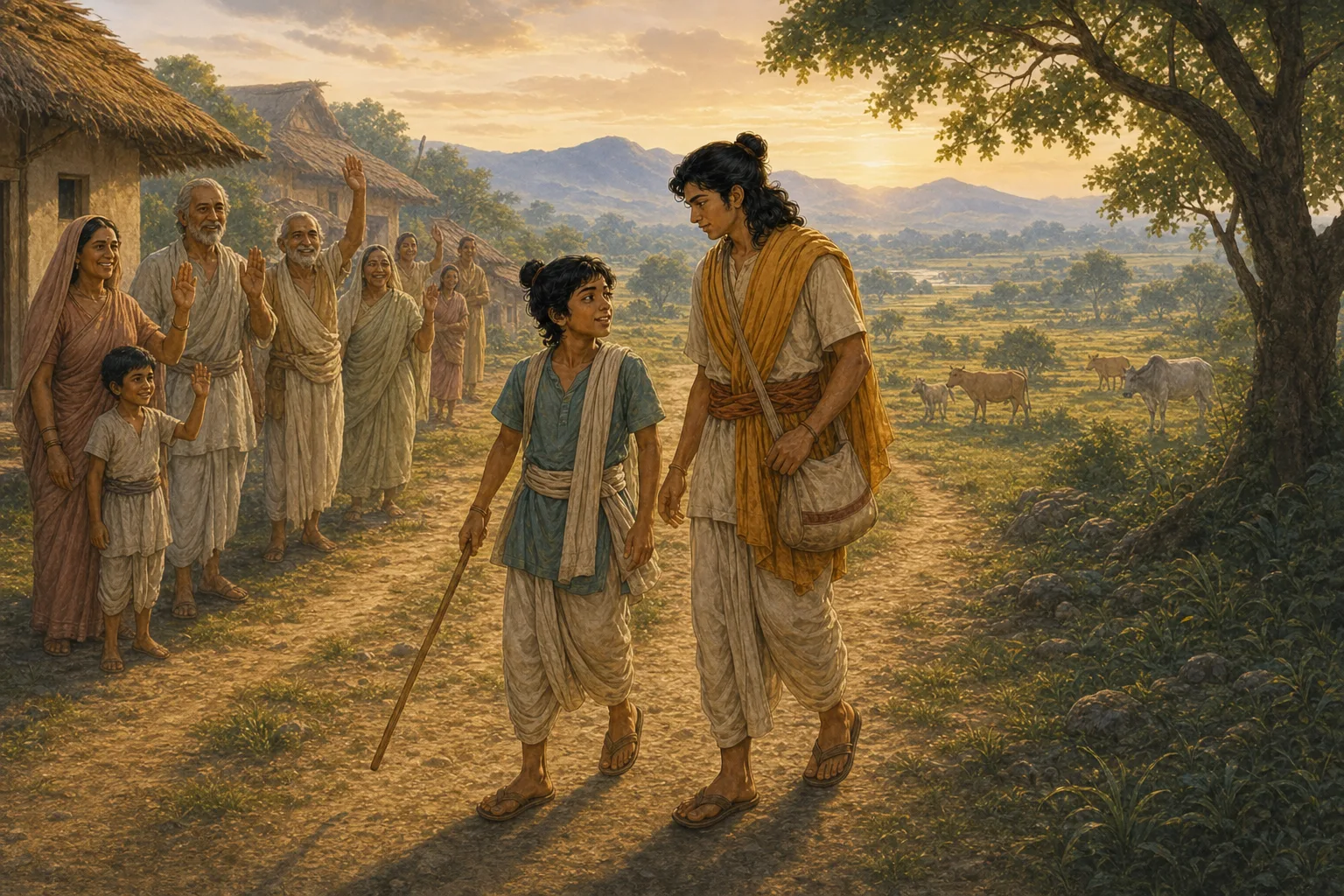
They had not travelled far when Shounaka asked, "Can a mountain become proud?"
Manisiddhu glanced at the blue hills ahead.
"That," he said, "is a question for the road."
Side by side, the storyteller and the curious cowherd continued toward Kāśī.
New stories in your inbox
One story every week, and a special tale on festivals. Free, always.
Your email goes to our newsletter provider (beehiiv) so we can send you stories. It is not linked to any child's reading on this site. Unsubscribe any time from the email footer.