Ruru and Pramadvara
Mahabharata
Part 1: Two lives meet in the forest
In a forest hermitage lived a young man named Ruru. He came from a family of sages, but he was not interested only in books and prayers. He listened closely to birds, knew where deer drank at sunset, and helped older residents gather fruit and firewood.
Not far away, Sage Sthulakesha had raised a girl named Pramadvara. Her birth parents were the celestial musician Vishvavasu and the apsara Menaka, but Sthulakesha had cared for her from infancy. Pramadvara grew into a thoughtful young woman who loved the forest paths and brought quiet cheer wherever she went.
When Ruru and Pramadvara met, they found that conversation came easily. They walked beneath flowering trees, spoke about the lives they hoped to build, and treated one another with warmth and respect.
Their families blessed their wish to marry. The hermitages began preparing for a joyful celebration.
One afternoon, a few days before the wedding, Pramadvara went walking with her companions. Fallen blossoms covered the path. Hidden among them lay a sleeping snake.
Pramadvara did not see it. Her foot came down close beside the snake, startling it awake. It struck in fear and slipped away into the grass.
Pramadvara collapsed.
Her companions called for help. The sages came quickly, but the snake's poison had already stilled her breath. They laid her peacefully beneath a tree and sent someone to find Ruru.
Part 2: A choice born from love
When Ruru saw Pramadvara lying still, sorrow seemed to close around him.
He walked alone to the riverbank.
“If kindness, service, and honest prayer have any value,” he said, “let them help Pramadvara now. I would give everything I have to see her live.”
A celestial messenger appeared in a gentle light.
“Ruru,” the messenger said, “every life has its appointed span. Yet the devas have heard the love in your plea. If you freely give half the years allotted to you, those years may be given to Pramadvara. You must choose without pressure, knowing that your own life will be shorter.”
Ruru thought of the future he had imagined. Then he thought of Pramadvara's future—her friendships, her wisdom, and all the good she might yet bring into the world.

“I give half my years freely,” he said.
The messenger carried his answer to the realm of Yama, guardian of justice and death. Permission was granted.
Back beneath the tree, warmth returned to Pramadvara's hands. She drew a breath and opened her eyes.
Ruru knelt beside her, overcome with relief. Pramadvara listened as the sages explained what had happened. She took Ruru's hand, grateful not only for his gift but also for the freedom with which he had given it.
In time, they celebrated their marriage with their families and friends.
Yet Ruru's sorrow had left a shadow.
Part 3: When grief becomes anger
Ruru could not forget the snake hidden beneath the flowers. Each time he saw one moving through the forest, fear and anger rose together.
“A snake took Pramadvara from us,” he thought. “No snake can be trusted.”
He began walking with a heavy staff. Whenever he saw a snake, he chased it away. Soon he stopped asking whether it was venomous or whether it had threatened anyone. In his mind, every snake had become the same snake.
Pramadvara saw the change in him.
“Your grief was real,” she said gently. “But the creature that startled beneath my foot is gone. These other animals did not harm me.”
Ruru heard her words, but his anger was not ready to release him.
One day he found a large, slow serpent resting beside a fallen tree. Its body was broad, but its head had none of the markings of a venomous snake.
Ruru raised his staff.
The serpent did not strike or flee.
“Why do you wish to hurt me?” it asked.
Ruru froze. “A snake nearly took Pramadvara's life. I have sworn that snakes will never cause such grief again.”
“Did I bite her?” the serpent asked.
“No.”
“Did I threaten you?”
“No.”
“Then if you punish me for another creature's act, will that be justice—or will it only give your grief a new victim?”
Part 4: Sahasrapata's story
The serpent told Ruru that his name was Sahasrapata and that he had once been a human sage.
“In my youth,” Sahasrapata said, “I had a friend named Khagama. One day I made a snake from grass and tossed it near him as a foolish joke. He was so startled that he fainted. When he awoke, he cursed me to become a harmless serpent.”
Sahasrapata had apologized at once.
“Khagama saw that I truly regretted my action,” he continued. “He could not withdraw his spoken curse, but he gave it an ending. He said that when I met Ruru, son of Pramati, I would regain my human form.”
Ruru slowly lowered his staff.
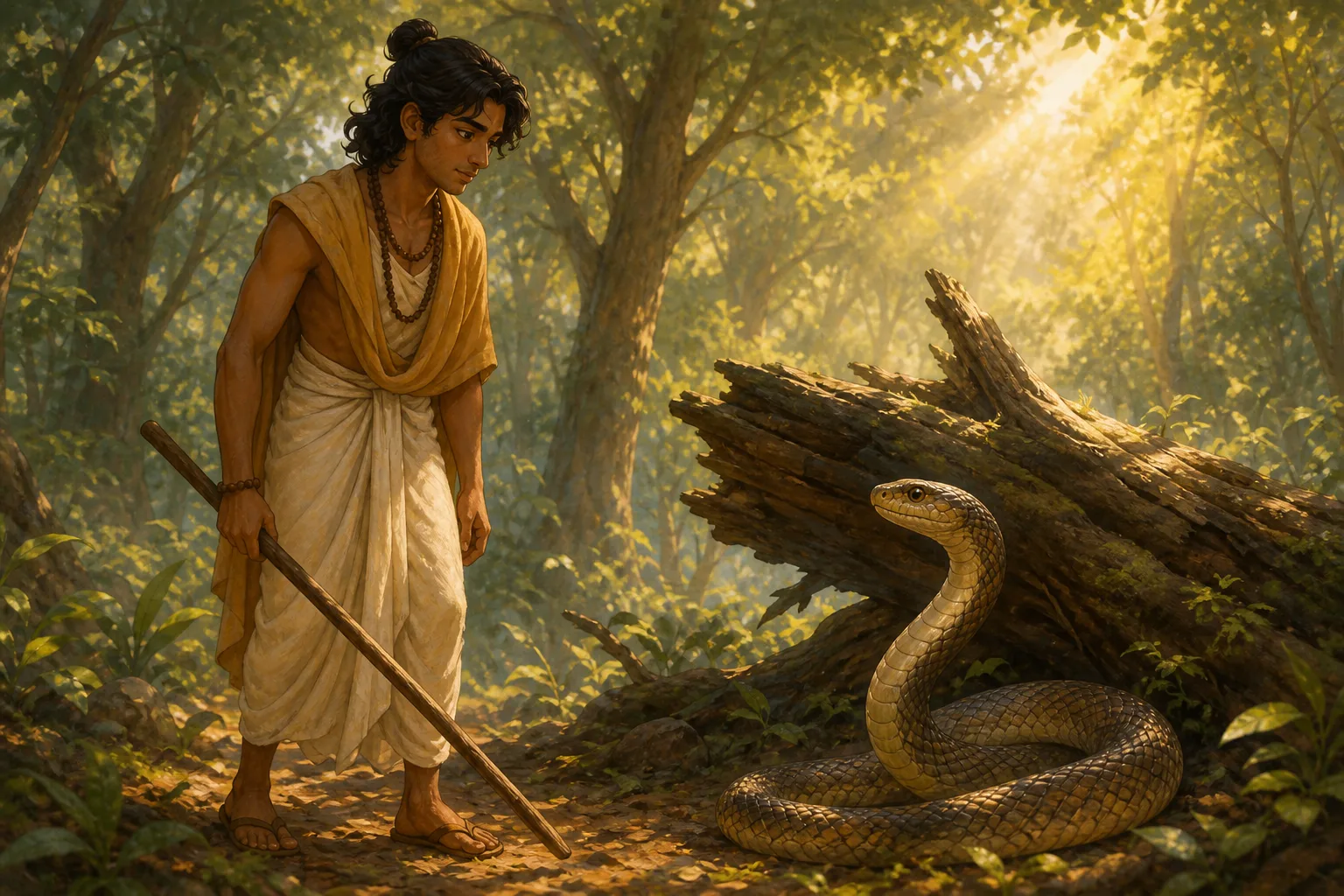
As he did, the serpent's shape shimmered. In its place stood an elderly sage with kind eyes.
“You have released me,” Sahasrapata said. “Now release yourself from the belief that all who look alike must share one guilt. Some snakes are dangerous, many are not, and none should be condemned without cause. A person devoted to wisdom protects life wherever possible.”
Ruru looked at the staff in his hands. He remembered Pramadvara's words and saw how far his fear had carried him.
“I wanted to prevent another loss,” he said. “Instead, I was preparing to cause one.”
Part 5: A different promise
Ruru returned to Pramadvara and told her about Sahasrapata.
“You were right,” he said. “I cannot undo what happened to you, but I can choose what my grief becomes.”
Together they made a new promise. They would warn people away from truly dangerous snakes, move carefully through tall grass, and seek knowledgeable help when an animal entered a home. But they would not harm a creature simply because of fear.
Ruru set aside his heavy staff.
The forest did not become perfectly safe. No forest ever is. Yet it became a place where Ruru again noticed differences: the harmless serpent sunning on a rock, the cobra that deserved distance, the rustle made by a lizard, and the flowering path where Pramadvara now walked beside him.
His love had once led him to share half his years. At last, that same love taught him how to value the years and lives of others.
“Grief deserves compassion, but it must never become punishment for the innocent.”
New stories in your inbox
One story every week, and a special tale on festivals. Free, always.
Your email goes to our newsletter provider (beehiiv) so we can send you stories. It is not linked to any child's reading on this site. Unsubscribe any time from the email footer.