Nala and Damayanti
Mahabharata
Part 1: The swan's message
King Nala ruled Nishadha with fairness and skill. He understood horses better than anyone in his kingdom, listened carefully to people who brought him problems, and loved the gardens and lakes around his city.
In the neighbouring kingdom of Vidarbha lived Princess Damayanti. Travellers spoke of her intelligence, generosity, and steady judgment. Although Nala and Damayanti had never met, each heard so much about the other that curiosity slowly became admiration.
One afternoon Nala saw a flock of golden-winged swans beside a lake. When he gently caught one, it surprised him by speaking.
“Release me,” said the swan, “and I will carry honest words between you and Damayanti.”
Nala opened his hands at once.
The swan flew to Vidarbha and found Damayanti in a palace garden. It told her about Nala—not only that he was handsome and royal, but that he treated people fairly and cared for his kingdom.
“If he is as you describe,” Damayanti said, “tell him I hope we may meet.”
Soon King Bhima, Damayanti's father, announced her swayamvara, a gathering at which she would choose her husband. Princes travelled from many lands. Nala set out for Vidarbha with hope in his heart.
Part 2: A choice among the devas
On the road Nala met Indra, Agni, Varuna, and Yama. They too had heard of Damayanti and were travelling to the swayamvara.
“Nala,” they said, “carry our proposal to the princess.”
Nala was troubled. “I have come to ask for the same honour. How can I speak for those who are competing with me?”
“You have given your word to serve truth,” they reminded him.
Nala entered the guarded palace through their divine power and appeared before Damayanti. He faithfully delivered every proposal, even though doing so hurt him.
Damayanti listened. “I honour the devas,” she said, “but choosing a life companion is a decision I must make with a clear heart. I choose you. Come to the swayamvara, and let me say so openly.”
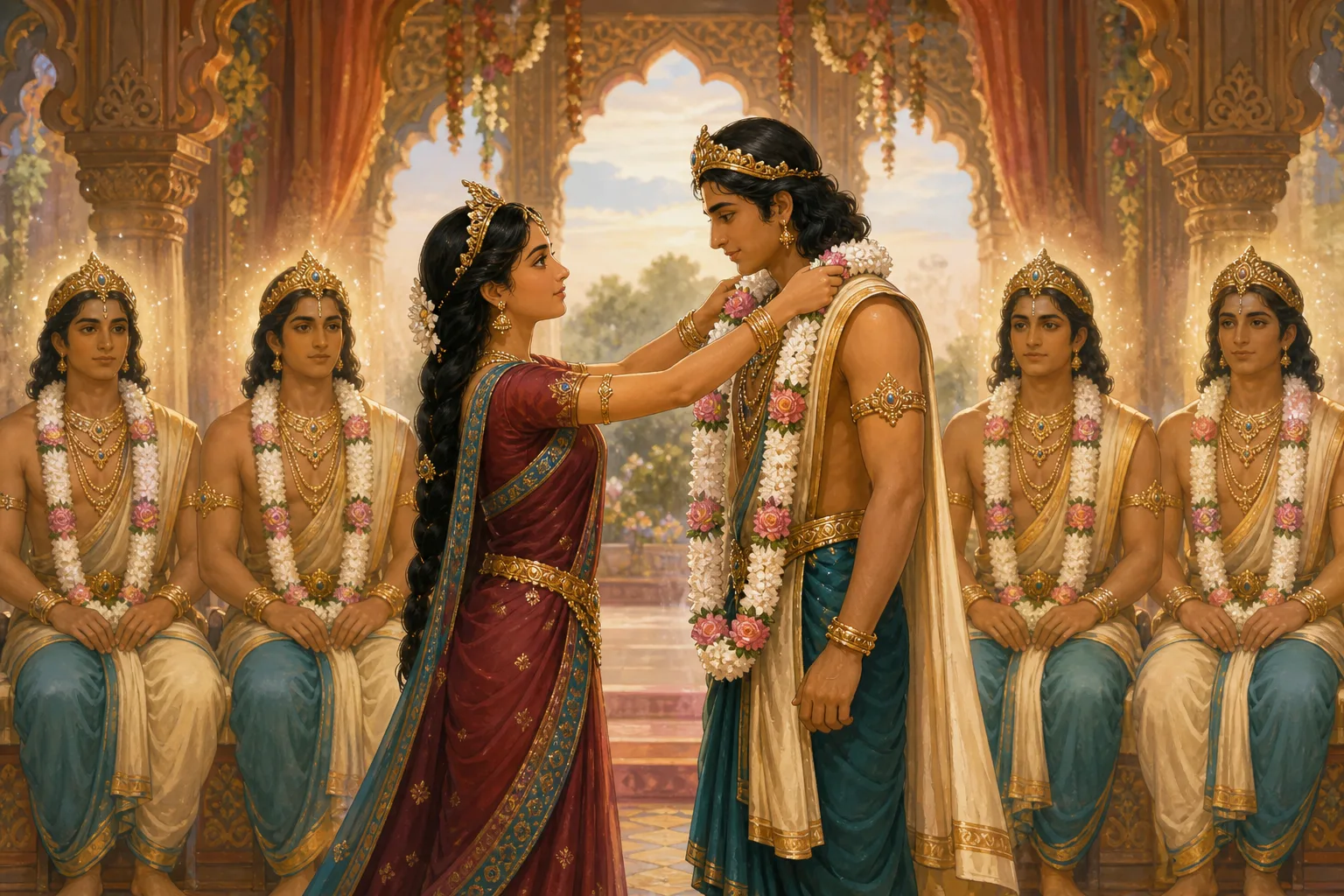
On the appointed day, the four devas tested her. They took Nala's appearance and sat beside him, so five identical figures faced Damayanti.
She looked closely. Four figures did not blink. Dust did not cling to their feet. Their flower garlands remained perfectly fresh, and their bodies cast no ordinary shadow.
The fifth figure breathed, blinked, and carried the dust of the road.
Damayanti placed the wedding garland around the true Nala's neck.
The devas accepted her choice with dignity. They blessed the couple and returned to their realms.
But Kali, a spirit associated in this tale with discord and destructive impulse, arrived too late. Angry that Damayanti had chosen Nala, he waited for an opening through which he could disturb the king's judgment.
Part 3: The game that would not end
For years Nala and Damayanti ruled happily. They had two children and worked together for Nishadha's well-being.
Nala's cousin Pushkara often challenged him to games of dice. Usually Nala refused. But one day, after a small lapse in his usual discipline, Kali found the weakness he had been waiting for. A restless certainty entered Nala's thoughts.
“This time I cannot lose,” Nala told himself.
He accepted Pushkara's challenge.
At first the wagers were small. Then Nala lost jewels, herds, chariots, and land. Each loss made him more desperate to win back what was gone.
Damayanti came to the gaming hall.
“Stop now,” she urged. “A game that takes away your freedom to leave is no longer a game.”
Nala heard her, but the dice seemed to promise that the next throw would repair everything.
It did not.
Damayanti quietly arranged for their children to travel to her parents in Vidarbha, where they would be safe. She returned to Nala and continued asking him to step away.
At last Pushkara won the kingdom itself. Nala left the palace wearing only simple clothing. Pushkara warned the citizens not to help him.
Damayanti could have returned to Vidarbha at once, but she chose to walk beside her husband.
“You should not have to share the consequences of my choices,” Nala said.
“I did not choose the game,” Damayanti replied. “But I will choose my own path now. We face the truth together.”
Part 4: Exile and abandonment
They travelled through the forest, hungry and exhausted. Nala tried to catch a flock of birds by tossing his remaining cloth over them. The birds flew away carrying it, and a voice seemed to mock him: the dice themselves had taken wing, leaving him with nothing.
Damayanti divided her garment so Nala would not be without clothing.
Guilt pressed on him. Kali's influence whispered that Damayanti would be safer without him.
One night, while she slept, Nala cut the shared cloth in two. He walked away, returned, and walked away again. Love drew him back; shame drove him off. At last he disappeared into the trees.
Damayanti woke alone.
She grieved, but she did not surrender her judgment. She followed tracks, called Nala's name, and survived dangers without losing her sense of self. A great serpent threatened her, but a passing hunter drove it away. When the hunter then behaved dishonourably toward her, Damayanti firmly resisted and escaped.
She joined a group of merchants, crossed wild country, and eventually found shelter with the queen mother of Chedi. Damayanti did not reveal her royal identity immediately. She asked only for safe work and the freedom to keep searching.
Meanwhile Nala came upon a forest fire and heard someone call for help. Inside the flames was Karkotaka, a naga caught by a curse.
Nala carried him out.
“I will help you in return,” Karkotaka said. He bit Nala, not to kill him, but to change his appearance and restrain Kali's power within him. Nala became shorter, leaner, and rough-haired.
“Take the name Bahuka,” said Karkotaka. “Serve King Rituparna of Ayodhya. Teach him your knowledge of horses, and learn from him the true science of numbers and dice. When the right time comes, these garments will restore your form.”
Part 5: Damayanti organizes the search
Damayanti's family eventually found her and brought her home to Vidarbha. She embraced her children, but she did not accept that Nala was lost forever.
She sent trusted messengers in every direction. Instead of merely asking for a missing king, they recited a question only Nala would fully understand:
“What should be said to the person who left a faithful companion sleeping alone in the forest?”
In Ayodhya, a strange-looking horse keeper named Bahuka heard the words. His eyes filled with tears.
“Perhaps the person was overcome by suffering and believed, wrongly, that leaving would protect the one he loved,” he answered. “The abandoned companion's loyalty is not diminished, but the harm must still be faced.”
The messenger returned to Damayanti.
She listened closely. The answer did not excuse Nala. Yet its sorrow, and its understanding of the private moment, made her suspect that Bahuka was her husband.
She needed evidence.
Damayanti announced that a second swayamvara would occur the very next day. It was not a true plan to remarry. It was a carefully designed message. She knew that only a charioteer with Nala's unmatched skill could bring a distant king to Vidarbha in time.
When King Rituparna heard the news, he ordered Bahuka to prepare the chariot.
Part 6: The road back to Vidarbha
Bahuka selected four horses that others thought too lean for such a journey. He saw their hidden strength and harnessed them with care.
The chariot flew across the land.
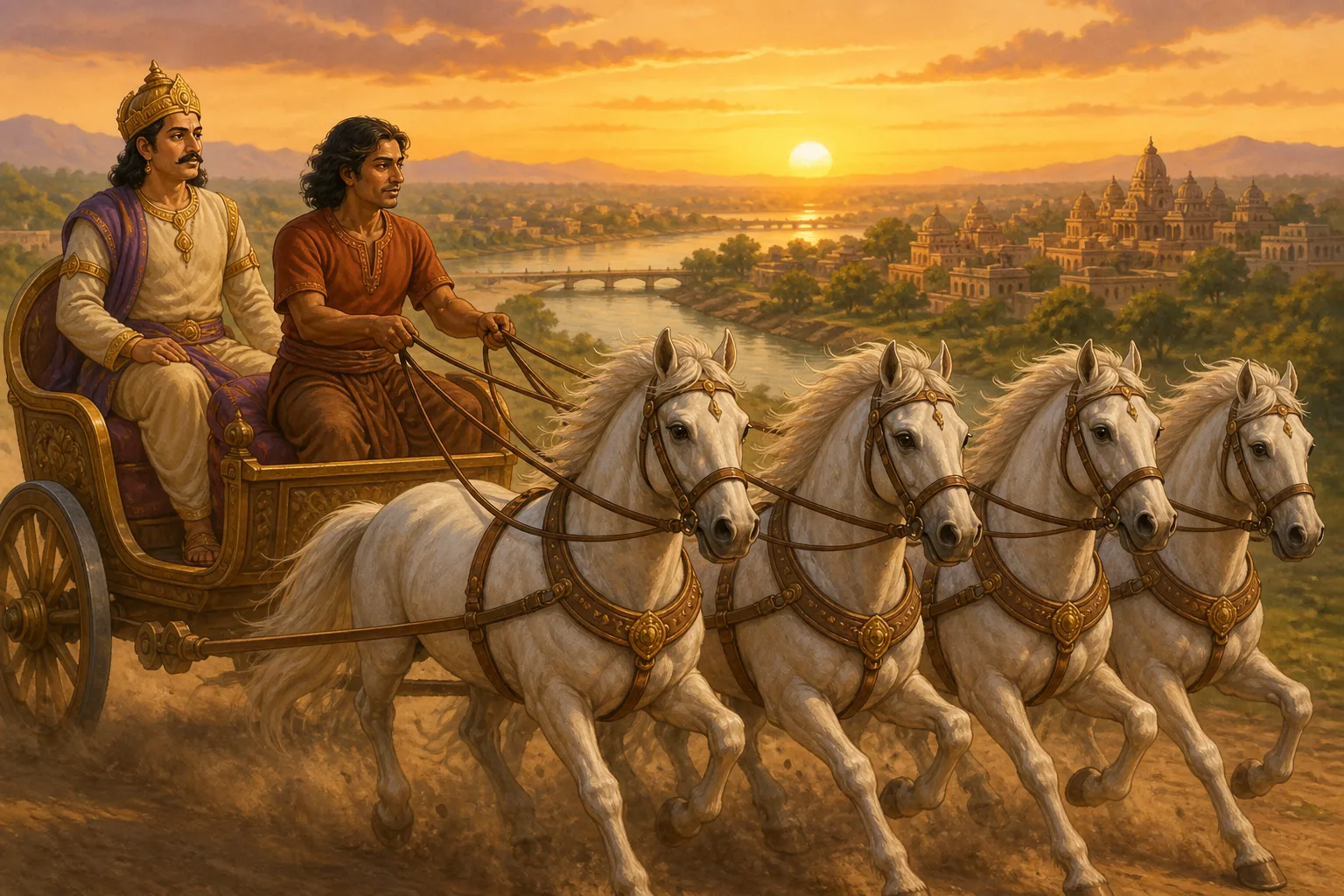
Rituparna watched Bahuka guide the horses through turns, rivers, and forest roads without cruelty or confusion. During the journey, the king glanced at a great tree and announced the number of leaves and fruits upon its branches.
Bahuka did not believe anyone could know such a number so quickly. They stopped and counted a portion, then calculated the whole. Rituparna was correct.
“Teach me this knowledge of numbers,” Bahuka said.
“Gladly,” answered the king, “if you teach me how to understand and guide horses as you do.”
They exchanged their skills. With Rituparna's knowledge, Nala finally understood the patterns and probabilities that had once controlled him. He saw the dice clearly instead of imagining they owed him a victory.
Kali's hold broke. The destructive spirit left him.
Still wearing Bahuka's form, Nala brought Rituparna to Vidarbha by sunset.
Part 7: Tests of recognition
King Bhima's court was puzzled. No swayamvara had actually been prepared.
Damayanti sent observers to watch Bahuka. They saw him enter a narrow doorway without bending because the doorway seemed to make room. Empty vessels filled when he needed water. Dry grass kindled when he held it near the sun. Most of all, they saw how gently and expertly he cared for the horses.
Damayanti then sent her children to him. Bahuka embraced them and wept, but explained his tears by saying they reminded him of children far away.
At last Damayanti met him in a private hall with trusted family nearby.
“Why did Nala leave me alone?” she asked.
Bahuka did not deny the harm. “He was trapped by shame, fear, and a force that fed upon his worst judgment. He believed leaving would save you. He was wrong.”
“And why should I trust that he would choose differently now?”
“Because regret alone is not change,” he replied. “He has learned to understand the game that mastered him, to ask for help, and to speak the truth about what he did.”
Damayanti explained her false swayamvara message. “I used the only signal that could bring you here quickly. I have remained faithful to our bond, but I also needed to know whether you could return honestly.”
Nala put on the garments Karkotaka had given him. His familiar form returned.
The reunion was joyful, but not careless. Nala apologized without asking Damayanti to forget. Damayanti spoke openly about the fear and hardship she had endured. They agreed that repairing trust would be part of their life together.
Part 8: A kingdom restored
Nala returned to Nishadha and challenged Pushkara once more. This time he understood the dice and set clear limits. He won back the kingdom without falling into the fever that had once controlled him.
Pushkara stood before him, expecting punishment.
Nala thought of how Kali had used envy, pride, and secrecy to spread destruction.
“I will not rebuild Nishadha upon another cycle of humiliation,” he said. He restored Pushkara's personal freedom and gave him a fair portion with which to live, while keeping the responsibilities of the kingdom secure.
Damayanti and their children returned to Nishadha. The people welcomed them, but the royal family did not pretend the lost years had never happened.
Nala changed the way games and wagers were handled in his court. He listened when Damayanti warned him, shared decisions more openly, and used his new knowledge to teach that chance is not a promise.
Damayanti continued to be known for more than loyalty. Her planning, courage, and refusal to accept easy answers had helped guide them home.
Their story endured because love did not magically prevent hardship. Love gave them a reason to search, learn, tell the truth, and rebuild after harm.
“Love remains strong when it is joined with truth, skill, patience, and the courage to repair harm.”
New stories in your inbox
One story every week, and a special tale on festivals. Free, always.
Your email goes to our newsletter provider (beehiiv) so we can send you stories. It is not linked to any child's reading on this site. Unsubscribe any time from the email footer.