Bhrigu and Agni
Mahabharata
Part 1: A promise from long ago
Long ago, Sage Bhrigu lived with his wife, Puloma, in a quiet hermitage. Tall trees shaded their home, birds nested in the branches, and a small sacred fire burned steadily near the place where Bhrigu prayed.
Puloma was expecting a child. Bhrigu cared deeply for her, and before leaving one morning to bathe in the river, he asked Agni, the divine presence within the sacred fire, to watch over the hermitage.
“I will return soon,” Bhrigu told Puloma. “Rest here, and do not trouble yourself with the day's work.”
Puloma smiled. “Go in peace. I will be safe.”
Not long after Bhrigu had gone, a powerful rakshasa approached the hermitage. He too was called Puloma. Years earlier, before Puloma's family had arranged her marriage to Bhrigu, the rakshasa had asked to marry her. Her family had refused him.
He had never accepted that decision.
Now he entered the hermitage and saw Puloma alone. She welcomed him as a traveller, offering fruit and water according to the custom of hospitality. But the visitor did not come in peace.
He turned toward the sacred fire.
“Agni,” he said, “you witness what happens in every home. Tell me truthfully: was this woman once promised to me before she became Bhrigu's wife?”
Part 2: Agni's difficult answer
Agni's flames grew still.
He understood the danger in the question. If he answered carelessly, Puloma might be harmed. If he hid the truth, he would fail in his duty as a witness.
At last Agni spoke with great care.
“You wished to marry her,” he said, “but wishing does not make a marriage. Her family did not complete a marriage with you. Puloma became Bhrigu's wife through the rites her family accepted.”
The rakshasa heard only the part he wanted to hear.
“Then she was meant for me first!” he cried.
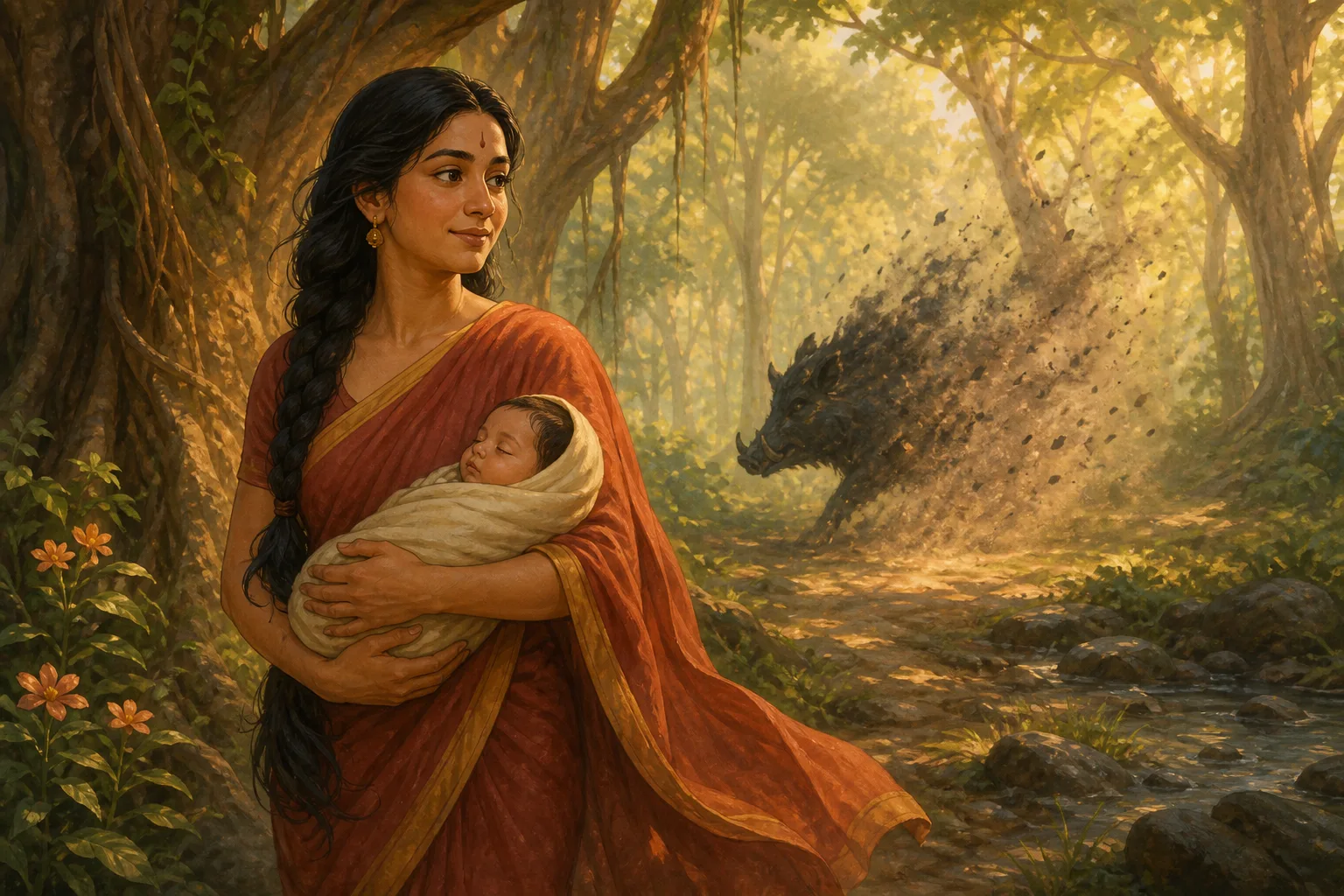
Before Puloma could call for help, he changed into the form of a great wild boar and carried her away through the forest.
Agni's flames leapt in alarm, but the rakshasa rushed beyond the hermitage.
Puloma was frightened, yet she did not stop thinking. She held tightly to a branch as they passed and cried out for help. The forest seemed to race around her.
The shock brought the birth of her child sooner than expected. A radiant baby slipped safely into her arms. The child shone with such bright spiritual light that the rakshasa could not bear it. His stolen shape dissolved, and he fell away like ash scattered by the wind.
Puloma gathered her baby close. She named him Chyavana, “the one who came forth,” and slowly made her way home.
Part 3: A curse born from grief
When Bhrigu returned, he saw Puloma approaching with the newborn child. Relief filled him, then fear, then anger.
“Who told the rakshasa where you belonged?” he asked.
Puloma answered honestly. “He questioned Agni. Agni explained that I was truly your wife, but the rakshasa twisted the answer and carried me away.”
Bhrigu looked at the sacred fire. His fear for Puloma and Chyavana had not yet settled. In that storm of feeling, he spoke too quickly.
“Agni, you gave him the answer that led him to us. From this day, may you consume everything—pure and impure alike!”
The curse echoed through the hermitage.
Agni was deeply hurt.
“I did not give Puloma to him,” Agni replied. “I said that his old claim was not a marriage. I am called to carry offerings and to witness promises. How could I protect truth if I answered a question with a lie?”
But a sage's spoken curse could not simply be forgotten.
Agni withdrew from the hearths and sacred fires of the world.
Soon families could not cook their food. Lamps would not stay lit. Ceremonies could not continue, because the flames that carried offerings were gone. People gathered around cold hearths and wondered what had happened.
The devas and sages went to Brahma for help.
Part 4: Brahma's wise change
Brahma called Agni before him and listened without interruption.
Agni told him about the rakshasa's question, his careful answer, Puloma's abduction, and Bhrigu's curse.
“I spoke truth,” Agni said. “Yet I was blamed for another person's wrongdoing. If my presence brings only anger, why should I return?”
Brahma answered gently. “You were right not to call an unfulfilled wish a marriage. The rakshasa chose to misuse your words, and that choice was his own. But the world still needs your warmth and light.”
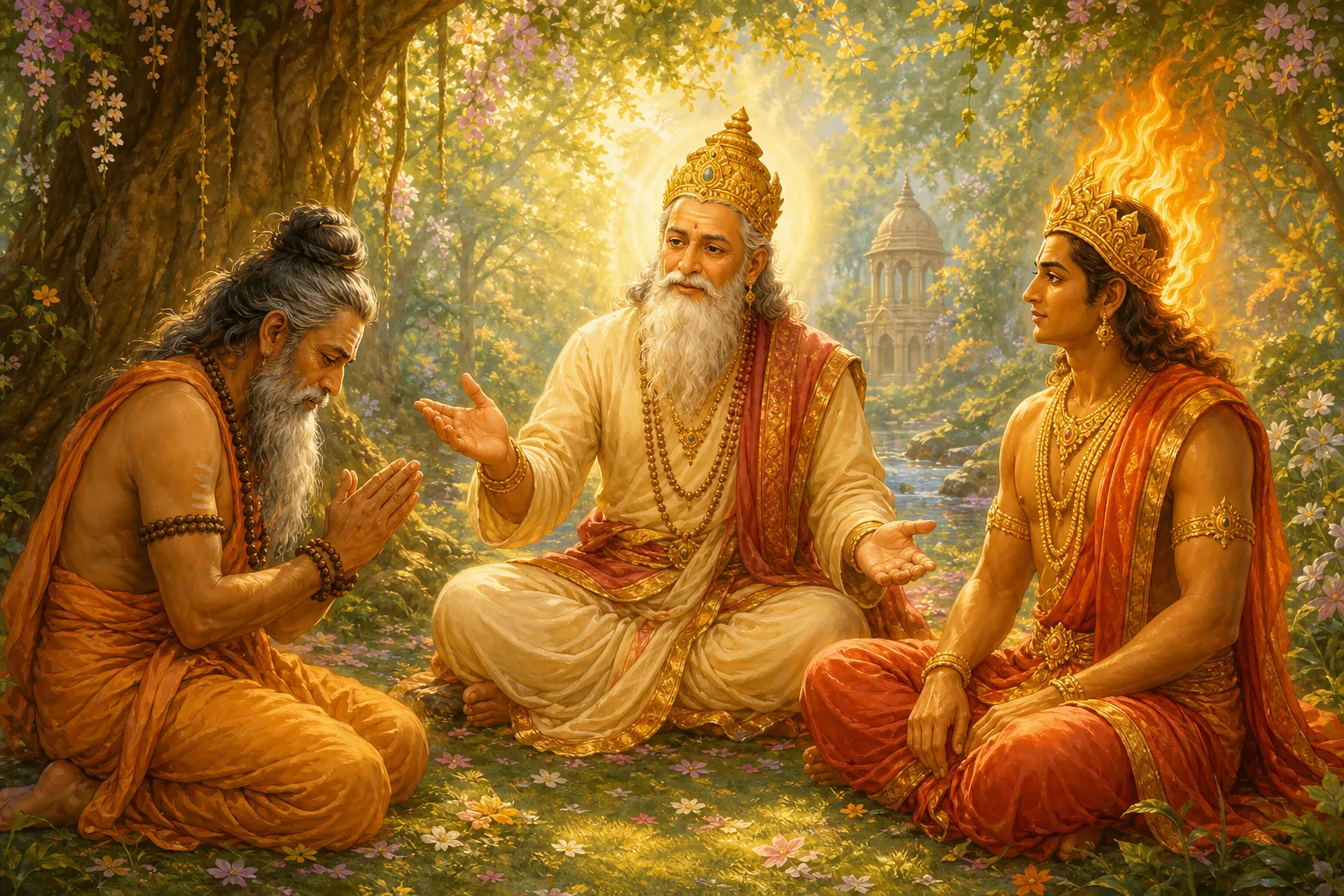
Then Brahma turned to Bhrigu.
By now the sage's anger had cooled. Looking at Puloma and baby Chyavana, he understood that fear had driven his harsh words.
“Agni,” Bhrigu said, “I cannot pretend I never spoke the curse. But I can acknowledge that I judged you before listening. I am sorry.”
Brahma considered the curse.
“A powerful word cannot always be taken back,” he said, “but its path can be guided. Agni will indeed touch many things. Yet fire will not make everything the same. It can separate, transform, and purify. It can cook food, warm homes, give light, and carry sacred offerings. What is harmful may be consumed; what is offered with a pure purpose may be made ready for service.”
Agni's glow returned, warm and steady rather than fierce.
Across the world, hearths rekindled. Lamps shone again. The hermitage fire burned beside Bhrigu, Puloma, and their child.
Bhrigu had learned that even a wise person can speak unjustly when fear turns suddenly into anger. Agni had learned that truth sometimes needs patience after it is spoken. And everyone who saw the restored flame remembered that power is at its best when it gives warmth, light, and clarity.
“Truth must be joined with compassion, and anger must make room for understanding.”
New stories in your inbox
One story every week, and a special tale on festivals. Free, always.
Your email goes to our newsletter provider (beehiiv) so we can send you stories. It is not linked to any child's reading on this site. Unsubscribe any time from the email footer.