Astika and King Janamejaya's Snake Sacrifice
Mahabharata
Part 1: Kadru, Vinata, and a dishonest wager
Long before King Janamejaya was born, the sage Kashyapa had two wives, Kadru and Vinata. Kadru became the mother of the naga people, while Vinata waited many years for two extraordinary sons.
Vinata grew impatient and opened one of her two eggs before its time. A radiant child named Aruna emerged, but his body was not yet fully formed.
“Mother,” Aruna said sadly, “your impatience has harmed me. Do not open the second egg. Wait, and my brother will one day free you from bondage.”
Then Aruna rose into the sky. In time he became the charioteer who guides the Sun's blazing journey.
One day Kadru and Vinata saw Uchchaihshravas, the magnificent white horse that had emerged during the churning of the ocean.
“His whole body is white,” Vinata said.
“His body is white, but his tail is black,” Kadru replied.
They made an unwise wager: whoever was wrong would serve the other. Kadru feared she would lose, so she ordered her naga sons to coil around the horse's tail and make it look black. Many refused to take part in a deception.
In fury, Kadru cursed them. “One day King Janamejaya will conduct a great snake sacrifice, and its fire will destroy you!”
Frightened, some nagas obeyed her trick. When the sisters saw the horse the next morning, its tail appeared black. Vinata lost the wager and was forced to serve Kadru.
The curse, however, had already been spoken.
Part 2: Garuda wins freedom
After many years, Vinata's second egg opened. Garuda emerged—a vast, golden-brown divine eagle whose wings seemed to fill the sky.
Because his mother was still bound by the wager, Garuda too had to serve Kadru and her naga sons. At last he asked them what price would buy freedom for Vinata and himself.
“Bring us amrita, the nectar guarded in Indra's celestial realm,” they answered.
The journey was dangerous. Garuda sought guidance from his father Kashyapa, gathered his strength, and flew toward the heavens. Indra had protected the nectar with fierce wind, a wall of fire, a spinning wheel, and two watchful serpents.
Garuda beat back the dust with his wings. He gathered river water and quenched the flames. Making himself as small as an insect, he passed between the wheel's turning spokes. Then he reclaimed his mighty form, overcame the guardians, and lifted the sealed vessel.
Vishnu met him in the sky.
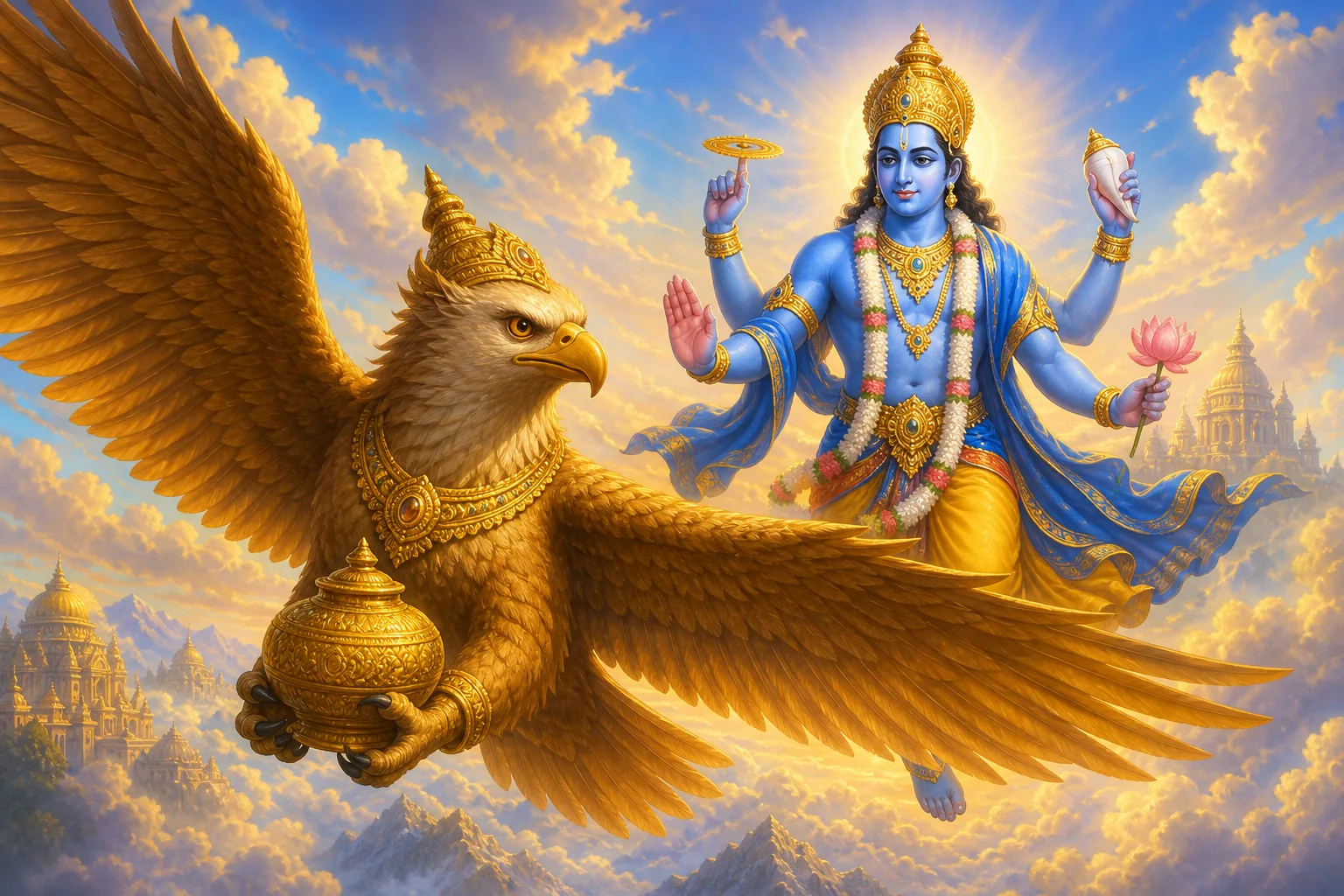
“You have shown extraordinary courage and devotion to your mother,” Vishnu said. “Ask for a boon.”
Garuda asked to remain free from sickness and death without needing to drink the nectar he carried. Vishnu granted the wish.
Indra then approached. “If the nagas drink this nectar, nothing will restrain those among them who use their power unjustly.”
“I must deliver the vessel or my mother will not be freed,” Garuda replied. “But after they release us, you may recover it before anyone drinks.”
So Garuda placed the vessel before the nagas. They honoured their bargain and freed Vinata and her son. While they went to wash before touching the sacred nectar, Indra carried it back to the heavens.
Garuda had won freedom without breaking his word.
Part 3: The child who might stop a curse
Kadru's curse still hung over the naga people. Their king, Vasuki, searched for a way to prevent the destruction of every naga, guilty and innocent alike.
He learned of a prophecy: his sister Jaratkaru would have a son, Astika, whose wisdom could stop Janamejaya's sacrifice.
Jaratkaru married a sage who shared her name. Their life together was brief and difficult, but before the sage returned to his solitary path, he told her that their child would become a protector.
Astika was raised by his mother and his uncle Vasuki. He learned sacred teachings from wise tutors, but he also learned to listen. His human and naga family taught him that a community could contain kindness, error, courage, and fear all at once.
“Never defend wrongdoing simply because the wrongdoer is related to you,” his mother told him. “But never let someone condemn an entire people for one person's deed.”
Astika remembered those words.
Part 4: Parikshit and Takshaka
Years later, King Parikshit ruled Hastinapura. He was a capable king, but one hot day in the forest he became exhausted and lost his patience.
At a hermitage he asked Sage Shamika whether a wounded deer had passed nearby. Shamika was observing a vow of silence and did not reply.
Parikshit felt ignored. In a moment of disrespect, he lifted a dead snake with the end of his bow and draped it around the silent sage's shoulders. Almost at once he regretted the act and returned home.
Shamika's son Shringi heard what had happened. Anger overcame him, and he pronounced a curse: within seven days, the naga king Takshaka would cause Parikshit's death.
Shamika rebuked his son. “The king acted wrongly, but a moment of insult does not justify taking a life. Anger has made your punishment greater than the offence.”
The curse could no longer be withdrawn. Shamika sent a warning to Parikshit.
The king built a guarded chamber high upon a stone pillar, hoping to remain safe until the seventh day ended. Takshaka nevertheless entered in a tiny form hidden within a piece of fruit. When Parikshit discovered the small creature, he believed the danger had nearly passed and handled it carelessly.
Takshaka revealed himself. The curse was fulfilled, and Parikshit died.
The kingdom mourned. Parikshit's young son Janamejaya inherited the throne.
Part 5: A son's grief becomes a terrible plan
When Janamejaya was older, he asked his ministers to tell him exactly how his father had died. He heard about Parikshit's insult, Shringi's curse, Takshaka's determination, and a healer whom Takshaka had persuaded to turn away.
Uttanka, still angry because Takshaka had once stolen Queen Paushya's earrings, urged the king to take revenge.
Janamejaya's grief hardened.
“Takshaka took my father,” he said. “I will hold a sacrifice that draws Takshaka and every naga into its fire.”
The preparations began. Priests raised a vast platform and lit the ceremonial flames. They chanted words of summoning.
Across forests, rivers, and the naga realm, serpents felt themselves pulled toward the fire. Some were dangerous and some harmless. Some knew Takshaka and some had never met him. Families clung to one another as the force of the ritual drew them onward.
Takshaka fled to Indra's celestial court and sheltered near his throne.
Vasuki saw his people disappearing. Remembering the prophecy, he called Astika.
“The hour has come,” Vasuki said. “Go to Janamejaya. Save whoever can still be saved.”
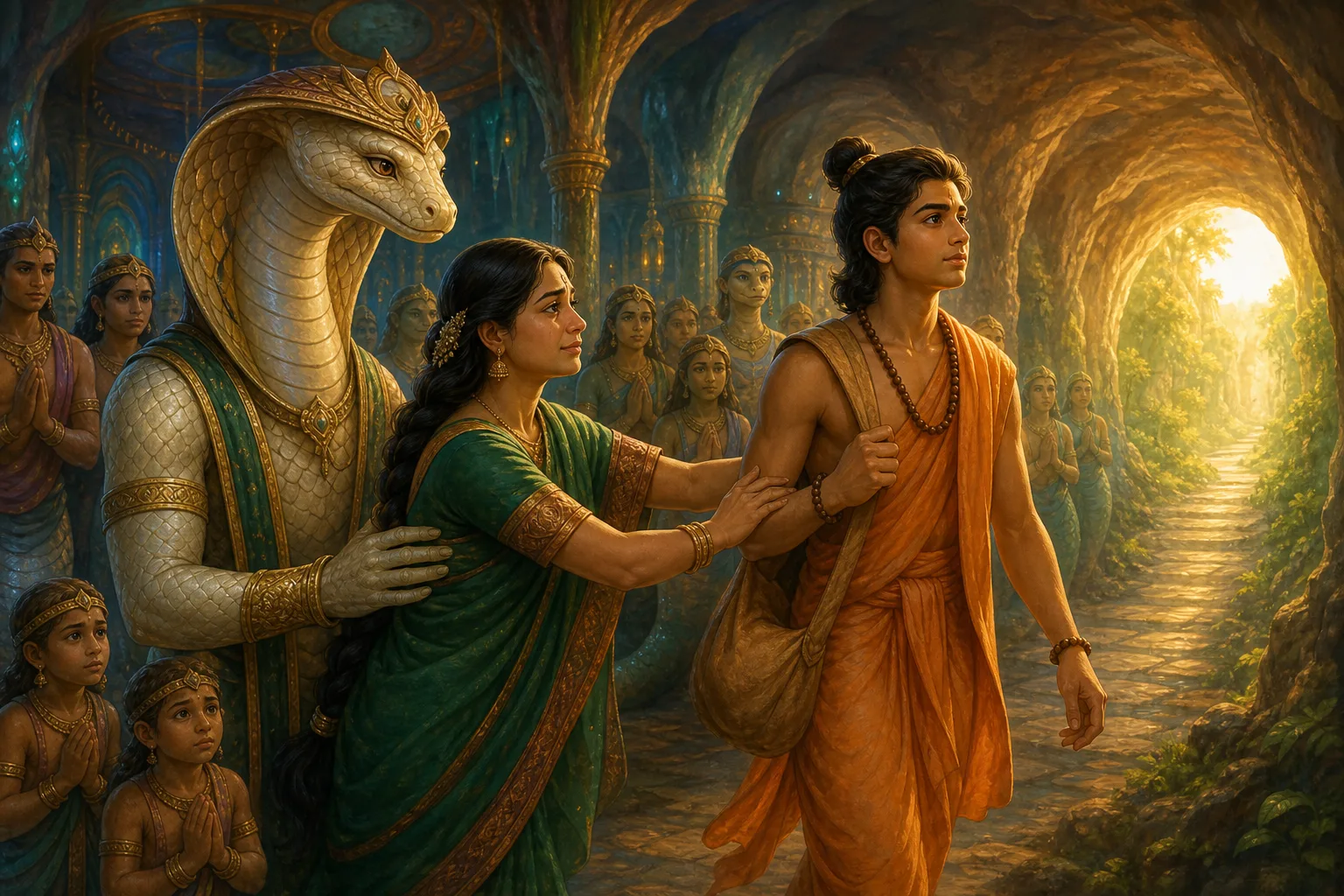
Astika bowed to his mother.
“Speak truth,” Jaratkaru told him. “Do not answer hatred with hatred.”
Part 6: Astika enters the sacrifice
At the edge of the sacrificial ground, guards tried to stop the young sage. Astika greeted them respectfully and spoke with such clarity about the duties of rulers and learned people that they allowed him to enter.
The fire roared. The priests were now trying to pull Takshaka from Indra's protection.
Astika did not begin with an accusation. He honoured the king's responsibility to protect his people. He praised learning when it served justice. He spoke of the strength required to keep a promise.
Janamejaya was impressed.
“Young sage,” the king said, “your words carry unusual wisdom. Ask me for a boon, and if it is within my power, I will grant it.”
The chief priest urged the king to wait until Takshaka fell.
Their chants grew stronger. High above, Takshaka slipped from his shelter and began to descend toward the flames.
“Now ask,” Janamejaya told Astika.
Astika raised one hand.
“Stop,” he said—not in fear, but with the steadiness of someone protecting life.
For a moment Takshaka hung motionless in the sky.
“My boon is this,” Astika said. “End the sacrifice. Let Takshaka face judgment for his own actions, but spare the naga people who had no part in your father's death.”
The king stared at him. “Ask for cattle, jewels, or land. Do not ask me to release my enemy.”
“A gift is chosen by the giver,” Astika replied, “but a boon is the request you promised to honour. A king's word must be stronger than his anger.”
Part 7: The fire goes out
Janamejaya looked into the flames. He thought of his father's disrespectful moment, Shringi's oversized curse, Takshaka's deadly answer, and now his own ritual drawing thousands of uninvolved lives toward destruction.
Each act of anger had produced a larger one.
“If I continue,” he said slowly, “I will not end the chain. I will become its next link.”
He ordered the priests to stop.
The chanting ceased. The pull of the sacrifice released Takshaka and every naga still living. The flames settled into an ordinary fire.
Astika thanked the king—not because the earlier destruction was right, but because stopping it required courage too.
Janamejaya did not forget his father. He also did not pretend Takshaka had acted well. But he gave up the plan to punish a whole people for one death.
When Astika returned, Vasuki and Jaratkaru welcomed him with relief. The naga community remembered him as the young sage who stood between fear and fire.
And Janamejaya remembered that justice asks, “Who is responsible, and what will make the future safer?” Revenge asks only, “Who else can be made to suffer?”
By keeping his promise to Astika, the king finally chose the harder question.
“Justice ends wrongdoing; revenge spreads it to the innocent.”
New stories in your inbox
One story every week, and a special tale on festivals. Free, always.
Your email goes to our newsletter provider (beehiiv) so we can send you stories. It is not linked to any child's reading on this site. Unsubscribe any time from the email footer.