The Deliverance of Aghasura
Krishna was about five years old. Early one morning he sounded a small horn bugle to wake his cowherd friends and their calves. Carrying lunch bags, flutes, horn bugles, and sticks for guiding the calves, they set out for a forest picnic. Along the way the boys hid one another's lunch bags, imitated birds, jumped with monkeys, and laughed at their reflections in the water.
Kansa had already sent demons such as Putana, Shakatasura, Trinavarta, and Bakasura to destroy Krishna. Now he sent Aghasura, the younger brother of Putana and Bakasura. Seeking revenge for his siblings, Aghasura decided to swallow Krishna together with every cowherd boy and calf. Even the devas feared his power and waited for his defeat.
Aghasura assumed the form of a gigantic python. His body seemed as thick as a mountain and many miles long. His lower lip rested upon the earth while his upper lip rose toward the clouds. His teeth resembled mountain peaks, his tongue looked like a broad red road, and his hot breath felt like wind emerging from a cavern. At first the boys thought he was a wondrous natural feature of Vrindavan. Then they wondered whether he might truly be a living python. Trusting that Krishna would protect them, they entered his mouth laughing and clapping.
Krishna immediately understood that this was Aghasura, not a cave. He wanted to stop his friends, but all the boys and calves had already gone inside. Aghasura did not swallow them at once; he waited for Krishna to enter. After considering how to save everyone together, Krishna stepped into the demon's mouth. Aghasura closed it, and the air inside began to fail.
Krishna expanded his body until Aghasura's throat was blocked and the demon's life-air escaped through the top of his head. Krishna then restored the unconscious boys and calves with his nectar-like glance and led everyone safely out through the python's mouth. A brilliant light emerged from Aghasura's body. It remained in the sky until Krishna came out, and then merged into Lord Mukunda. That is why people remember this day not only as Aghasura's defeat but as his deliverance.
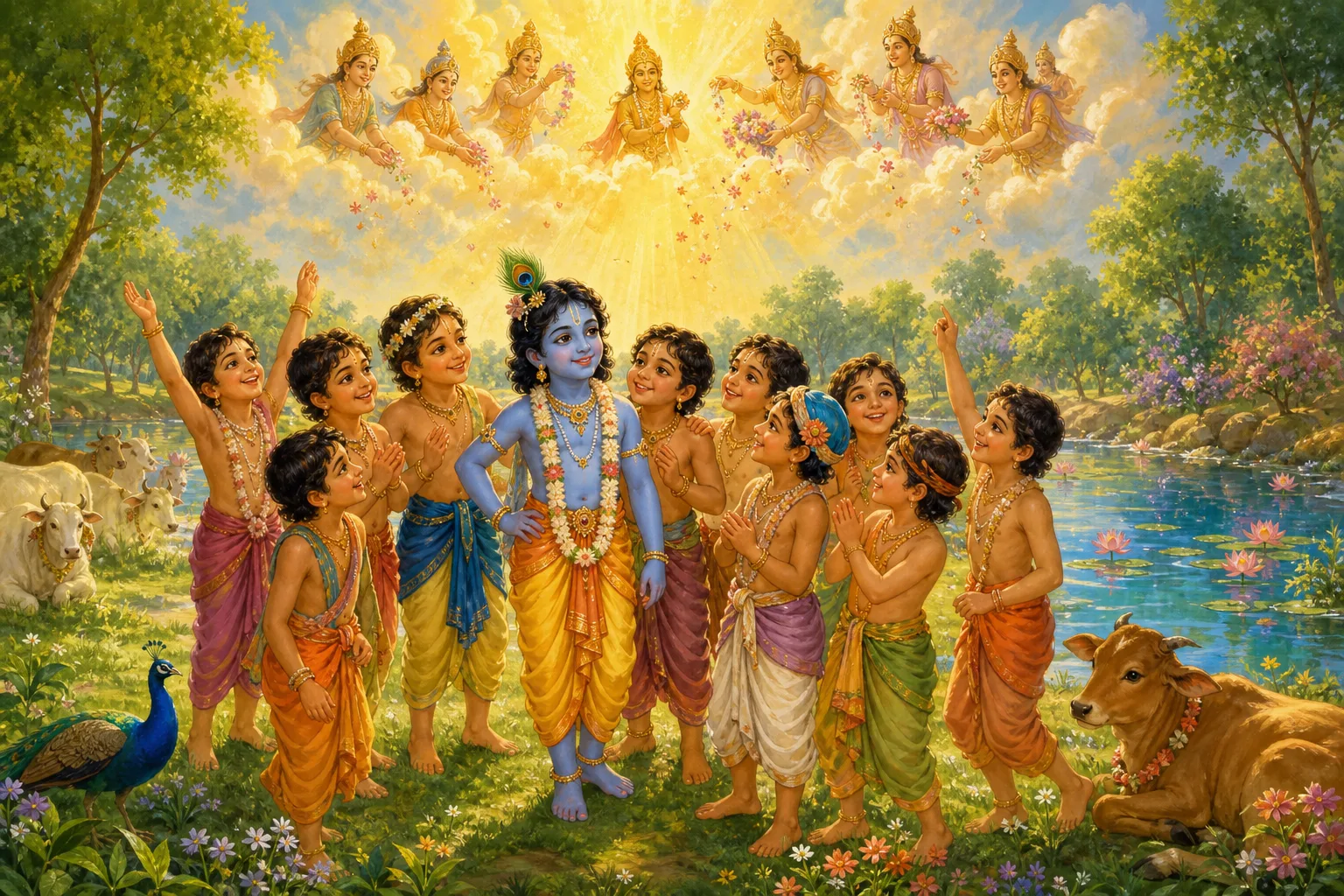
The devas showered flowers from the sky, the gandharvas sang, and celestial drums resounded. In time the python's immense body dried into a hollow skin, and for years afterwards the children of Braj climbed in and out of it, marvelling at the mouth they had once walked through.
New stories in your inbox
One story every week, and a special tale on festivals. Free, always.
Your email goes to our newsletter provider (beehiiv) so we can send you stories. It is not linked to any child's reading on this site. Unsubscribe any time from the email footer.