Mahaprasthana: The Pandavas' Final Journey
Many years had passed since the great war of the Mahabharata. The Pandavas had ruled Hastinapura with care, repaired what war had broken, and watched a new generation grow.
Then news arrived that Krishna had completed his life on earth and the Yadava clan had come to an end. Yudhishthira understood that one age was closing and another was beginning. He gathered Bhima, Arjuna, Nakula, Sahadeva, and Draupadi.
“We have completed the work entrusted to us,” he said quietly. “It is time to place the kingdom in younger hands and begin our final journey.”
Yudhishthira crowned Parikshit, the son of Abhimanyu, as king of Hastinapura. He asked the elders to guide the young ruler and reminded Parikshit to protect every person with fairness and compassion.
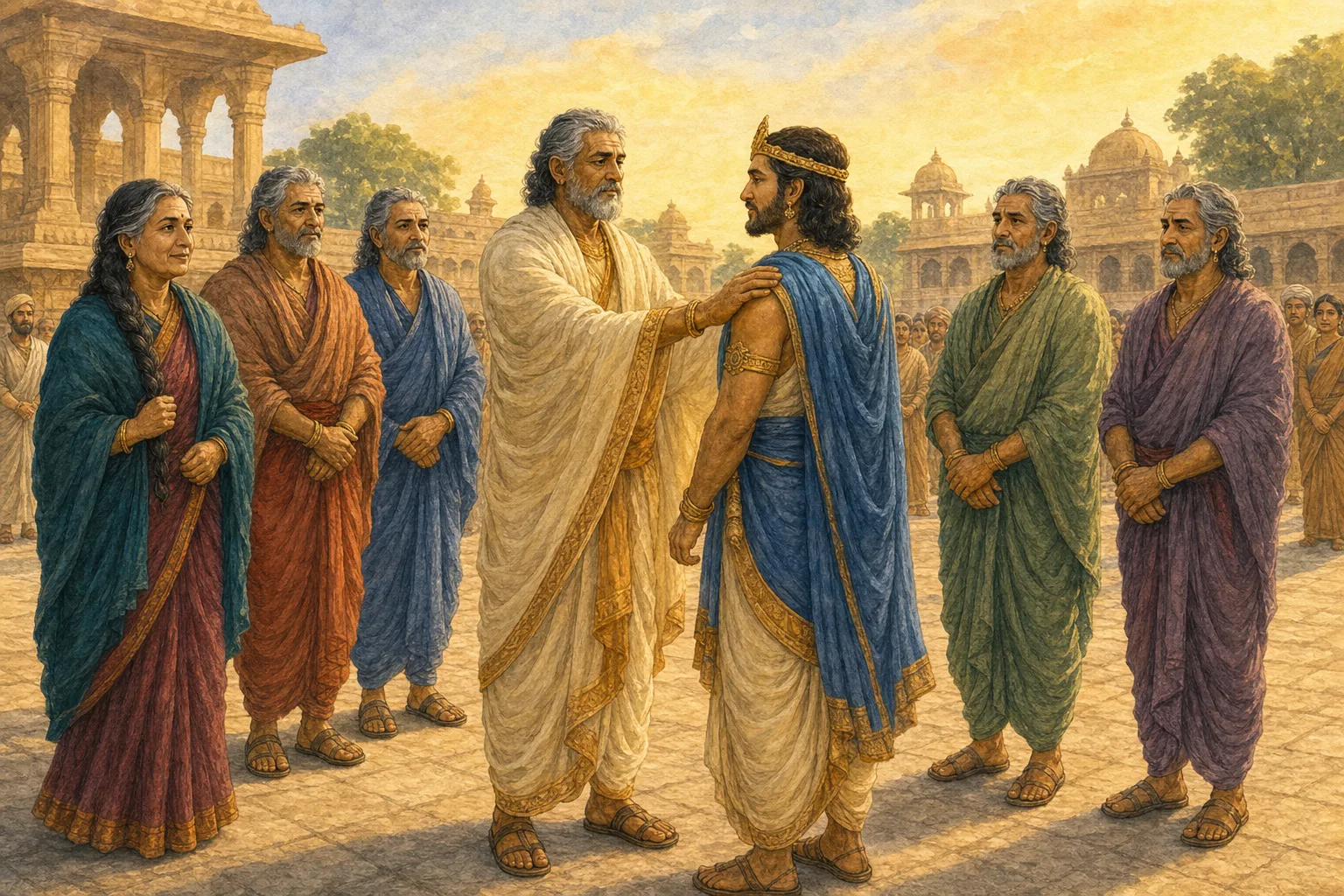
The Pandavas and Draupadi laid aside their royal ornaments and rich clothing. Dressed in simple robes, they left the palace without chariots, servants, or treasure. The people followed them for a while with tearful eyes. At last, the travellers blessed the citizens and continued alone.
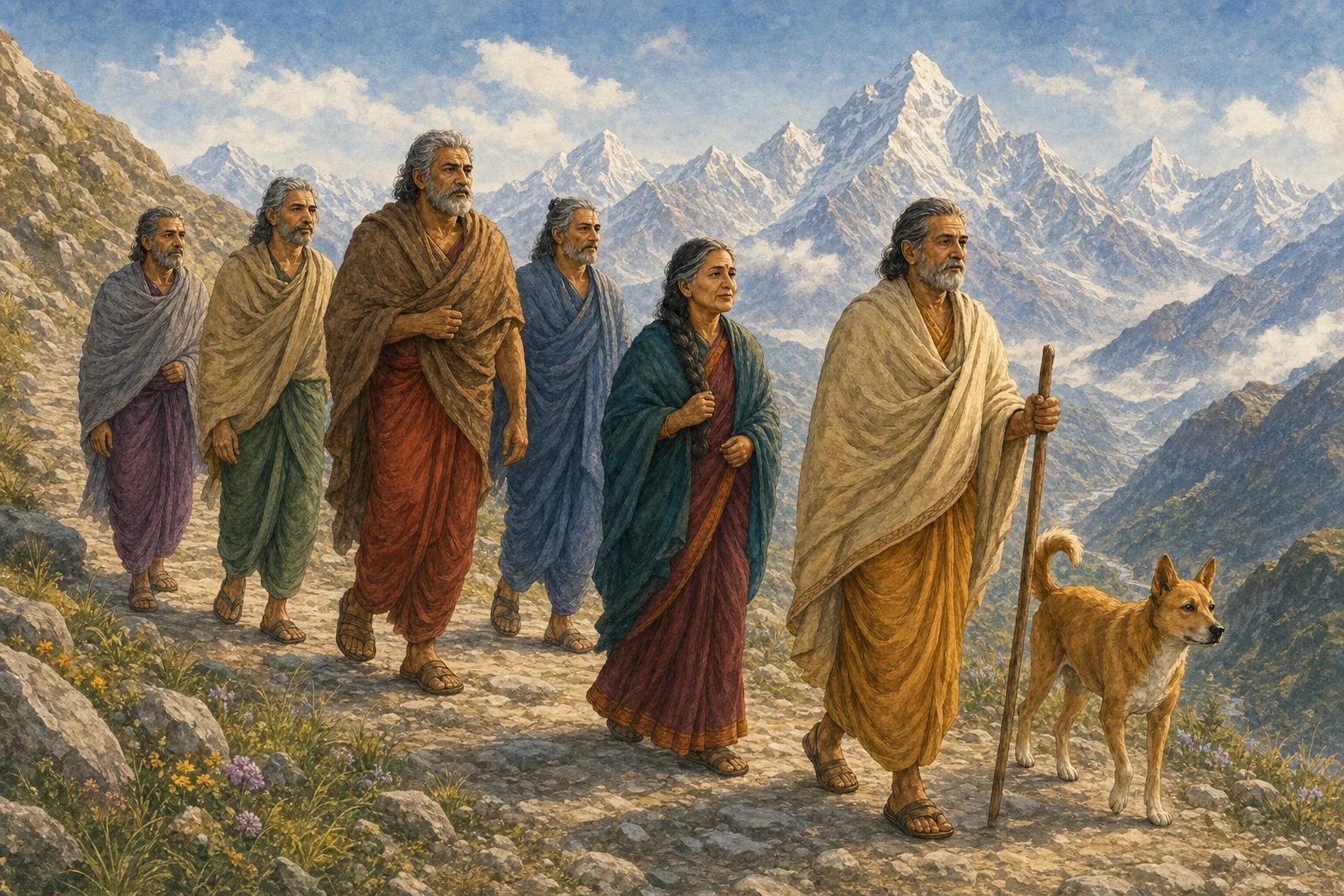
A quiet golden-tan dog began walking behind them.
No one called it, yet it stayed close. It crossed dusty roads, green forests, riverbanks, and stony ground with the family. When the path turned north toward the Himalayas, the dog still followed.
The journey was called Mahaprasthana—the Great Departure. It was not a search for a new kingdom. It was a journey of letting go.
The plains slowly gave way to steep valleys and shining peaks. Cold winds tugged at their shawls. Each step demanded patience, but the six travellers encouraged one another. The dog padded beside Yudhishthira, never asking for food or rest.
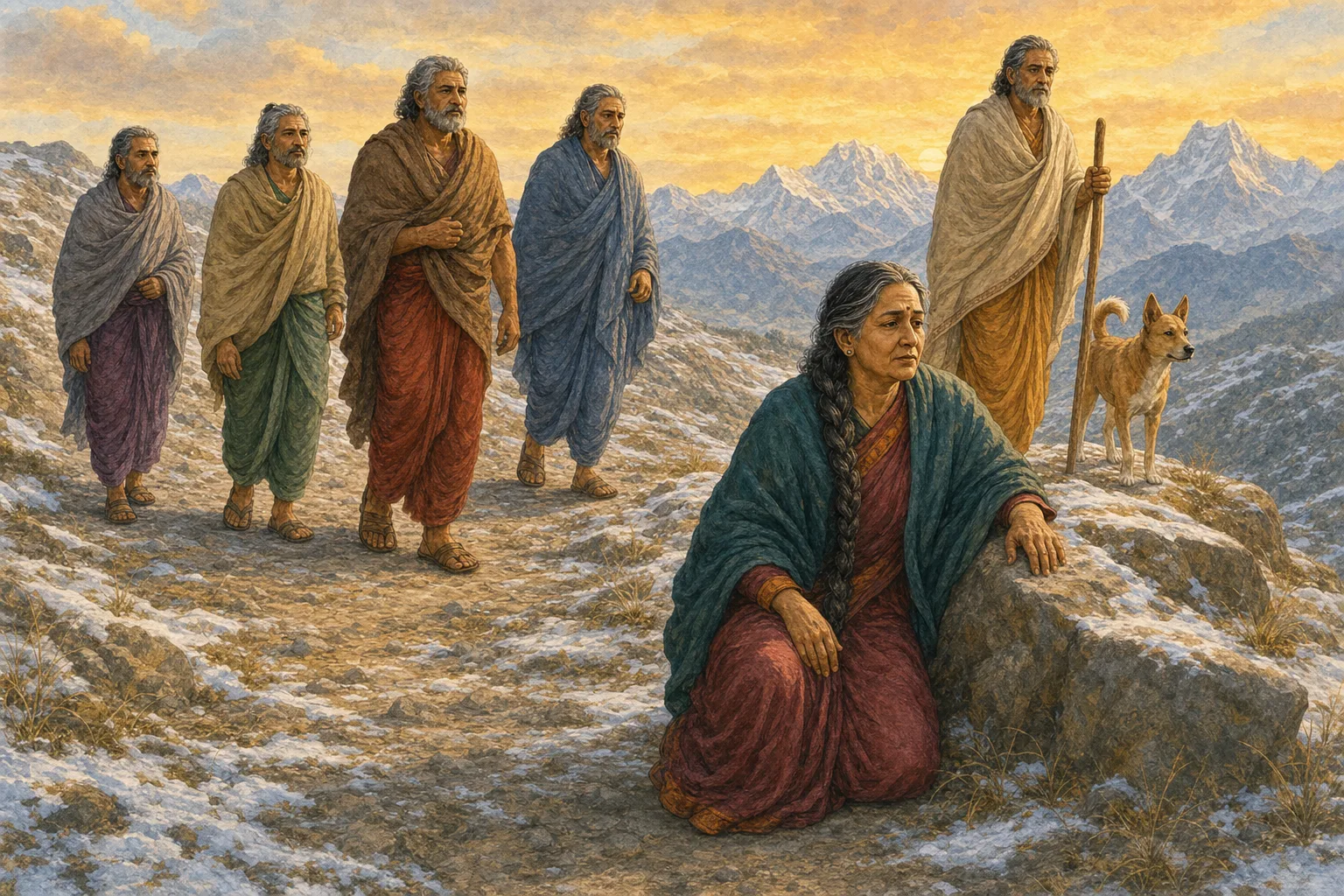
One day, on a difficult ridge, Draupadi's strength failed. She gently lowered herself beside a rock and could go no farther.
Bhima looked back in grief. “Draupadi has lived bravely and endured so much. Why has she fallen first?”
Yudhishthira's voice was filled with sorrow. “Draupadi loved us all, yet in one corner of her heart she favoured Arjuna. Even the greatest among us carry small human weaknesses. Her many virtues are not forgotten.”
The path of renunciation allowed no turning back. With heavy hearts, they continued, trusting that Draupadi's spirit would find peace.
Farther on, Sahadeva fell. He had been wise and humble in many ways, but deep inside he had sometimes believed that no one could equal his knowledge.
Then Nakula fell. He had been gentle and devoted, yet he had quietly taken pride in his beauty.
Arjuna was next. The great archer had served with courage, but he had once boasted that he could defeat every enemy in a single day. His skill was real; so was the pride he had not completely released.
At last, mighty Bhima stumbled. “Brother,” he called, “why can I not finish the journey?”
Yudhishthira answered tenderly, “You were strong, brave, and fiercely loving. But you sometimes boasted of your strength and enjoyed more food without first noticing what others needed.”
These words did not erase the goodness of Draupadi or the brothers. They reminded Yudhishthira that every human being is a mixture of strengths and imperfections. One by one, his companions had completed their earthly journeys.
Only Yudhishthira and the dog continued.
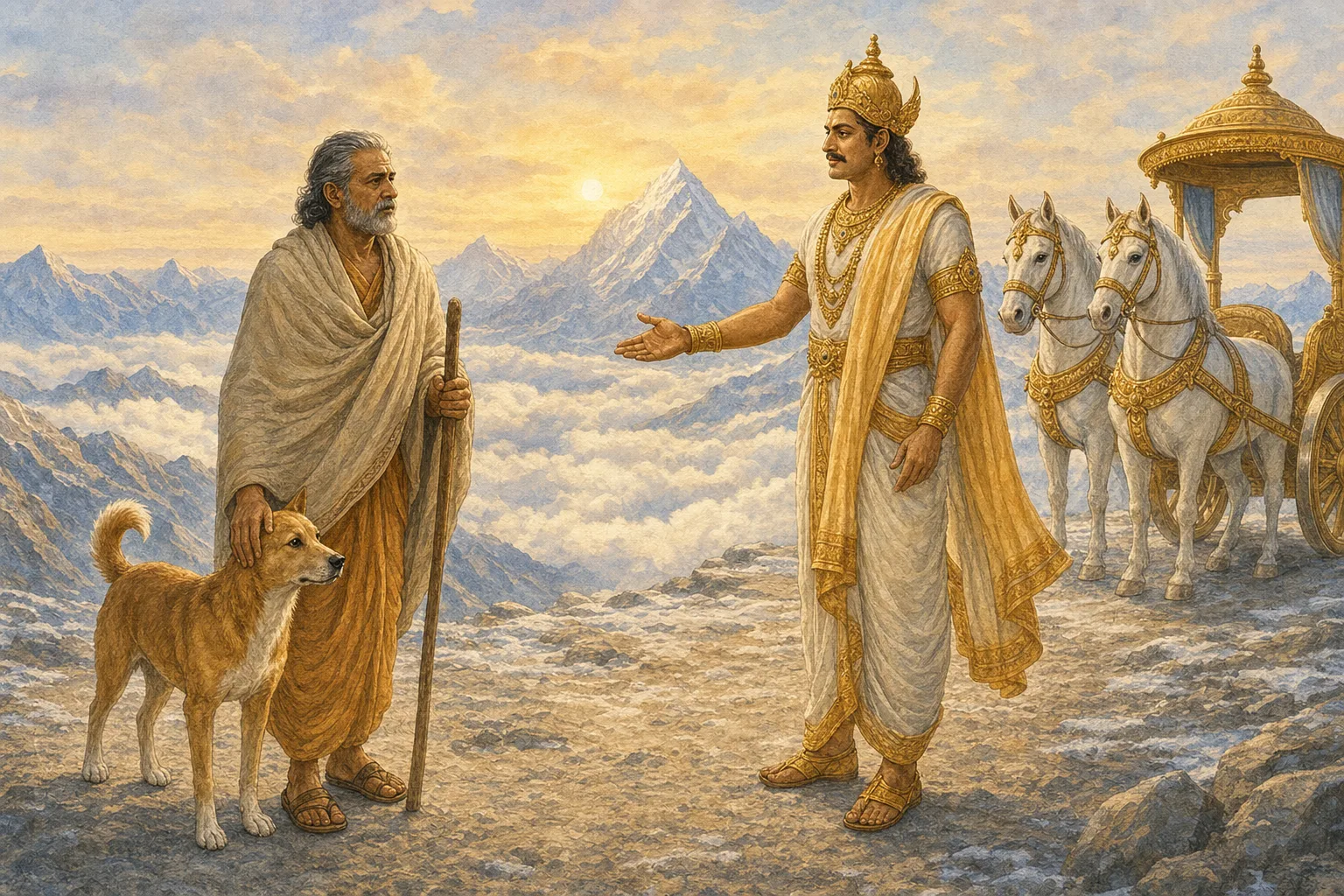
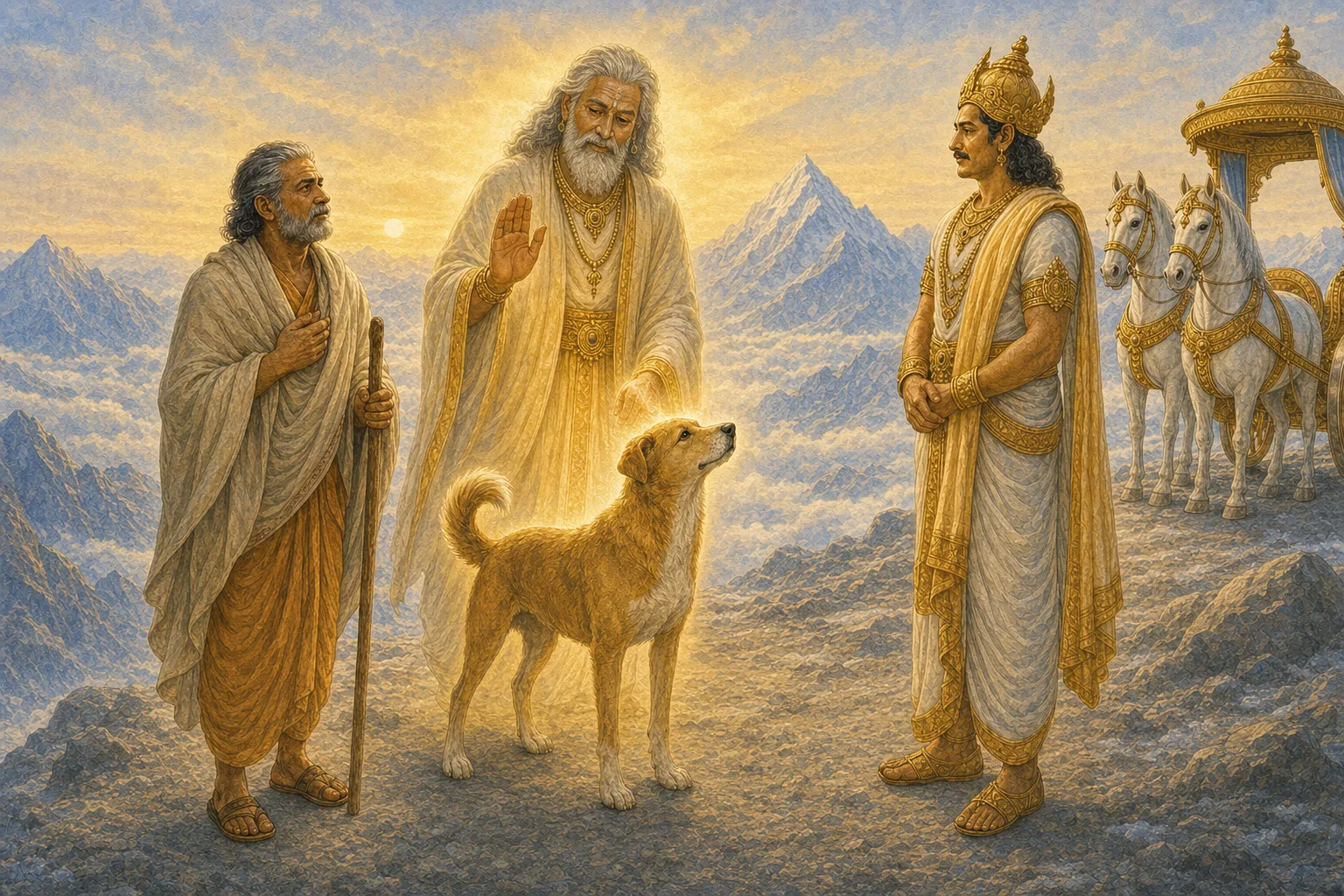
At the highest summit, clouds opened around a brilliant chariot. Indra, king of the devas, stood beside it.
“Yudhishthira,” Indra said, “your life of dharma has brought you to heaven's gate. Step into my chariot.”
Yudhishthira asked, “What of Draupadi and my brothers?”
“They have already left their earthly bodies and gone ahead,” Indra replied. “You will meet them again.”
Yudhishthira turned toward the dog. “Then this faithful creature will come with me.”
Indra shook his head. “The dog cannot enter. Leave it here, and every heavenly joy will be yours.”
The dog looked up at Yudhishthira with trusting eyes.
“I cannot do that,” Yudhishthira said. “My loved ones fell when I had no power to save them. This dog is alive, depends upon me, and has never abandoned me. I will not purchase happiness by betraying one who trusts me.”
At once, warm light surrounded the dog. Before Yudhishthira stood Dharma, the deity of righteousness and Yudhishthira's divine father.
“This was your final test,” Dharma said. “You chose compassion even when heaven itself seemed to be the reward for turning away. Loyalty to the vulnerable is true dharma.”
Indra smiled, and Yudhishthira entered the celestial chariot with Dharma beside him.
Yet one more test remained.
When Yudhishthira reached heaven, he first saw Duryodhana seated in splendour. He could not see Draupadi or any of his brothers.
“How can I enjoy heaven without those I love?” he asked. “Please take me wherever they are.”
A guide led him toward a dark and difficult place. There Yudhishthira heard the familiar voices of Draupadi and his brothers calling to him. Though the path was unpleasant, he refused to leave.
“If they must remain here,” he said, “then I will remain beside them.”
The moment he made that choice, the darkness vanished. Fragrant air replaced the gloom, and the devas appeared around him.
Indra explained that the vision had been temporary. In the ancient order described by the tale, warriors received the result of their courage, while every ruler also had to face the consequences of imperfect choices. Yudhishthira had once spoken a carefully hidden half-truth during the war to disarm the teacher Drona. For that act, he was shown a brief shadow before entering lasting peace.
He was then led to a clear celestial river. As Yudhishthira entered its shining water, the grief and anger of earthly conflict fell away. On the other bank stood Draupadi, Bhima, Arjuna, Nakula, and Sahadeva, radiant and free from pain.
They welcomed him with joy.
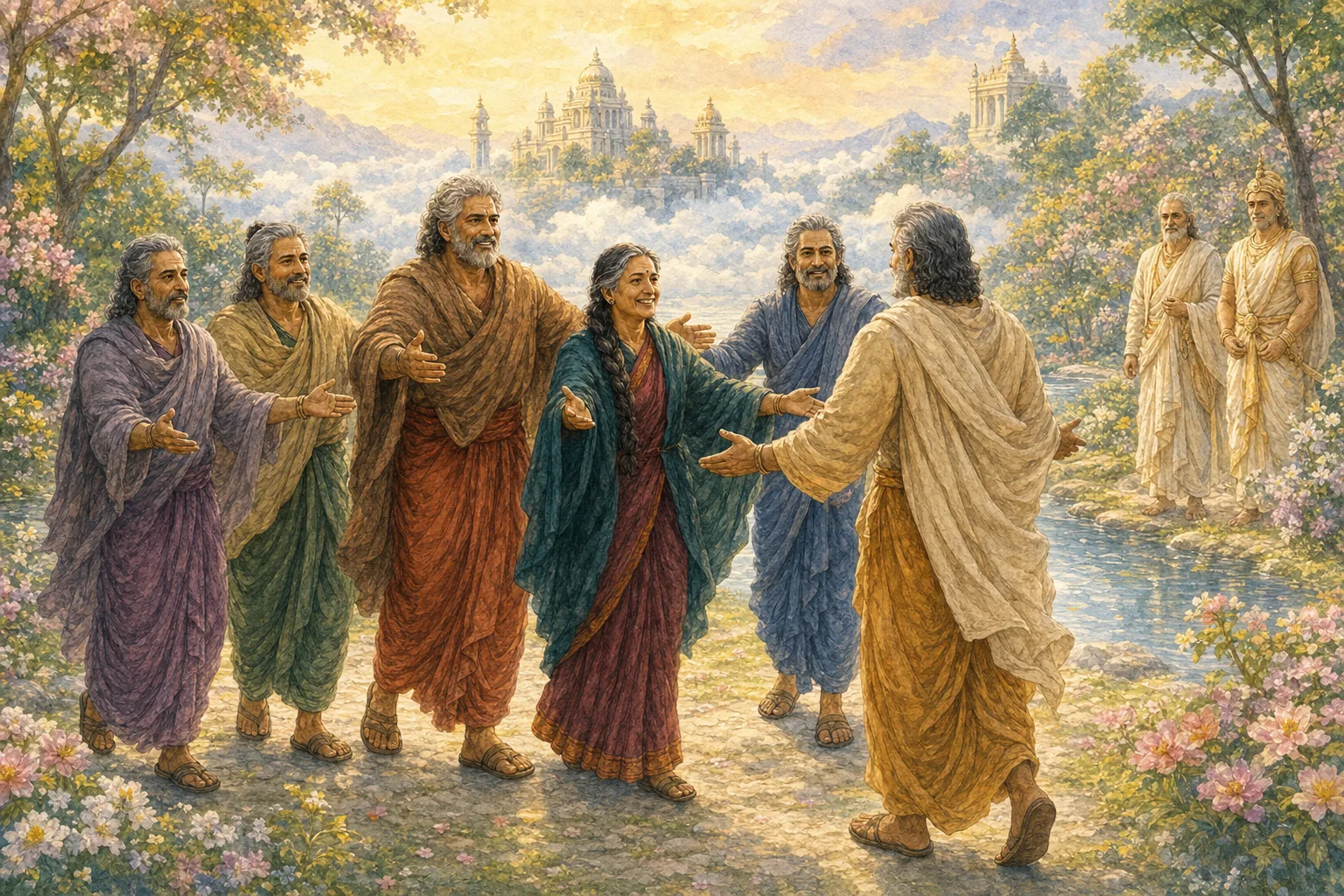
In that peaceful realm, old rivalries no longer mattered. The Pandavas and Draupadi had completed their human journeys, faced their remaining imperfections, and returned to their divine forms.
Mahaprasthana is remembered not only as a journey toward heaven, but as a final lesson in dharma. Yudhishthira reached the end because he would not trade compassion for reward, would not abandon a trusting companion, and would not accept happiness while those he loved seemed to suffer alone.
Moral: True dharma is shown through compassion, loyalty, humility, and refusing to abandon those who trust us.
“True dharma is shown through compassion, loyalty, humility, and refusing to abandon those who trust us.”
New stories in your inbox
One story every week, and a special tale on festivals. Free, always.
Your email goes to our newsletter provider (beehiiv) so we can send you stories. It is not linked to any child's reading on this site. Unsubscribe any time from the email footer.