Dhruva and the Pole Star
Shrimad Bhagavatam
Part 1: No room on the king's lap
King Uttanapada had two queens, Suniti and Suruchi, and two young sons. Suniti's son was Dhruva. Suruchi's son was Uttama.
Dhruva was about seven years old. He loved watching court musicians, asking the palace teachers questions, and running through the garden with Uttama.
One day both boys entered the royal hall. Uttama climbed onto their father's lap. Dhruva hurried forward to join him.
Queen Suruchi stopped Dhruva.
“That place is for my son,” she said. “If you want the highest place, you should have been born to me.”
The king heard, but he did not correct her. Dhruva's excitement turned into shame. He ran to his mother.
Suniti gathered him close.
“What Queen Suruchi said was unkind,” she told him. “Your worth does not depend on pushing Uttama away or winning a place on someone's lap. When people fail to see you clearly, seek the One whose care is not limited by palace favour.”
“Where can I find that One?” Dhruva asked.
“Vishnu is remembered everywhere,” Suniti said, “but sages often go to quiet places to listen with their whole hearts.”
Dhruva decided that he would go to the forest and pray. Suniti did not encourage a child to face danger alone, but his resolve was extraordinary. She arranged for attendants to follow at a safe distance and asked the forest sages to watch over him.
Part 2: Narada changes the question
On the road Dhruva met Sage Narada, carrying his vina.
“The forest is difficult,” Narada said. “Are you running away because you are angry?”
“I want a place no one can take from me,” Dhruva replied.
Narada heard both hurt and pride in the answer.
“A throne can be taken. Praise can change. Even a seat beside a king belongs to a moment,” he said. “If you seek Vishnu only to stand above someone else, the wound will travel with you. Let your prayer ask instead: What kind of person can I become?”
Narada guided Dhruva to a safe grove called Madhuvana beside the Yamuna. He taught him a simple devotional mantra and showed him how to sit, breathe, eat modest nourishing food, and balance prayer with rest.
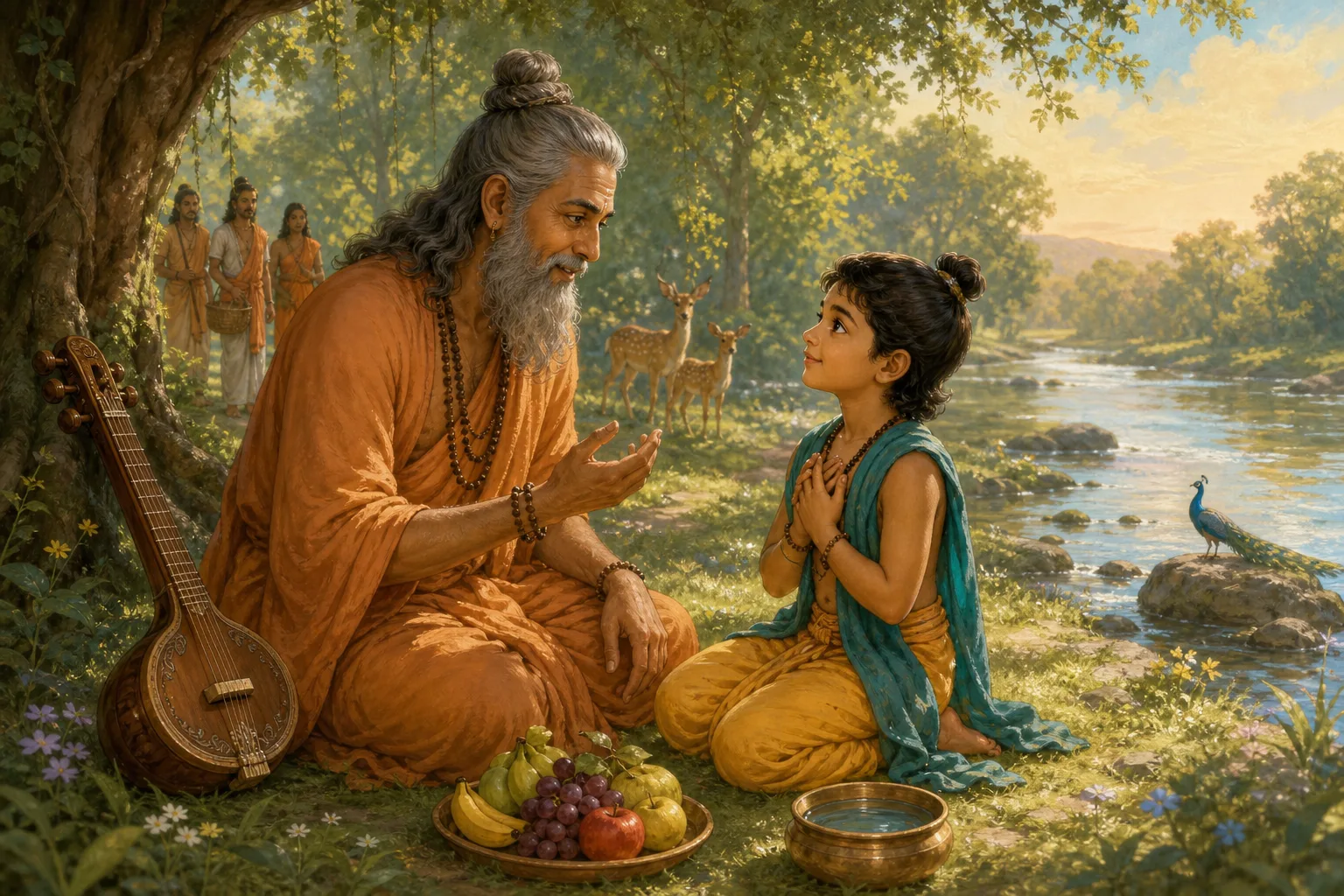
“Devotion is not harming your body,” Narada reminded him. “It is returning your attention, patiently and truthfully, to what matters.”
Dhruva began.
Part 3: The forest listens
At first every sound distracted him. Monkeys rustled leaves. Peacocks called. His feet itched. He remembered Suruchi's words and imagined returning with a crown brighter than Uttama's.
Each time, he returned to the mantra.
Days passed. Dhruva helped carry water at the hermitage, shared fruit with other children, and listened to the river. His prayer slowly changed.
He no longer asked only for a higher place.
He asked for steadiness. He asked that his mother be treated with dignity. He asked to return without hatred toward Uttama, who had not caused the hurt.
The sincerity of his devotion seemed to make the whole grove quiet. Even the wind softened among the leaves.
A brilliant light appeared before him.
Part 4: Vishnu's blessing
Vishnu stood in the grove, serene in yellow and blue, holding the conch, discus, lotus, and mace as symbols of divine order and protection.
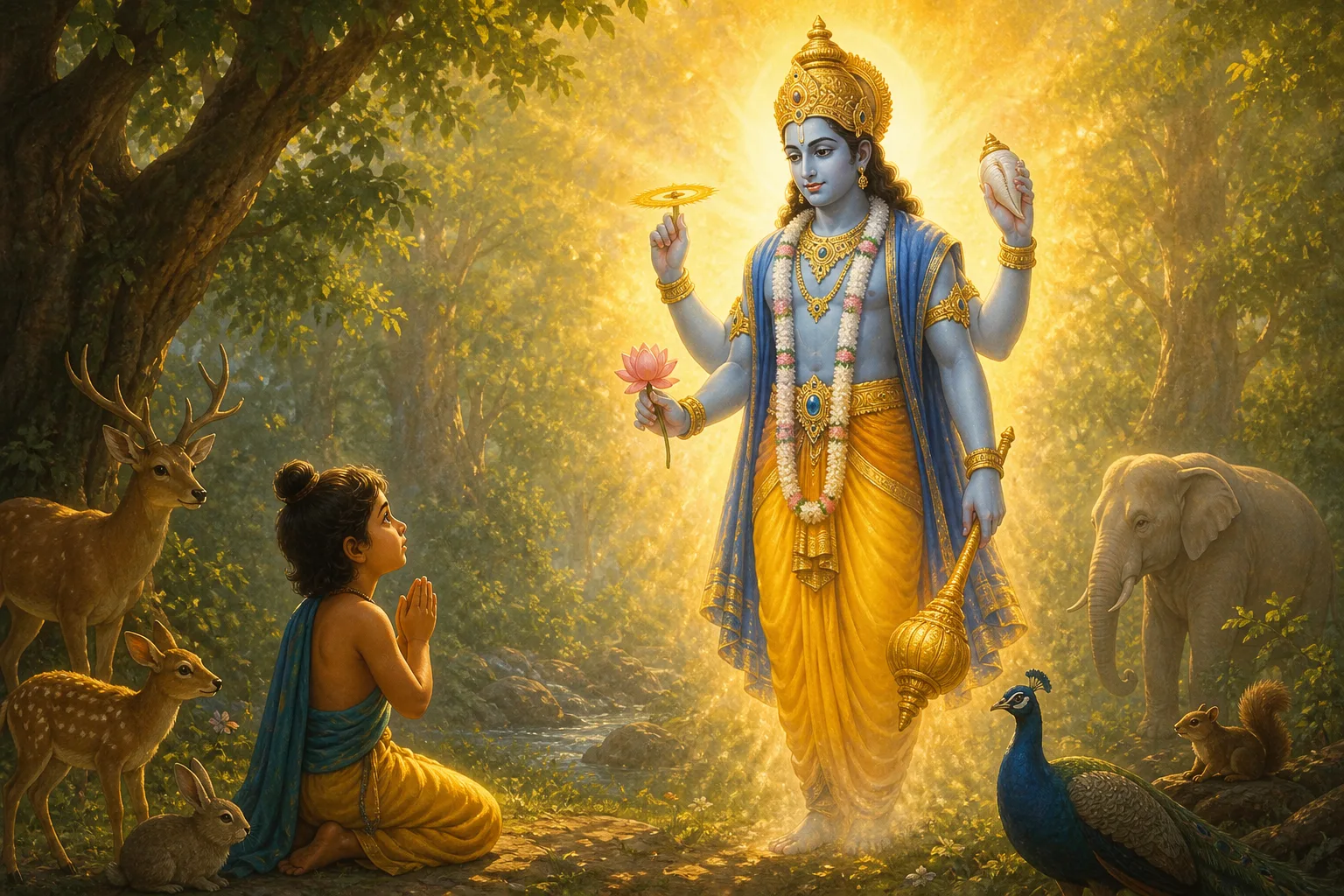
Dhruva opened his eyes. The words he had practised disappeared in wonder.
Vishnu touched the conch gently near the boy's forehead, and Dhruva found his voice.
Instead of demanding victory over Suruchi, he spoke of the peace he had discovered and his wish to serve wisely.
“When I began,” Dhruva admitted, “I wanted a place higher than everyone else's. Now that I see you, that wish feels like searching for a coloured stone after finding a jewel.”
Vishnu smiled.
“Your hurt was real, and you transformed it without passing it to another,” he said. “Return home. In time you will rule, and if you remain steady, your place in the sky will become a guide for travellers. Other stars will appear to turn around it, but its purpose will be direction, not pride.”
Dhruva bowed.
Part 5: Returning without revenge
Back in the palace, King Uttanapada had regretted his silence. He had sent searchers and waited anxiously for news.
When Dhruva returned, the king came down from the throne and embraced him.
“I failed to protect you from an unjust word,” he said. “I am sorry.”
Suniti welcomed her son with tears of relief. Uttama ran to him, and Dhruva hugged his younger brother.
Queen Suruchi stood uncertainly nearby.
Dhruva did not pretend her words had caused no harm.
“What you said made me believe there was room for only one child,” he told her. “I will not accept that belief. But I do not wish to take Uttama's place or drive you away.”
Suruchi saw that the child she had tried to diminish had returned with a strength that did not need to humiliate her. She apologized, and the family began the slower work of changing how they treated one another.
Part 6: A steady king
As Dhruva grew, he studied government, listened to farmers and craftspeople, and learned the difference between firmness and anger. When Uttanapada eventually retired, Dhruva became king.
His life was not free of sorrow. In one later conflict, news of Uttama's death filled him with rage, and Dhruva nearly punished an entire community. Wise elders reminded him of the lesson he had learned as a child: grief does not make collective blame just.
Dhruva stopped, listened, and chose a more measured path.
That moment mattered as much as his forest prayer. Steadiness is not something learned once. It is a direction we choose again whenever anger tries to pull us away.
Dhruva ruled for many years. When the time came to pass responsibility to the next generation, he returned to contemplation with a grateful heart.
Part 7: The northern light
The ancient story says that Dhruva was given a lasting place in the northern sky.
On a clear night, travellers can find the Saptarishi—the seven sages, known in another sky tradition as the stars of the Great Bear—and follow their direction toward the Pole Star. Because the Pole Star appears nearly steady while other stars circle through the night, it has long helped people find north.
Storytellers remember that star as Dhruva.
It is not honoured because it defeated the stars around it. It is honoured because its steadiness helps others find their way.
The boy who once longed for the highest seat discovered something better: a place of purpose, where being firm did not mean being hard and where shining mattered most when the light could guide someone else.
“Lasting confidence grows from purpose and compassion, not from winning another person's place.”
New stories in your inbox
One story every week, and a special tale on festivals. Free, always.
Your email goes to our newsletter provider (beehiiv) so we can send you stories. It is not linked to any child's reading on this site. Unsubscribe any time from the email footer.