Mata Vaishno Devi – The Sacred Journey
Long ago, in the village of Hansali near present-day Katra, lived a kind and humble devotee named Shridhar. He and his wife had no children, and this sorrow often weighed on their hearts. Yet Shridhar never allowed sadness to lessen his faith. Every morning he lit a small lamp, offered flowers, and remembered the Divine Mother with love.
During Navratri, Shridhar decided to hold a kumari pujan, a ceremony honoring young girls as forms of the Goddess. He invited girls from the village, washed their feet respectfully, offered them seats, and served them a simple meal.
Among them sat a radiant girl whom no one recognized. She wore plain red clothes, but her calm eyes seemed to hold the light of the mountains. Shridhar felt deep peace whenever he looked at her.
After the worship, the other girls blessed the household and returned home. The mysterious girl remained.
“Shridhar,” she said gently, “invite everyone from the nearby villages to a bhandara at your home.”
Shridhar looked around his tiny house. He had only a little grain and hardly enough space for one family, let alone several villages.
“Mother,” he said, “how can I feed so many people?”
The girl smiled. “Give the invitation with a sincere heart. Leave the rest to me.”
Trusting her words, Shridhar walked from village to village. He invited farmers, potters, shepherds, elders, and children. People were surprised.
“How will Shridhar feed such a crowd?” they wondered. “His home is so small.”
On his way back, Shridhar met the great yogi Guru Gorakhnath traveling with his disciples. Among them was Bhairavnath, a powerful but proud ascetic. Shridhar bowed and invited them all.
Guru Gorakhnath accepted the invitation. Bhairavnath studied Shridhar closely.
“Let us see,” he said, “what kind of feast a poor man can provide.”
As the day approached, Shridhar grew anxious. Guests had begun arriving, but there were no overflowing storerooms and no large cooking fires. His wife whispered, “We have offered what we possess. Now we must trust the Divine Mother.”
Then the radiant girl returned. She carried a small vessel in her hands.
“Welcome everyone,” she told Shridhar. “No guest will leave hungry.”
Soon Shridhar's little home was filled with villagers, wandering seekers, Guru Gorakhnath, and his disciples. Somehow, everyone found a place to sit. The room seemed to open wider with every arriving guest.
The divine girl moved among them with her small vessel. She served fragrant rice, warm puris, vegetables, sweets, and creamy kheer. No matter how much she served, the vessel never emptied.
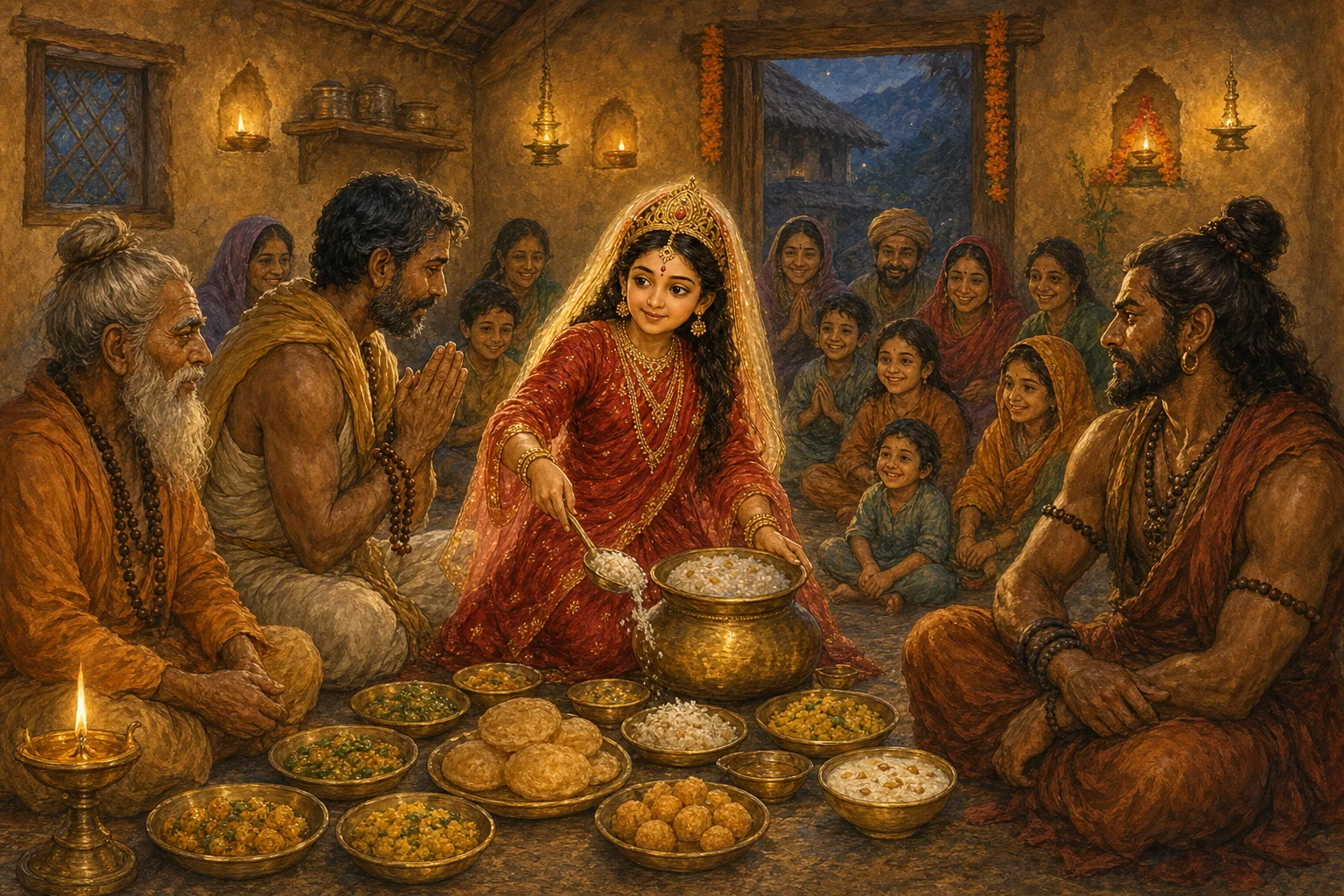
Children laughed with delight. Elders folded their hands in wonder. Shridhar understood that his guest was no ordinary child.
At last the girl came to Bhairavnath.
“What would you like?” she asked.
Bhairavnath refused the pure food before him. He demanded meat and wine instead.
The girl answered calmly, “This is a sacred meal in a Brahmin devotee's home. Only pure vegetarian food is being served. Please accept it with respect.”
But Bhairavnath remained stubborn. He had begun to suspect that the child possessed extraordinary power, and pride made him want to test her. When he reached out to seize her, the girl slipped beyond his grasp.
In an instant she became as light as the wind and moved toward Trikuta mountain.
“She is no ordinary girl!” cried Bhairavnath, racing after her.
The divine girl crossed forests, stony paths, and steep slopes. Bhairavnath followed, determined to discover her secret. Hanuman, the devoted son of the wind, came to protect her on the journey.
After traveling for some time, Hanuman grew thirsty. The girl raised her bow and released an arrow into the mountainside. Clear water sprang from the rock and flowed down the path.
Hanuman drank gratefully. The Mother washed her long hair in the sparkling stream. According to tradition, this sacred water became known as Banganga—the river brought forth by an arrow. Pilgrims still pause there to refresh themselves before continuing their climb.
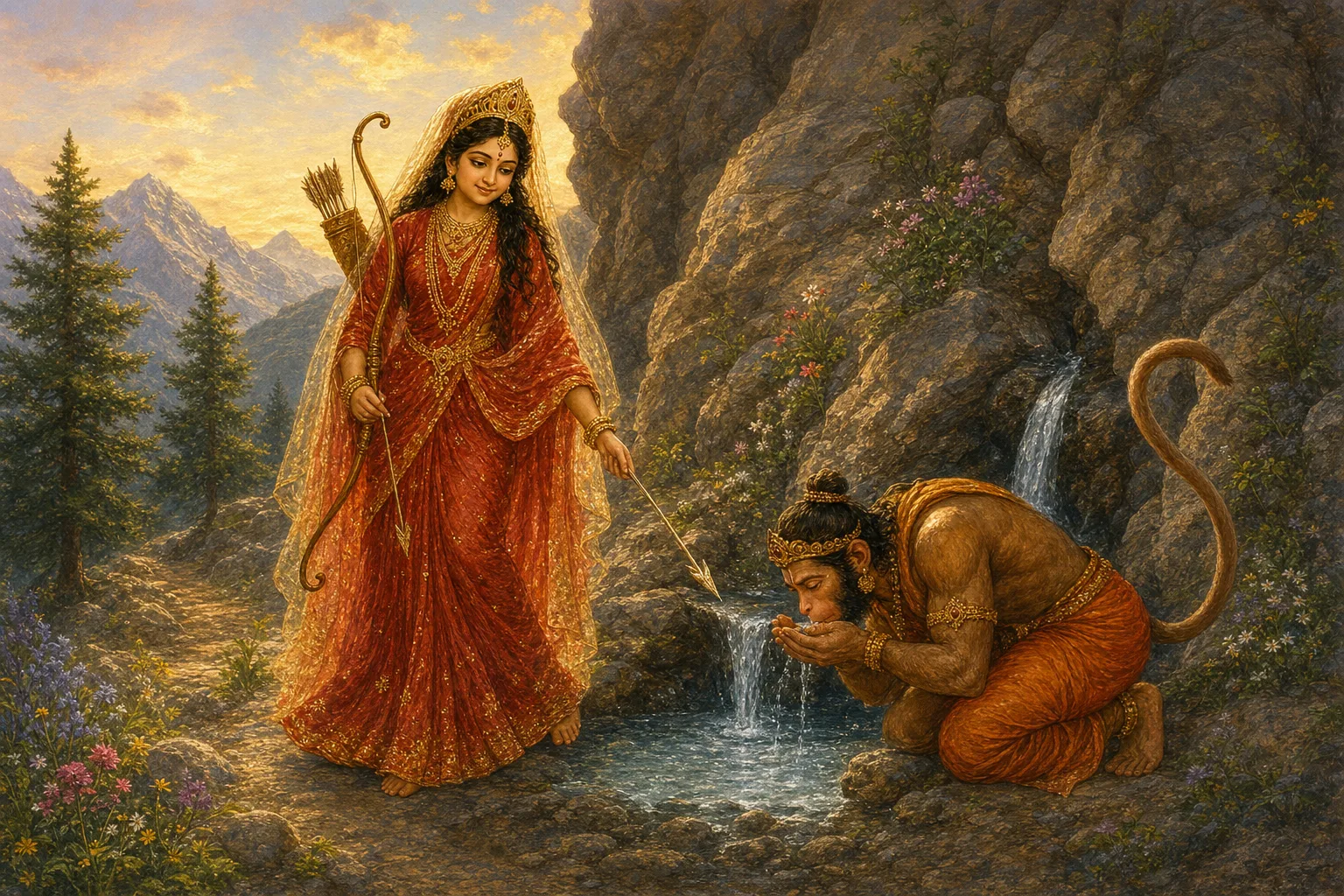
The Mother continued upward. At one place she stopped and looked back to see whether Bhairavnath was still following. That place came to be remembered as Charan Paduka, where devotees honor the sacred footprints of the Mother.
Bhairavnath saw signs of her power everywhere, yet he would not turn back.
Farther up Trikuta mountain, the Mother entered a narrow cave. There she remained in deep meditation for nine months. The cave felt like a peaceful shelter in the heart of the mountain.
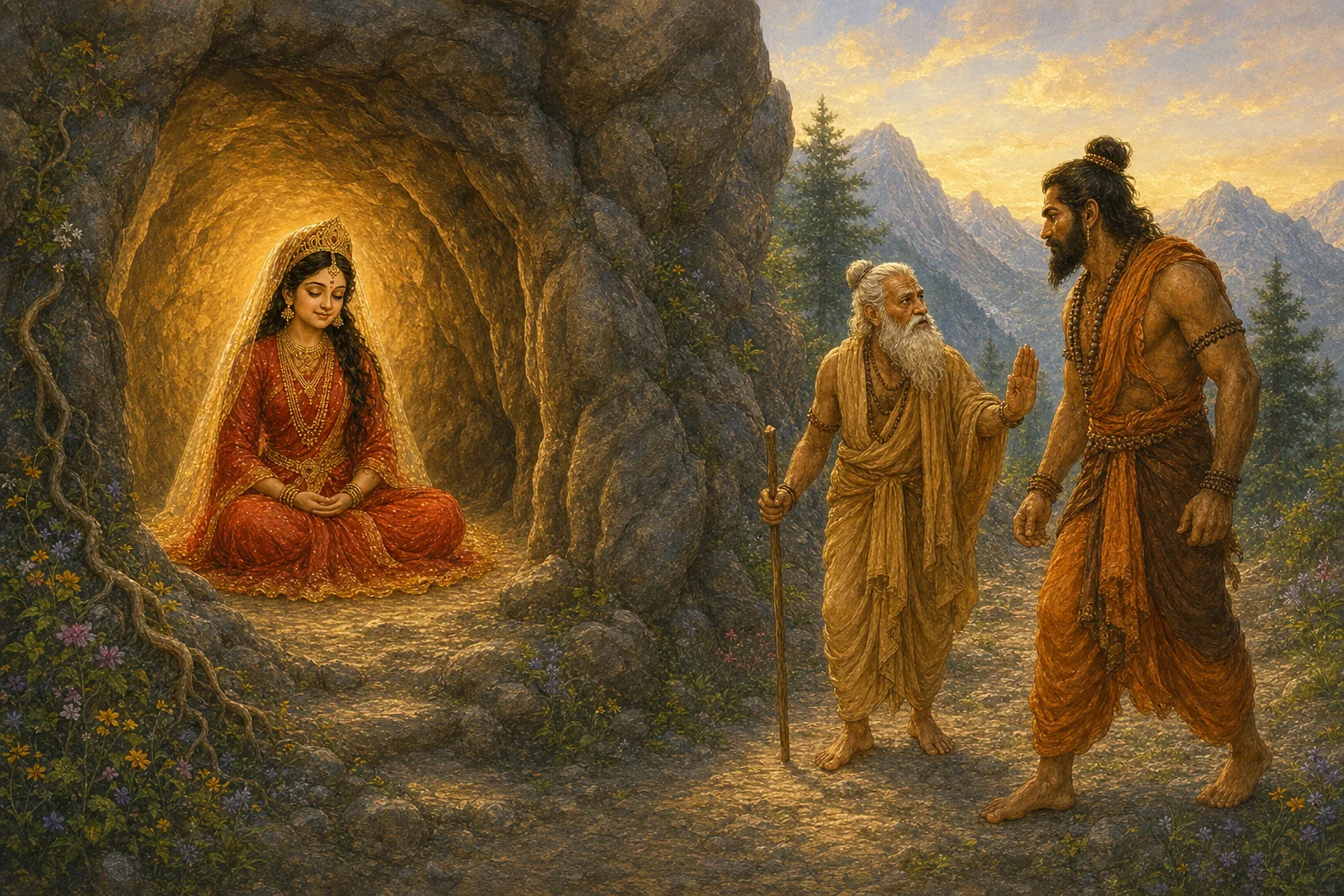
This holy place became known as Ardhkuwari, Adhkuwari, or Garbh Joon. Pilgrims remember it as the cave where the Mother performed her long tapasya.
Bhairavnath searched the mountain until he reached the cave. A wise sadhu stopped him.
“The one you are pursuing is not an ordinary girl,” the sadhu warned. “She is Adishakti Jagadamba, the Divine Mother of the universe. Give up your pride and do not follow her farther.”
But Bhairavnath ignored the warning.
Knowing that the time had come to continue her purpose, the Mother made another opening through the cave and emerged on the other side. She moved toward the place now known as the holy Bhawan.
Outside the cave, the young girl revealed her radiant divine form. The mountain seemed to glow around her.
“Bhairavnath,” she said, “you have been warned. Turn back. Pride and force cannot reveal the truth you seek.”
For a moment he hesitated, but stubbornness overcame wisdom. He continued toward the holy cave.
Hanuman stood guard outside and tried to stop him. A long struggle followed. Bhairavnath would not accept defeat, and even the tireless Hanuman began to grow weary.
Then Mata Vaishnavi appeared in the powerful form of Mahakali. With one final act, she ended Bhairavnath's pursuit. Tradition says that his head fell in Bhairav Valley, higher on Trikuta mountain, where the Bhairavnath temple now stands.
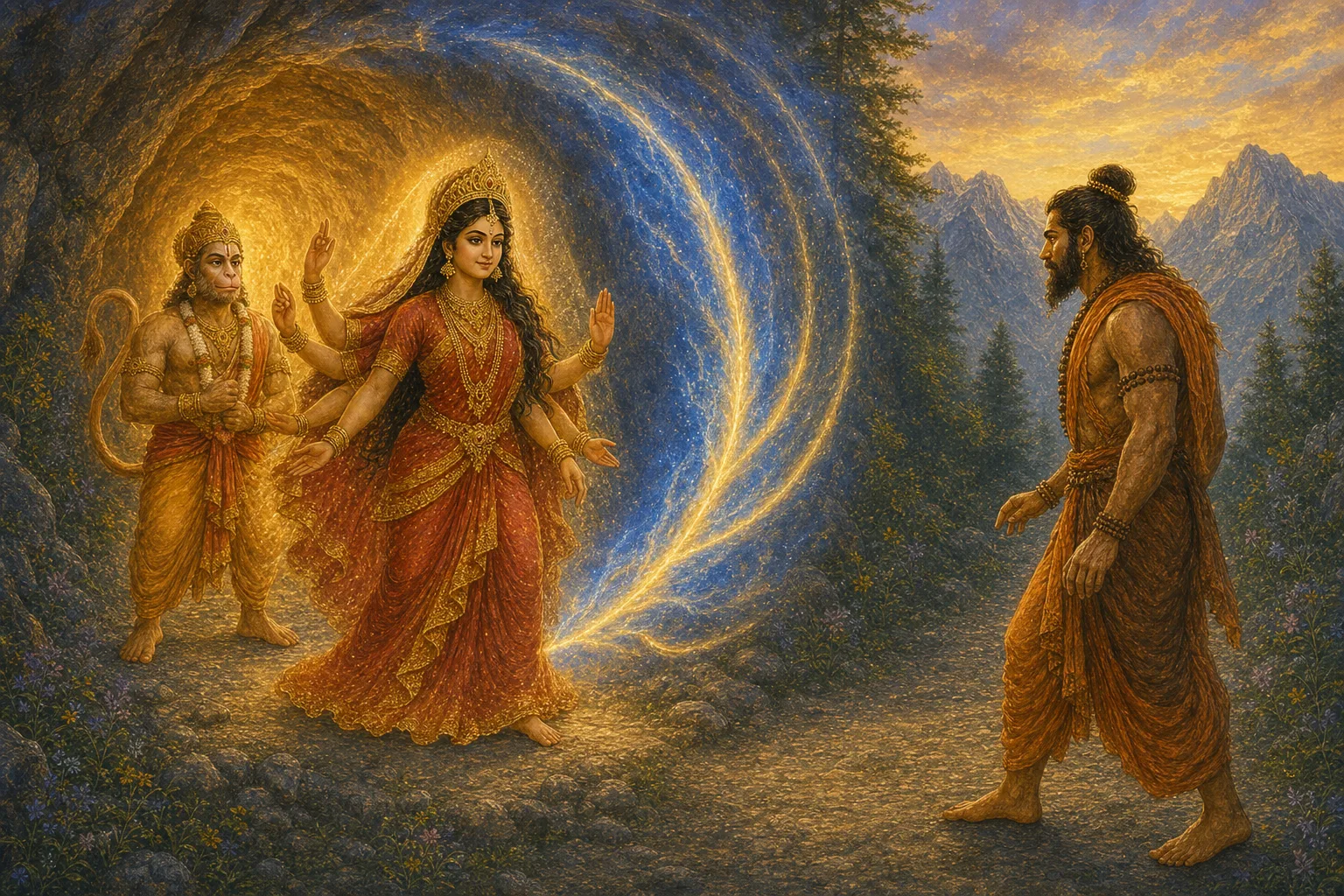
The chase was over. The mountain became still.
Freed from anger and pride, Bhairavnath finally understood whom he had challenged. He bowed before the Mother and begged forgiveness.
“I was blinded by arrogance,” he said. “Please show me mercy.”
The Divine Mother saw his repentance. She also knew that, beneath his misguided actions, he had longed for liberation from the cycle of birth and death.
Mata Vaishno Devi forgave him and granted him moksha. She also gave him a special blessing.
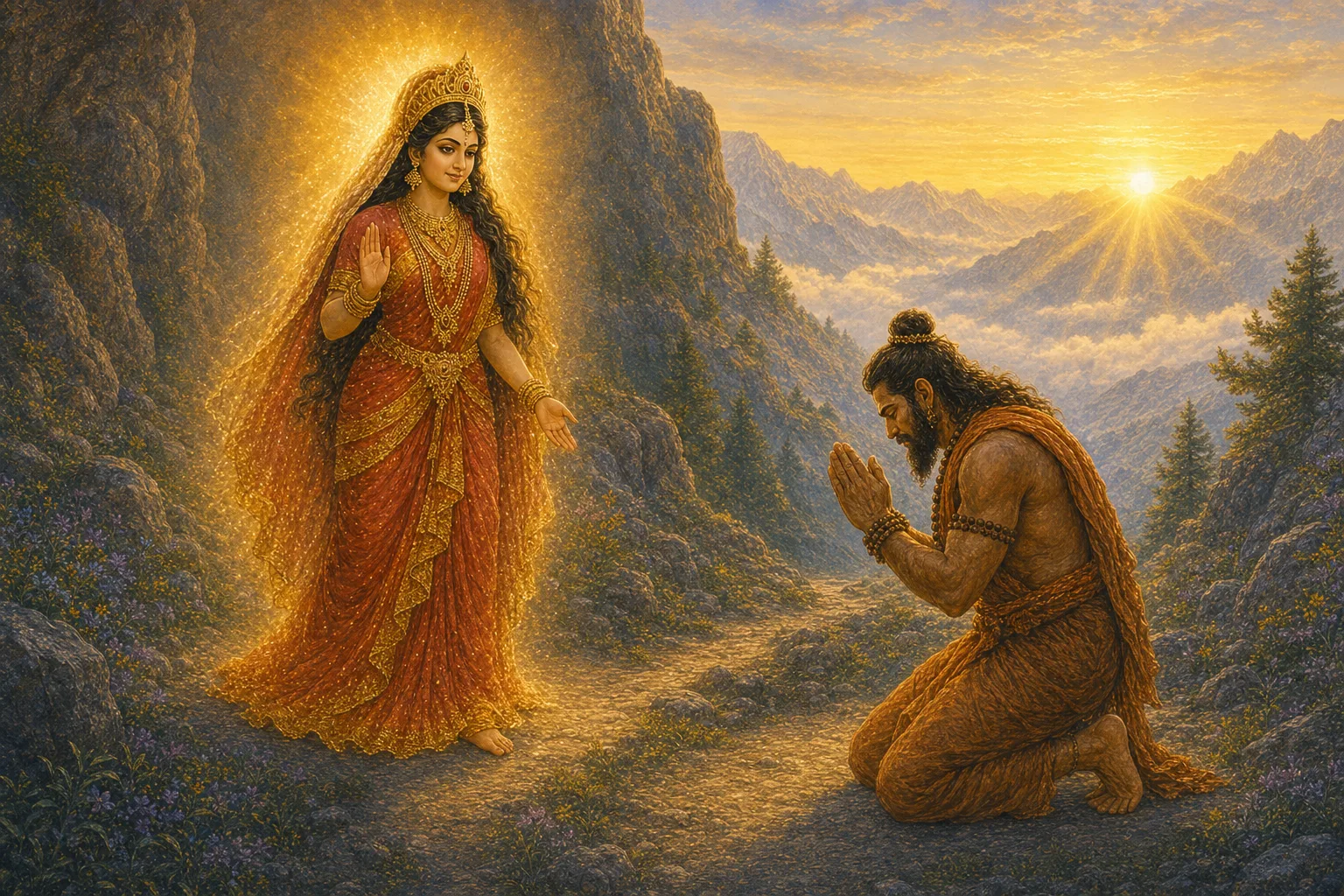
“A pilgrim's journey to my shrine will not be considered complete,” she declared, “until the pilgrim also visits your temple after receiving my darshan.”
For this reason, devotees traditionally continue from the Bhawan to Bhairavnath's temple, climbing the steep mountain path to complete their pilgrimage.
The story teaches that sincere repentance can open the door to forgiveness, but Bhairavnath's long pursuit also remains a warning: spiritual power must never be sought through pride, disrespect, or force.
At the holy cave, Mata Vaishno Devi chose to remain close to her devotees. She took the form of three natural rock pindis.
The three pindis are revered as Mahakali, Mahalakshmi, and Mahasaraswati. Together they represent strength, abundance, wisdom, and the complete form of Mata Vaishno Devi.
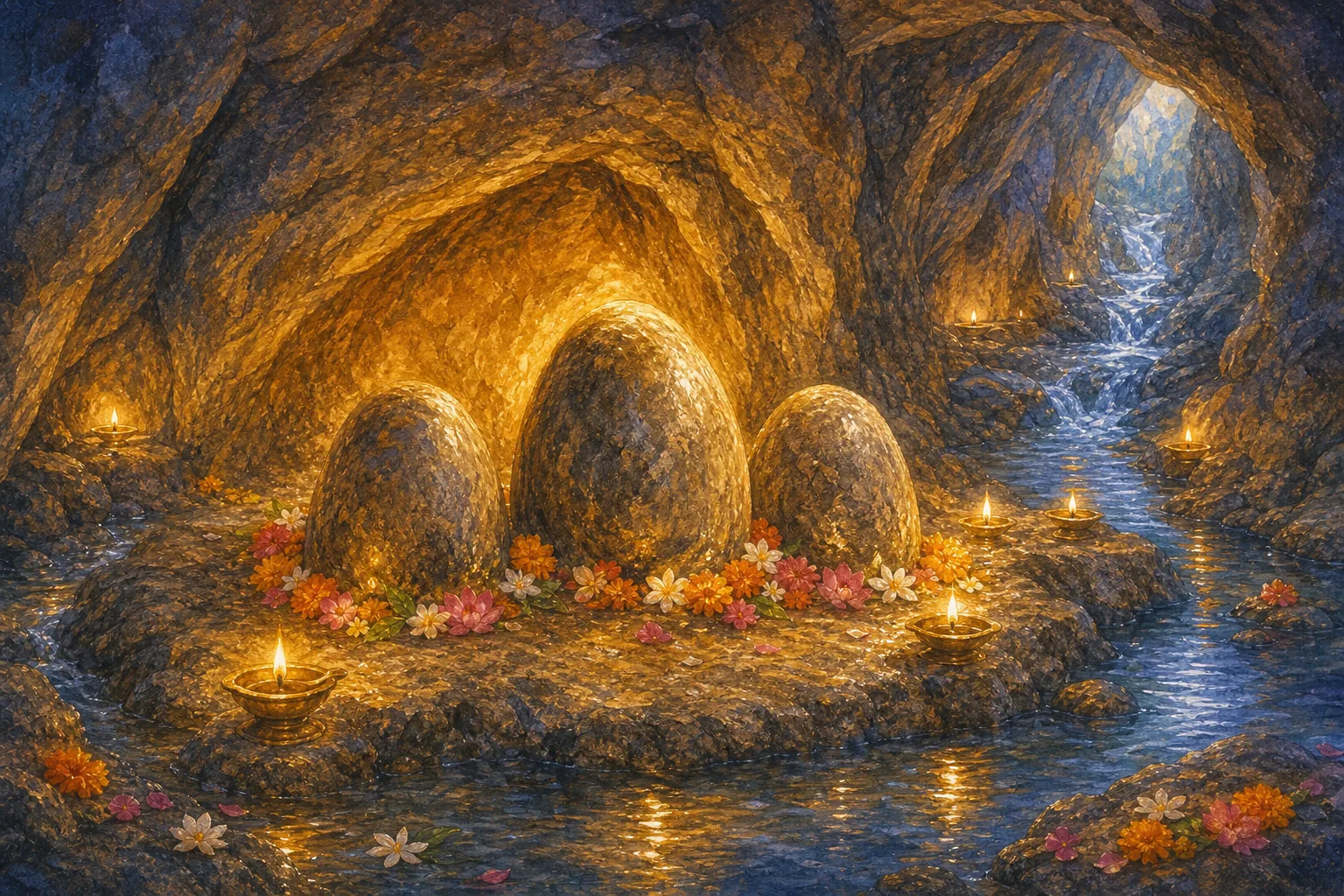
No carved statue was needed. Within the quiet cave, the sacred rock forms and the flowing water became the Mother's eternal presence. Devotees came with prayers, gratitude, and hope. Some asked for courage, some for guidance, and some simply wished to feel close to the Divine Mother.
The Mother listened to every sincere heart.
Back in Hansali, Shridhar waited anxiously after the miraculous bhandara. He searched for the divine girl, but no one could tell him where she had gone.
Then she appeared in his dream. She showed him the mountain path, Banganga, the sacred stops along the climb, and the entrance to the holy cave.
At dawn, Shridhar set out toward Trikuta mountain. He followed the way he had seen in the dream. The journey was difficult, but faith guided each step. At last he found the cave and the three sacred pindis.
Shridhar bowed with tears of joy. He offered water and flowers and began worshipping the Mother with devotion.
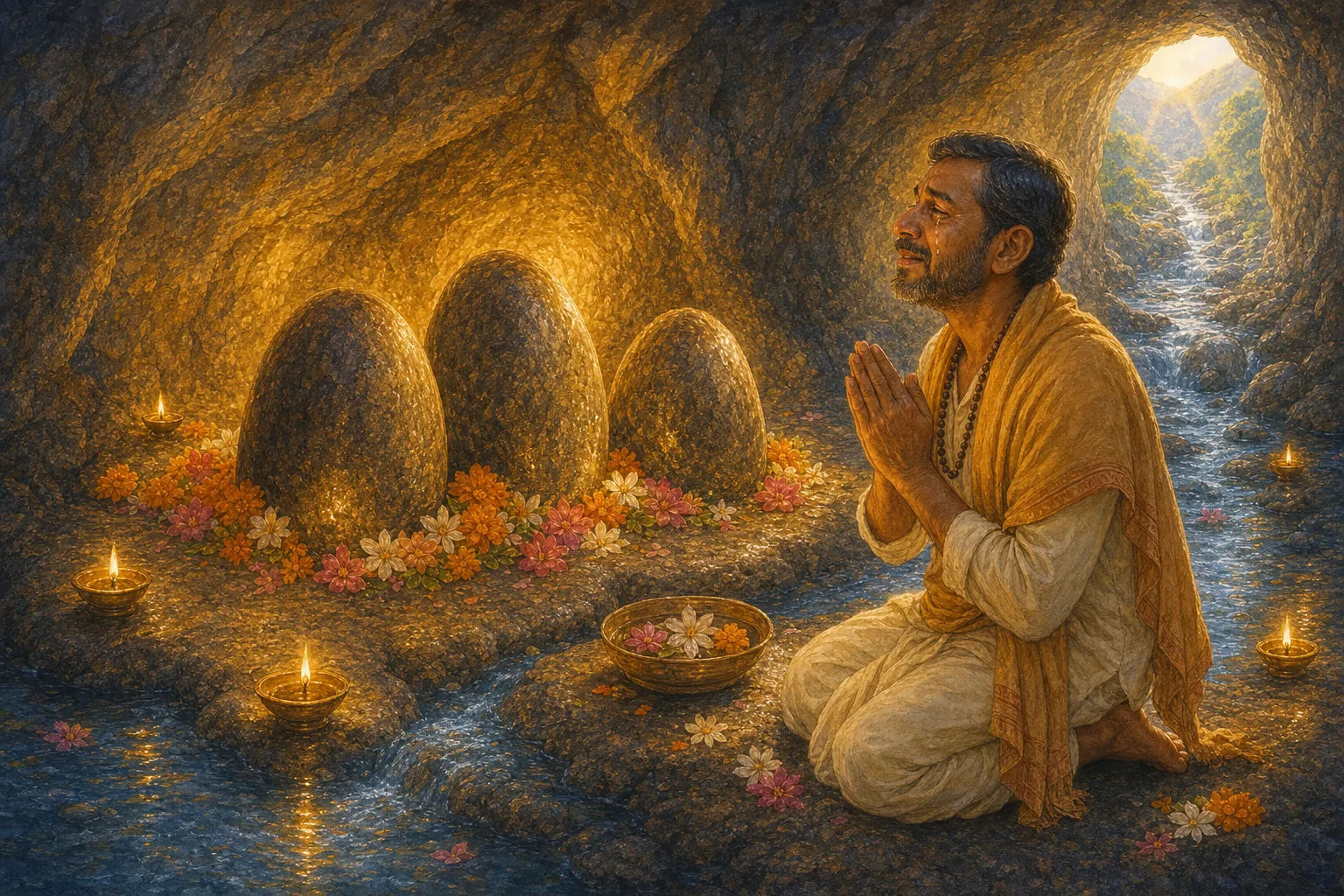
Mata Vaishno Devi appeared before him and blessed him. Tradition says that Shridhar and his descendants continued serving at the holy shrine.
Through the years, more and more devotees learned of the sacred cave. They traveled through Katra and climbed Trikuta mountain, remembering Shridhar's faith and the Mother's compassion.
They paused at Banganga, remembered her footprints at Charan Paduka, passed the cave of Ardhkuwari, received darshan of the three sacred pindis at the Bhawan, and continued to Bhairavnath's temple to complete the pilgrimage.
Some journeys began with a prayer. Others began with gratitude. Every pilgrim carried a different hope, but the mountain path reminded them of the same lesson: faith grows through humility, courage, service, and perseverance.
Shridhar had worried that his little home could never hold a great bhandara. Yet when he acted with trust and generosity, the Divine Mother made room for everyone.
And so devotees still call with love, “Jai Mata Di!”—a joyful remembrance of Mata Vaishno Devi, who guides sincere hearts along the sacred path.
Moral: Faith becomes powerful when it is joined with humility, courage, generosity, and sincere repentance.
“Faith becomes powerful when it is joined with humility, courage, generosity, and sincere repentance.”
New stories in your inbox
One story every week, and a special tale on festivals. Free, always.
Your email goes to our newsletter provider (beehiiv) so we can send you stories. It is not linked to any child's reading on this site. Unsubscribe any time from the email footer.